Contents 6 sections
What is your main goal?
How do you digest dairy?
What matters most to you?
Summarise this article with:
💡 The essentials
In bodybuilding, whey is the last piece of the puzzle, not the first. In order: progressive training, enough protein across the day (around 1.6 g per kg), the right calories, enough sleep. Whey then serves to plug the gap between your meals and your protein target.
- Useful dose: 20 to 40 g of protein per serving.
- Timing: before or after your session, whichever you prefer.
- Essential? No, not if your meals already do the job.
Whey and bodybuilding go together in the popular imagination, to the point where people often buy the tub before they have a training programme. This article puts whey back in its proper place in a lifting routine: what matters before it, where to fit it into your week, and when it does nothing for you at all. If the product is new to you, start with our definition of whey protein; for its uses outside the gym, see what whey protein does.
🏋️ The pyramid of priorities in bodybuilding
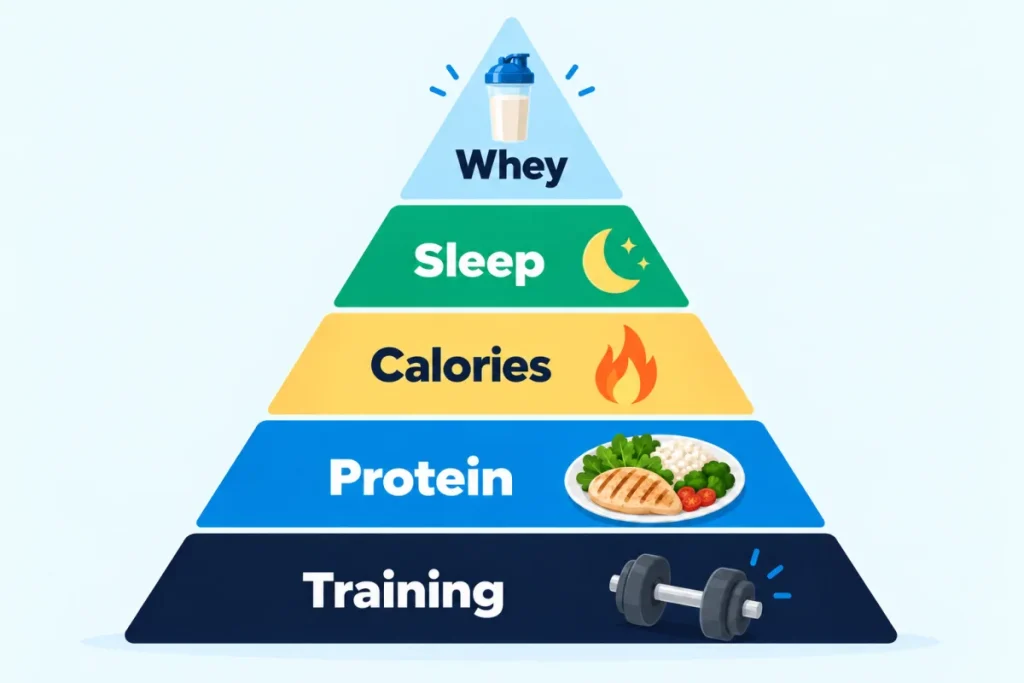
1. Progressive training
It is the session that tells the muscle to grow, not the shaker. A dose-response meta-analysis (Schoenfeld et al., 2017) shows that the more sets you do per muscle per week, the bigger the gain in size. Without a load that keeps going up and enough volume, whey has nothing to build with.
2. The protein in your day, not the protein in your shaker
The best-supported benchmark: around 1.6 g of protein per kg of body weight per day, in total. Beyond that, the meta-analysis of 49 trials by Morton et al. finds no further gain in lean mass. The ISSN puts most lifters’ requirements between 1.4 and 2.0 g per kg, and ANSES between 1.3 and 1.5 g for experienced strength athletes.
ANSES recommends that two thirds of that protein comes from food, with the final third allowed to come from good-quality supplements. In practice, whey tops up your meals; it does not replace them. The sums for your own weight and goal are in how much whey protein per day.
3. Calories, depending on whether you are bulking or cutting
Bulking calls for a slight calorie surplus; a cutting phase calls for a deficit, and protein becomes even more important. The ISSN states that 2.3 to 3.1 g per kg can help trained lifters hold on to their lean mass during a hypocaloric period. So whey’s role changes with the phase: see whey protein for mass gain, whey protein and weight loss, and if you are torn between whey and a gainer, whey or mass gainer.
4. Sleep
Sleeping badly puts a direct brake on muscle building. In a randomised study, a single night without sleep cut muscle protein synthesis by 18% the following day, with more cortisol and less testosterone (Lamon et al., 2021). No shake makes up for nights that are too short.
🥤 Where to fit whey protein into your training week
Aim for 20 to 40 g of protein per serving (or around 0.25 g per kg), spreading your intake out every 3 to 4 hours: that is the ISSN’s recommendation. After a session that works the whole body, 40 g of whey stimulated protein synthesis more than 20 g did in trained men (Macnaughton et al., 2016).
The exact timing matters far less than the total amount. A meta-analysis on timing finds no effect from when you take it around your session once total protein is accounted for. Before, after, in the morning or as a snack: pick whatever is practical for you. For the details, see when to take whey protein, whey protein before a workout, whey protein on rest days and whey protein before bed.
| Example: a 75 kg lifter | Protein |
|---|---|
| Daily target (1.6 g per kg) | 120 g |
| Provided by meals and snacks | 95 g |
| Gap to fill | 25 g, or roughly one serving of whey |
If your meals already cover the 120 g, whey will give you nothing beyond convenience. For day-to-day preparation (water or milk, shaker, recipes), follow our guide to taking your whey properly.
🧪 Which type of whey protein for bodybuilding?
For most lifters, a whey concentrate is enough; a whey isolate makes sense if lactose bothers you or if you are in a cutting phase. Concentrate holds a little more lactose and fat for a better price (figures in our guide to the composition of whey protein), isolate holds very little, and hydrolysed whey costs more for a benefit limited to specific cases. The full comparison is in which whey protein to choose, along with our picks of the best whey isolates and of hydrolysed whey.
❓ Is whey protein essential for bodybuilding?
No. Its own effect is real but modest: on average an extra 0.30 kg of lean mass and 2.49 kg of strength across programmes of at least six weeks, according to Morton et al. The effect is more marked in trained lifters and weaker with age. If you hit your protein target with your meals without tying yourself in knots, you can do without it.
It becomes genuinely handy when your needs are high and your time is short: a big frame, a cutting phase, a vegetarian who eats dairy, a packed schedule. If you are looking for a second supplement that is useful for lifting, think of creatine, which the ISSN judges effective for intense efforts and safe in healthy people; see whey protein and creatine. And to set your expectations on timescales, read how long whey protein takes to work.
⚠️ Watch out
More protein does not mean more muscle. If you push your intake up in order to build muscle mass, ANSES recommends not going beyond 2.5 g per kg per day, and for no more than six months. If you have kidney disease, an allergy to milk proteins, or you are pregnant, or for a teenager taking up resistance training, ask a doctor’s advice before any supplementation.
🏆 Our verdict on whey protein for bodybuilding
🔬 Our method
We ranked the levers of muscle gain using the meta-analyses on protein supplementation (Morton 2018), on timing (Schoenfeld 2013) and on training volume (Schoenfeld 2017), the ISSN position stands, the ANSES recommendations, and studies on whey dosage (Macnaughton 2016) and sleep (Lamon 2021). The worked example is an illustrative calculation.
Our verdict: whey is an excellent support tool in bodybuilding, as long as it comes last. It is worth buying if you have a programme that progresses, you sleep properly and you are regularly 20 to 40 g of protein short each day. It is not for you if you are starting out with no programme, if your meals already cover your needs, or if you are hoping it will make up for patchy sessions.
To choose your product, our ranking of the best whey proteins compares the big names on the market, and if you are just starting out, the selection of whey protein for beginners sticks to the essentials.
❓ Frequently asked questions
Does whey protein help you gain mass?
Not on its own: it is the training and the calorie surplus that build mass. Whey helps you hit your protein target, with an average effect of around an extra 0.30 kg of lean mass over six weeks or more of resistance training, according to the meta-analysis by Morton et al.
How much whey protein should you take per day for bodybuilding?
The amount your meals are short of in order to reach around 1.6 g of protein per kg, which is often one to two servings of 20 to 40 g. ANSES advises that two thirds of your protein should come from food.
Should you take whey protein before or after your session?
Both work. The ISSN considers it a matter of personal tolerance, and the meta-analysis by Schoenfeld et al. shows no advantage from timing once your total protein is reached.
Is it good to drink whey protein every day, even without a session?
Yes, if it helps you reach your protein target: muscle also rebuilds on rest days. The anabolic effect of a session lasts at least 24 hours. A healthy adult can take it daily as long as the total stays sensible.
What are the 3 types of whey protein?
Concentrate, isolate and hydrolysate, to which native whey is often added as a fourth. Concentrate is the most economical, isolate the lowest in lactose, hydrolysate the most expensive. The detail is in our guide to choosing your whey.
📚 Sources
- Morton et al., meta-analysis of protein supplementation and resistance training, Br J Sports Med, 2018
- ISSN, official position stand: protein and exercise (Jäger et al., 2017)
- ANSES, protein intake: requirements and recommendations (2007) (in French)
- Schoenfeld et al., training volume and hypertrophy, J Sports Sci, 2017
- Lamon et al., sleep deprivation and protein synthesis, Physiol Rep, 2021