Contents 9 sections
- Whey and mass gainer: what are we talking about
- The real difference: the labels side by side
- Cost per gram of protein: whey wins
- The test: whey or mass gainer in 2 questions
- Whey vs mass gainer: the star comparison
- Our verdict: whey by default, a mass gainer as a stopgap
- The mass gainers whose labels we checked
- The whey proteins whose labels we checked
- Frequently asked questions
What is your main goal?
How do you digest dairy?
What matters most to you?
Summarise this article with:
💡 The essentials
What you are mainly short of is protein: take a whey. What you are mainly short of is calories and you cannot manage to eat more: take a mass gainer.
- Whey: 76 to 90 g of protein per 100 g, around 115 kcal per 30 g shaker.
- Mass gainer: 15 to 21 g of protein per 100 g, up to 1,260 kcal per serving (Serious Mass).
- A gram of protein costs less in whey: around €9 per 100 g against €13 in the gainer we compared.
When you want to put on muscle, it is easy to get stuck between whey and a mass gainer, two powders that look alike in the shaker but solve completely different problems. This article gives you the difference in figures, labels in hand, then a two question test to settle it.
If your question is specifically about a weight gain phase (calorie surplus, body type, homemade gainer), we cover that in detail in our guide to whey or a mass gainer for bulking. Here, we are comparing the two products to work out which one to buy.
🥛 Whey and mass gainer: what are we talking about?
Whey is milk serum protein, the liquid part of milk that separates from the curd during cheesemaking, filtered and then dried into a powder. Milk contains two families of protein: casein and whey. For the detail of how it is made, see what whey protein is.
A mass gainer is a carbohydrate-rich blend with protein added, often whey, sometimes casein, along with vitamins and creatine. Optimum Nutrition’s Serious Mass, for instance, contains 75 g of carbohydrate to 15 g of protein per 100 g according to the brand’s own label.
📊 The real difference: the labels side by side
Here is the surprise when you read the product sheets: per 100 g, a whey and a mass gainer deliver roughly the same calories (around 370 to 380 kcal). What changes is the split between macronutrients and, above all, the size of the recommended serving.
| Product (per 100 g) | Type | Kcal | Protein | Carbs | Recommended serving |
|---|---|---|---|---|---|
| Serious Mass (Optimum Nutrition) | Mass gainer | 376 | 15 g | 75 g | 335 g = 1,260 kcal, 50 g of protein |
| Mega Mass 4000 (Weider) | Mass gainer | 368 | 21 g | 69 g | as per label |
| Gold Standard 100% Whey (Optimum Nutrition) | Whey (isolate, concentrate and hydrolysate blend) | 374 | 76 g | 5.3 g | 31 g = 116 kcal, 24 g of protein |
| Pure Whey 100% Isolate chocolate (Decathlon) | Whey isolate | 379 | 82 g | 7.8 g | 30 g = 115 kcal, 25 g of protein |
| Whey Native Isolate unflavoured (Nutrimuscle) | Native whey isolate | 375 | 90 g | 3 g | 30 g |
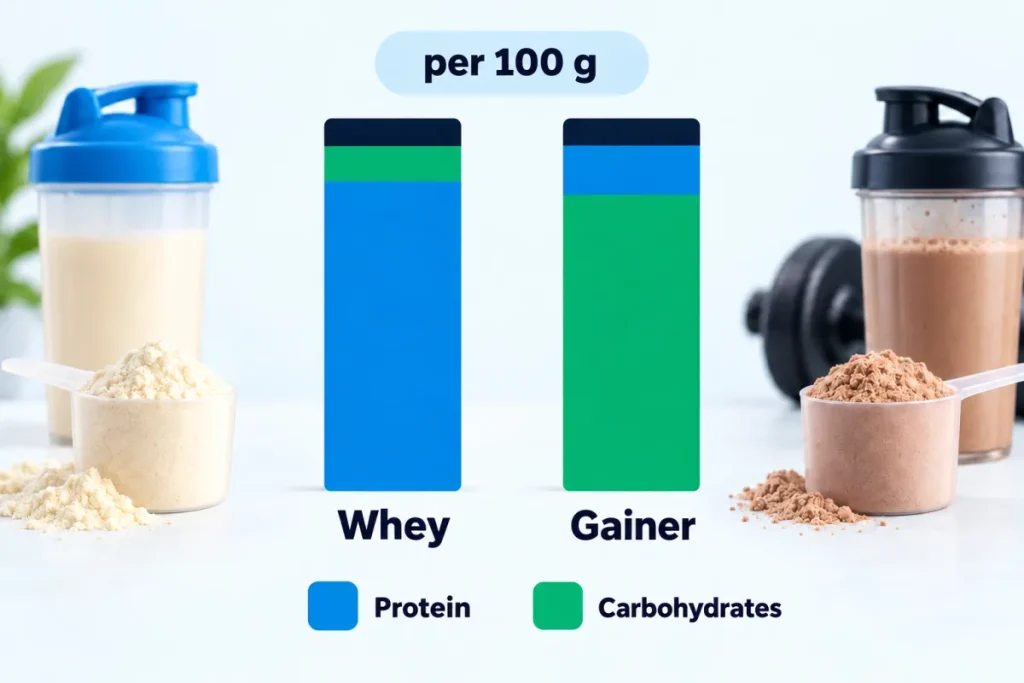
A serving of mass gainer is a full meal; a serving of whey is a protein yoghurt. The 1,260 kcal in one dose of Serious Mass is more than ten whey shakers’ worth of energy, while whey gives you half the protein for ten times fewer calories. Nothing forces you to take the full gainer dose either: half a serving already brings 630 kcal.
💶 Cost per gram of protein: whey wins
A mass gainer looks cheaper per kilo, but measured per gram of protein, whey remains the better value. Serious Mass sells for around €52 for 2.73 kg on the brand’s own site (checked in October 2026), which works out at roughly €13 per 100 g of protein. Nutrimuscle’s Whey Native Isolate, a premium whey at that, sits at around €117 for 1.5 kg, or roughly €9 per 100 g of protein.
Looked at the other way round, if what you are buying is calories, a mass gainer is a convenient way to drink them. But porridge oats, milk and a banana do the same job for less: that is the whole point of a homemade mass gainer shake.
🎯 The test: whey or mass gainer in 2 questions
Before you buy anything at all, write down what you eat for three or four days and compare it with your goal. Two numbers are enough: your protein and your calories.
Question 1: are you hitting your protein target?
To build or keep muscle, the ISSN position stand on protein (2017) settles on 1.4 to 2.0 g of protein per kg of body weight per day for most athletes. At 70 kg, that comes to roughly 100 to 140 g. If your diet does not get there, one or two whey shakers close the gap without blowing up your calories. For the exact sum, see how much whey protein per day.
Question 2: are you gaining weight?
If the scales are not moving when you want to gain, you are short of calories, not protein. If you cannot manage to add a meal or a solid snack (small appetite, busy schedule), a mass gainer becomes useful. If you already put on weight easily, it works against you: you will mostly store fat.
| Your situation | Our choice |
|---|---|
| Not enough protein, weight stable or rising | Whey |
| Protein fine, weight not going up, small appetite | Mass gainer (or a homemade shake) |
| Both are short | Mass gainer, or whey plus carbs in the same shaker |
| Cutting or losing weight | Whey, never a mass gainer |
| Everything is covered by your plate | Neither |
⚖️ Whey vs mass gainer: the star comparison
| Criterion | Whey | Mass gainer |
|---|---|---|
| Protein per calorie | ★★★★★ | ★★☆☆☆ |
| Calories per serving | ★☆☆☆☆ | ★★★★★ |
| Price per gram of protein | ★★★★☆ | ★★☆☆☆ |
| Versatility (cutting, maintenance, bulking) | ★★★★★ | ★★☆☆☆ |
| Help when your appetite is small | ★★☆☆☆ | ★★★★★ |
| Added sugars and fat gain risk | ★★★★★ | ★★☆☆☆ |
🔬 Our method
We compared the labels and official product sheets of two mass gainers and three whey proteins sold in France (calories, protein, carbohydrate, recommended serving, price listed in October 2026), then set protein needs against the ISSN position stand. We do not run laboratory tests or tastings: the star scores follow from those figures alone.
🏆 Our verdict: whey by default, a mass gainer as a stopgap
For the vast majority of lifters, we recommend whey: it works for bulking and for cutting, it costs less per gram of protein and it lets your plate handle the calories. A mass gainer does have a genuine use, but a narrow one: the slim person who really cannot manage to eat more. To pick the type of whey and the dose during a weight gain phase, see our guide to whey protein for mass gain.
A mass gainer is not for you if you put on weight easily, if you are cutting, if you are watching your blood sugar or if you can simply add a solid snack. And whey is no use either if your diet already covers your protein: it is a supplement, not an obligation.
🛒 The mass gainers whose labels we checked
- Serious Mass, by Optimum Nutrition: the most calorific, 1,260 kcal and 50 g of protein per 335 g serving, with 3 g of creatine.
- Mega Mass 4000, by Weider: slightly higher in protein (21 g per 100 g), but 13 g of sugars per 100 g.
If you are watching the pennies, a homemade gainer often works out cheaper and lets you choose your own carbs: read our pros and cons of a homemade gainer (in French). For a full ranking aimed at weight gain, see our comparison of the best whey protein for bulking.
🛒 The whey proteins whose labels we checked
- Pure Whey Protéine 100% Isolate, by Decathlon: 25 g of protein per shaker and under 0.5 g of sugar, an isolate you can pick up in store.
- Gold Standard 100% Whey, by Optimum Nutrition: 24 g of protein for 116 kcal, a blend of isolate, concentrate and hydrolysate.
- Whey Native Isolate, by Nutrimuscle: the highest in protein in our selection (84 to 90 g per 100 g depending on the flavour), low in lactose, but the most expensive to buy.
Two of these whey proteins are isolates: an isolate contains more protein and less lactose than a whey concentrate, at a higher price. To choose between the two, read whey isolate or standard whey protein and our guide on how to choose your whey protein.
⚠️ Watch out
Both whey and mass gainers contain milk: avoid them if you are allergic to milk protein. If you have kidney disease or diabetes, are pregnant or are on any treatment, ask your doctor before adding a protein supplement or a very sugary mass gainer.
❓ Frequently asked questions
What is the difference between whey and a mass gainer?
Whey is almost entirely protein, a mass gainer is mostly carbohydrate. Per 100 g, a whey gives you 76 to 90 g of protein, a mass gainer 15 to 21 g. A gainer is also taken in far bigger servings, so it delivers many more calories per shaker.
Does a mass gainer make you put on weight?
Yes, that is the point of it: it exists to create a calorie surplus. That weight will be mostly muscle if you train and keep the surplus moderate, and mostly fat if you do not. Whey, on the other hand, does not make you gain weight in itself: see does whey protein make you fat.
Can you take whey and a mass gainer at the same time?
Yes, but it is rarely necessary. A mass gainer already brings protein; adding whey only makes sense if, gainer included, you are still under your protein target. The simplest approach is usually whey day to day and calories from your plate.
Whey or a mass gainer for a beginner?
A beginner often needs neither at the start: the priority is training and regular meals. If one supplement is missing, it is usually whey, which is more versatile. Our pick of the best whey protein for beginners will help you get going.
📚 Sources
- Jäger et al., ISSN position stand on protein and exercise (2017)
- Official Serious Mass product page, Optimum Nutrition (in French)
- Official Gold Standard 100% Whey product page, Optimum Nutrition
- Nutritional values of the Mega Mass 4000, Open Food Facts (in French)
- Protein guidance from ANSES, the French food safety agency (in French)