Contents 10 sections
- Whey, a complete milk protein
- What whey really brings to a bulk
- Lean bulking: myth or reality
- Which whey should you choose for a bulk
- Types of whey on a bulk: the star comparison
- How much whey should you take on a bulk
- When should you take your whey on a bulk
- And what about a mass gainer, better than whey for bulking
- Our verdict
- Frequently asked questions
What is your main goal?
How do you digest dairy?
What matters most to you?
Summarise this article with:
💡 The essentials
For a bulk, a plain whey concentrate is all you need: isolate costs more for very little benefit when what you are chasing is calories.
- Protein target: around 1.6 g per kg of bodyweight per day, beyond which muscle gain plateaus.
- Dose: 20 to 40 g of protein per serving, just enough to top up what is on your plate.
- No calorie surplus, no mass gain, whey or no whey.
Starting a bulk and want whey to help you along? This article answers two questions: which whey to choose, and how much of it to take. Types of whey, dosing, timing: everything you need for a clean muscle gain, with the numbers to back it up.
Still torn between whey and a mass gainer for putting on size? Read whey or mass gainer for bulking first. Here we take it as given that whey is your supplement of choice and help you use it properly.
🥛 Whey, a complete milk protein
Whey protein is the liquid part of milk that separates from the curd during cheesemaking. Filtered and then dried, it yields a protein-rich powder made up mainly of beta-lactoglobulin and alpha-lactalbumin.
It is a complete protein: it contains every essential amino acid, the ones your body cannot make for itself. According to the ISSN, quickly digested proteins that are rich in essential amino acids and in leucine are the most effective at stimulating muscle protein synthesis, and that is exactly whey’s profile.
📈 What whey really brings to a bulk
The meta-analysis by Morton et al. (49 studies, 1,863 participants) shows that protein supplementation slightly increases the lean mass gains you get from lifting, by around 0.3 kg on average, and that the effect is clearer in people who already train. It is a nudge, not a transformation.
More to the point, past roughly 1.6 g of protein per kg of bodyweight per day, lean mass gains stop climbing in that meta-analysis. So whey is there to get you to that threshold when your meals fall short, not to push you far beyond it.
🔥 Lean bulking: myth or reality?
Plenty of beginners want a “lean” bulk with no fat gain whatsoever. Building muscle over time requires a calorie surplus, and a surplus comes with a little fat. The review by Iraki et al. recommends a surplus of around 10 to 20% and a weight gain of 0.25 to 0.5% of bodyweight per week to keep that fat in check.
Whey does not supply that surplus on its own: one shake comes to about 115 kcal. Your meals are what create the mass gain; whey simply secures the protein. If you cannot manage to eat enough, that is a job for a mass gainer, not for whey.
🧪 Which whey should you choose for a bulk?
Whey concentrate: the best value for money
Whey concentrate is the least processed and the cheapest form. It holds slightly less protein and slightly more lactose and fat than an isolate, which is no problem at all on a bulk, where those calories are welcome.
Whey isolate: useful if lactose sits badly with you
Isolate is filtered further to strip out lactose and fat, hence more protein per 100 g and a higher price. Decathlon’s isolate lists 82 g of protein per 100 g, and Nutrimuscle’s Whey Native Isolate 84 to 90 g depending on the flavour. On a bulk, it is only really justified if lactose bothers you. For the full picture, see whey isolate or standard whey.
Hydrolysed whey: pre-digested and dearer
Hydrolysed whey has been pre-cut into shorter peptides, which speeds up digestion. That advantage counts for little on a bulk, where your daily total is what matters; it mostly appeals to sensitive stomachs. It is all explained in our article on hydrolysed whey.
Native whey and CFM whey
Native whey is extracted straight from milk rather than from cheese-making whey, and CFM (cross-flow microfiltration) refers to a microfiltration process that produces very pure isolates. These are premium wheys; on a bulk, they improve comfort more than results. See our guide to native whey.
⚖️ Types of whey on a bulk: the star comparison
| Criterion | Concentrate | Isolate | Hydrolysed | Native |
|---|---|---|---|---|
| Price | ★★★★★ | ★★★☆☆ | ★★☆☆☆ | ★★☆☆☆ |
| Protein per 100 g | ★★★☆☆ | ★★★★★ | ★★★★☆ | ★★★★☆ |
| Lactose tolerance | ★★☆☆☆ | ★★★★☆ | ★★★★☆ | ★★★☆☆ |
| Specific value on a bulk | ★★★★★ | ★★★☆☆ | ★★☆☆☆ | ★★★☆☆ |
🧮 How much whey should you take on a bulk?
The right whey dose is the gap between what you need and what you already eat. The ISSN position stand on protein settles on 1.4 to 2.0 g per kg of bodyweight per day for most athletes, and 20 to 40 g of protein per serving (around 0.25 g per kg), spread every 3 to 4 hours.
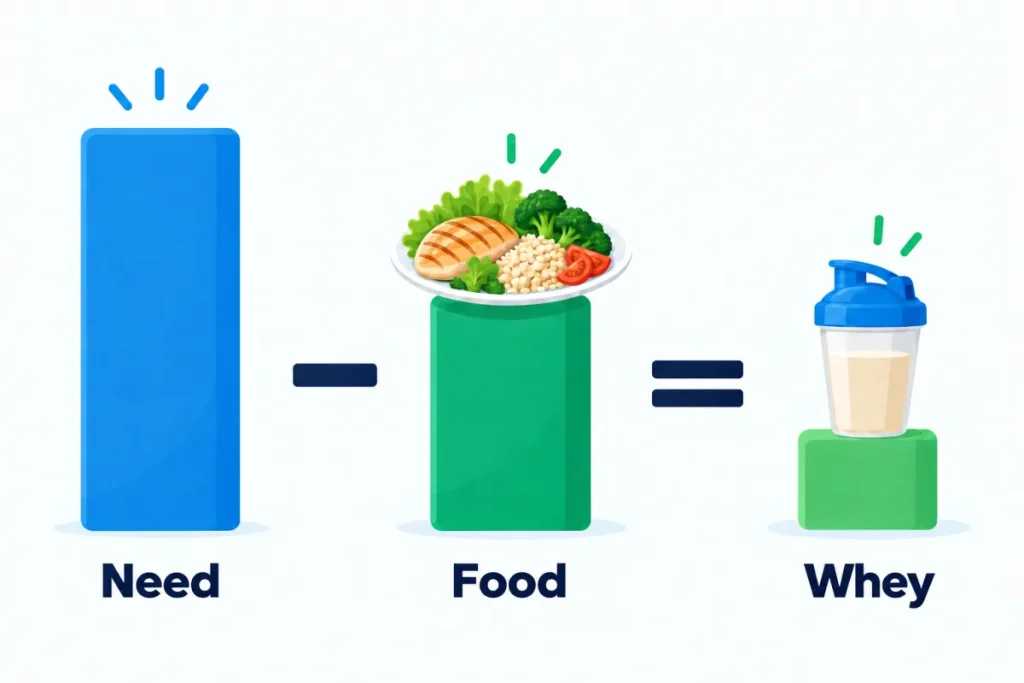
An example: at 75 kg, 1.6 g per kg gives you 120 g of protein a day. If your meals already bring 95 g, you are 25 g short: a single shake of about 30 g of powder covers it, with Optimum Nutrition’s Gold Standard, for instance, providing 24 g of protein per 31 g. The full calculation is in how much whey protein per day.
🕒 When should you take your whey on a bulk?
Before or after the session, both work: according to the ISSN, the anabolic effect of training lasts at least 24 hours and the best moment depends above all on what you tolerate. If you only take one shake a day, put it where your protein gap is biggest, often at breakfast or as a snack.
For the detail according to how your day runs, see when to take whey protein. On a bulk, consistency counts for more than the stopwatch.
🍚 And what about a mass gainer, better than whey for bulking?
A mass gainer is there to add calories, not protein. Optimum Nutrition’s Serious Mass brings 75 g of carbs for 15 g of protein per 100 g: useful if you struggle to eat enough, counter-productive if you put weight on easily. Our comparison of whey vs mass gainer goes through the labels and the price per gram of protein.
To go further, the review by Iraki et al. names creatine monohydrate (3 to 5 g per day) among the supplements worth using on a bulk: it is the best thing to pair with your whey, as we explain in whey and creatine.
🔬 Our method
We cross-checked the scientific benchmarks (the Morton et al. 2018 meta-analysis, the ISSN 2017 position stand, the Iraki et al. 2019 review) against the official labels of wheys sold in France (Optimum Nutrition, Decathlon, Nutrimuscle). We do not run laboratory tests: the star scores reflect those data and the way each type of whey is made.
🏆 Our verdict
On a bulk, we recommend a good-quality whey concentrate, dosed to get you to around 1.6 g of protein per kg, plus a moderate surplus that comes from your plate. Save the isolate for lactose intolerance, or for the cut that follows.
Whey will do nothing for you if your diet already covers your protein, or if your training is not progressing. And if the scale is not moving, the problem is calories: whey will not change that. For a product ranking, see our pick of the best whey protein for bulking.
⚠️ Watch out
Whey is a dairy product: avoid it if you are allergic to milk protein. If you have kidney disease, you are pregnant or you are on medication, ask your doctor before raising your protein intake sharply. For adults in general, ANSES, the French food safety agency, uses a reference value of 0.83 g per kg of bodyweight per day.
❓ Frequently asked questions
Which whey is best for mass gain?
A plain whey concentrate is the best pick for most people. It costs less, and the few extra grams of carbs and fat are useful when you are in a surplus. Only go for an isolate if lactose bothers you.
How much whey per day to gain mass?
One to two shakes a day is usually plenty. Work out what you need (around 1.6 g of protein per kg), take off what you eat, and fill the gap in servings of 20 to 40 g of protein.
Does whey make you put on weight?
Not on its own: one shake brings around 115 kcal. It is your total calorie surplus across the day that puts weight on. More detail in does whey protein make you fat.
Should you take your whey with water or milk on a bulk?
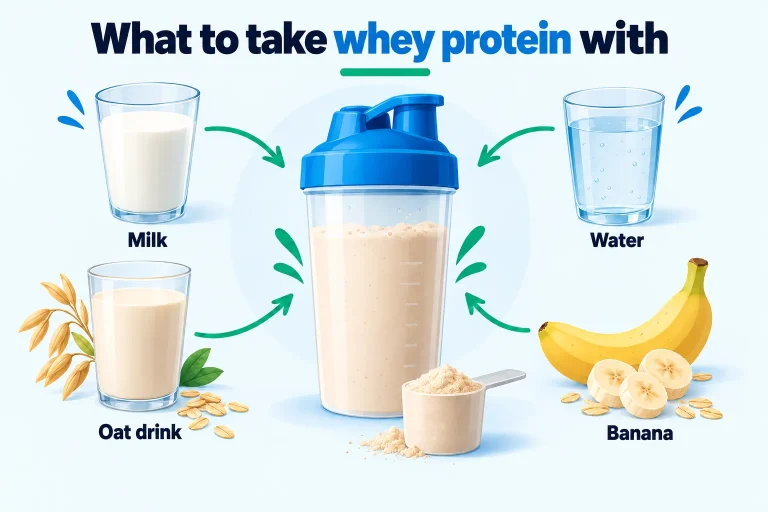
With milk if you struggle to hit your calories, with water if you already gain weight easily. Milk adds calories and protein to the shake; water keeps it light and easier to digest.