Contents 7 sections
What is your main goal?
How do you digest dairy?
What matters most to you?
Summarise this article with:
💡 The essentials
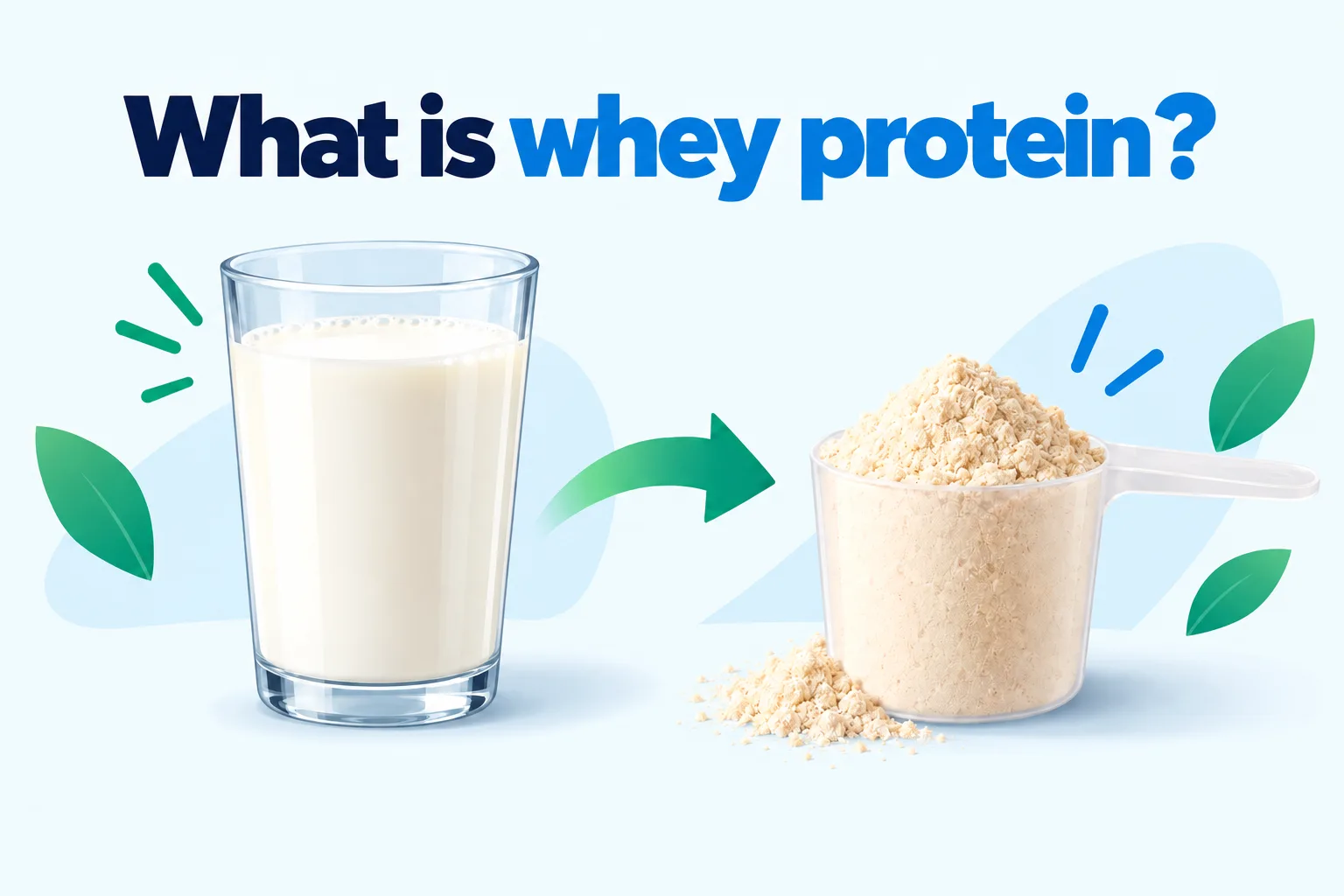
Whey protein is the protein of the whey itself, the watery liquid that separates from the curd when cheese is made. Filtered and then dried, it becomes the powder sold by sports nutrition brands.
- Origin: cow’s milk, where it accounts for roughly 20% of the protein (casein makes up the rest).
- Families: concentrate (at least 80% protein for WPC 80), isolate (at least 90%), native, hydrolysed.
- Status: a food, not a doping product and not a medicine.
You have seen tubs of whey at the gym or on the shelf, but the word still feels vague? This article answers one question only: what whey protein is, where it comes from and how it is made. To learn what it is for, exactly what one serving contains or how to fit it into a programme, we point you each time to the guide that covers that subject in detail.
🥛 Whey protein: the simple definition
“Whey” is the watery part of milk, what the French call lactosérum or petit-lait. By extension, whey is the name given to the proteins extracted from that liquid and sold as a powder. So when people say “whey protein”, they are simply talking about milk protein.
Cow’s milk contains two big families of protein. Casein accounts for roughly 80% of milk protein, and whey for most of the remaining 20%, according to a Nutrition Reviews review of dairy proteins. Whey itself is a blend of several proteins: beta-lactoglobulin, alpha-lactalbumin, lactoferrin and glycomacropeptide.
To put numbers on it: one litre of semi-skimmed milk provides about 34 g of protein (3.38 g per 100 g according to the ANSES Ciqual table), of which barely 7 g is whey if you apply that 20% share. That is why it takes a lot of milk, and therefore a lot of cheese, to produce one tub of whey.
🧀 Where whey comes from: a cheese by-product
Classic whey is born at the moment the milk curdles. In a dairy, rennet (an enzyme) or a starter culture is added to the milk: the casein coagulates and forms the curd, which will become cheese. The yellowish liquid that drains off is the whey. It holds the water, the lactose, minerals and the whey proteins.
For a long time this liquid was mostly used to feed animals. Today it is a valued raw material: the dairy industry extracts the proteins from it, especially for sports nutrition. And no, do not worry, the finished powder does not smell of cheese.
🏭 How whey protein powder is made
The principle is always the same: strip out of the whey everything that is not protein, then dry it. The steps vary from plant to plant, but the pattern is this:
- Separation: the whey is collected after curdling (or, for so-called native whey, the proteins are extracted straight from the milk).
- Filtration: membranes (microfiltration, ultrafiltration) or an ion exchange process hold back the proteins and let the water, the lactose and some of the minerals through.
- Concentration: the more you filter, the higher the protein content climbs and the lower the lactose and fat fall.
- Drying: the liquid concentrate is spray dried in a tower to obtain a powder.
- Formulation: the brand adds flavourings, sweeteners and an emulsifier (or does not), then packages it.
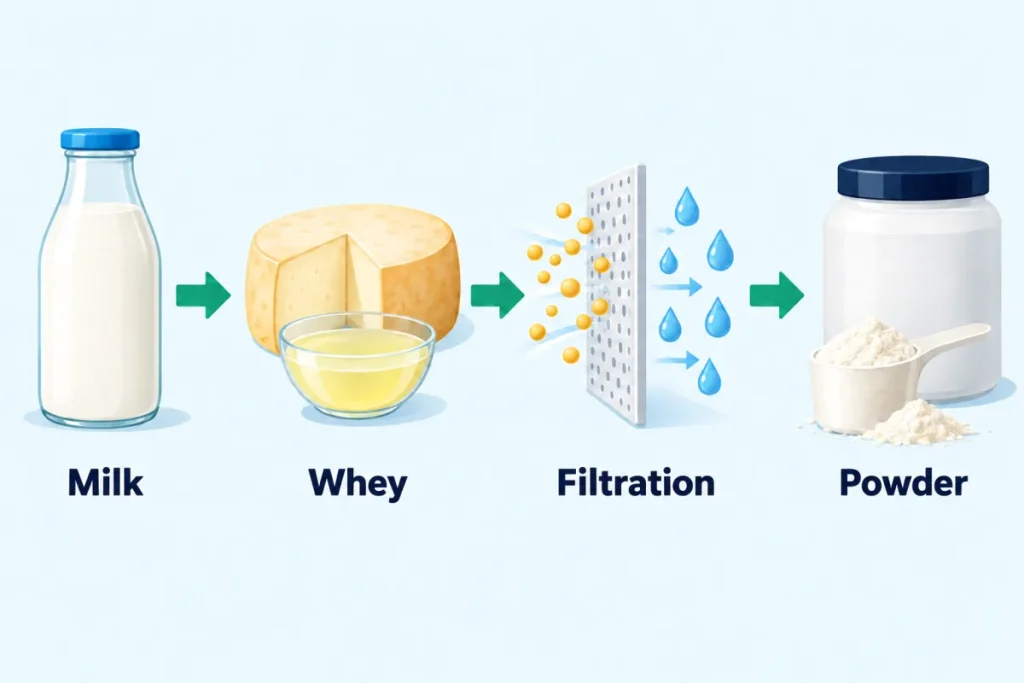
It is the degree of filtration that separates the families of whey, far more than the marketing. Which is why it pays to know how to tell them apart.
🧪 The families of whey at a glance
The thresholds below come from the American dairy industry standards (ADPI), which serve as the reference for the global ingredients trade. They describe the raw material, before flavourings are added: a flavoured whey therefore shows slightly less protein.
| Family | Protein (raw material) | Lactose | What to remember |
|---|---|---|---|
| Concentrate (WPC 80) | 80 to 82% (minimum 79.5%) | 4 to 10% | The most common and the cheapest |
| Isolate (WPI) | 90 to 92% (minimum 89.5%) | 0.5 to 1% | More heavily filtered, very little lactose |
| Native | Depends on the product | Depends on the product | Extracted from milk, not from cheese whey |
| Hydrolysed | Depends on the product | Depends on the product | Proteins pre-cut by enzymes, more expensive |
Whey concentrate is the original form: good value for money, a little lactose and a little fat. Isolate goes through a more thorough filtration; it is the logical choice if lactose bothers you (it is all explained in our article on whey isolate).
Native whey is obtained by microfiltering the milk itself, without going through cheesemaking: its proteins undergo fewer treatments. Do not let the “native” label hypnotise you, though: compare the protein percentage and the ingredients list above all (we go into the subject in our guide to native whey).
Hydrolysed whey has been “pre-digested” by enzymes that cut the proteins into shorter fragments. It costs more for a benefit that only makes sense in specific cases, detailed in our article on hydrolysed whey. To pick between these families according to your own profile, head to our guide to choosing the right type of whey.
🎯 What whey protein is for, in a nutshell
Whey protein is there to top up your protein intake easily, with few calories and fast digestion. That is useful when you lift weights, when you are dieting or when your appetite is lacking, but it is never compulsory if your diet is already enough. The detail of its uses (and of what it does not do) is in our article on what whey protein does.
On the regulatory side, the European Union only authorises general claims about protein: it contributes to the growth and the maintenance of muscle mass, and to the maintenance of normal bones. The whey-specific claims submitted to the EFSA (satiety, recovery, strength, weight) were rejected in 2010 for lack of sufficient evidence. Whey remains a convenient protein source, not a miracle product.
To go further: the exact make-up of one serving (leucine, lactose, additives) is pulled apart in our guide to whey protein composition, the right amount for your body weight in how much whey protein per day, the time it takes to see a result in how long whey protein takes to work, and its place in a training programme in our guide to whey protein and weight training.
⚠️ Watch out
Whey is a milk protein: it is off the table if you are allergic to milk proteins, even in isolate form. ANSES also advises against sports supplements without medical advice for children and teenagers, for women who are pregnant or breastfeeding and for people with kidney, liver or heart disease. In those cases, ask your doctor for advice. The risks are detailed in our file on the dangers of whey protein.
🏆 Our verdict on whey protein
🔬 Our method
For this definition we relied on the ADPI composition standards, the ANSES Ciqual table, a scientific review of dairy proteins, the ANSES opinion on sports supplements and the brands’ official product sheets, checked in October 2026. We do not run laboratory analyses.
Our verdict: whey protein is an ordinary food in a convenient form, neither magic nor suspect. It earns its place if you struggle to reach your protein needs or if you want a quick high-protein snack. On the other hand, it brings nothing if your plate already covers your needs, and it is not for you if you are allergic to milk or if you are after a “fat burner”.
If you want a quality whey without breaking the bank, we recommend the native whey isolate from Nutripure. According to its product sheet, it shows 94% protein, less than 0.2% lactose, and it is made from fresh milk collected from French cooperatives. The brand ships from France.
Want to compare before you buy? Our ranking of the best whey proteins reviews the other options, and if you are just starting out, our selection of whey proteins for beginners gets straight to the point.
❓ Frequently asked questions
What is the difference between whey and protein?
Whey is one protein among others: the one found in the whey of milk. “Protein powder” is a broader term that also covers casein, total milk protein, egg and plant proteins (pea, rice, soy). They all supply protein, with different digestion speeds and different amino acid profiles.
Is whey protein natural?
The raw material is natural: these are milk proteins, isolated by filtration and drying. The finished product, though, can contain flavourings, sweeteners or emulsifiers. If you want the simplest possible option, choose an unflavoured whey and read the ingredients list.
Is whey protein a doping product?
No, whey is a food, not a doping substance. The real risk is contamination of certain supplements bought outside controlled channels: ANSES advises choosing products that comply with the NF V94-001 standard, now the European standard EN 17444. To buy with peace of mind, see our guide on where to buy whey protein.
Is it good to drink whey protein every day?
For a healthy adult, yes, as long as your total protein amount stays sensible. The EFSA considers an intake of up to double the reference value (0.83 g per kg per day) to be safe in adults. Whey counts towards that total, exactly like meat or dairy.
Do you have to exercise to take whey protein?
No, but without exercise its benefit is limited to filling a protein gap. It does not build muscle on its own. We have devoted a whole article to the question: taking whey protein without working out.
📚 Sources
- ADPI: whey protein isolate (WPI) standard, 2023 and whey protein concentrate (WPC) standard, 2023
- Auestad and Layman, Dairy bioactive proteins and peptides, Nutrition Reviews, 2021
- ANSES, Ciqual food composition table (in French)
- ANSES, food supplements for athletes: risks to health and uncertain benefits (2016)
- EFSA, dietary reference values for protein (2012)