Contents 10 sections
- The calorie deficit decides, whey supports
- What the studies say about whey and weight loss
- Why you should keep your muscle while cutting
- Satiety and protein digestion: a genuine plus, but a modest one
- How much whey to take to lose weight
- When to take your whey when you want to lose weight
- Which whey to choose for weight loss
- Whey and fat burners: the idea that sounds good but is not
- Our verdict on whey for losing weight
- Frequently asked questions
What is your main goal?
How do you digest dairy?
What matters most to you?
Summarise this article with:
💡 The essentials
Whey does not make you lose weight on its own: the calorie deficit is what does that. What it does do is help you hold on to your muscle and reach a high protein intake without blowing up your calories.
- Aim for 1.2 to 1.6 g of protein per kilo per day, with 25 to 30 g per meal.
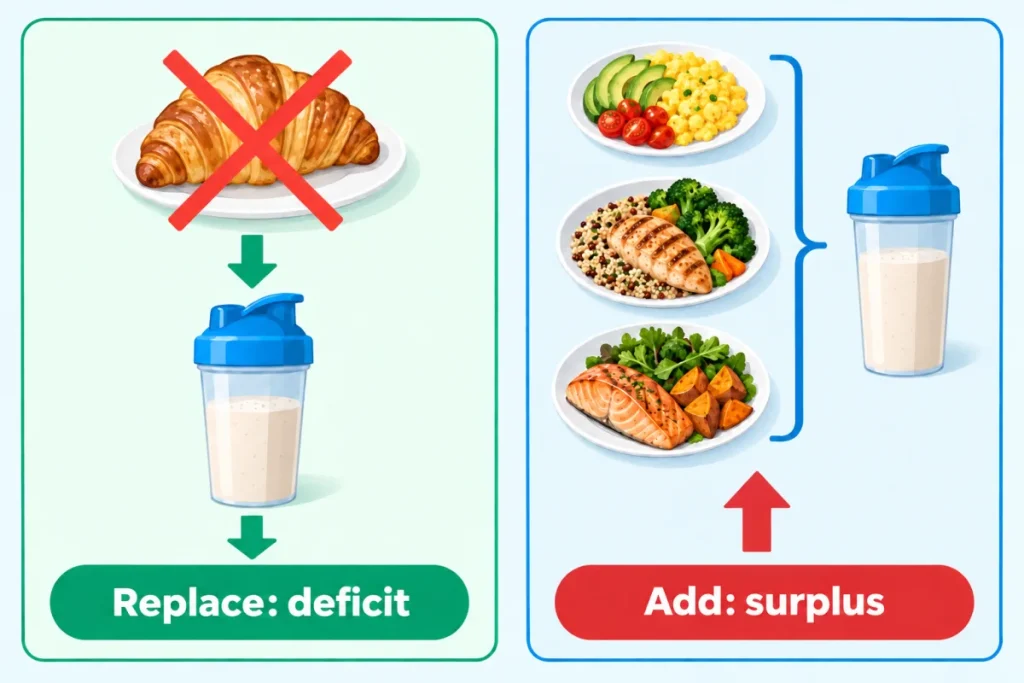
- A shake should replace calories (a snack, an afternoon pick-me-up), not be added on top of your day.
- You do not need a fat burner: ANSES has issued warnings about several of these products.
Whey is usually associated with bulking. Yet it is during a weight loss phase that a protein powder can be most useful: when the calories go down, keeping enough protein on your plate gets hard, and that is exactly where whey makes life easier.
This guide explains how whey does (and does not) act on weight loss, what the studies show, how much to take and when. If you are torn between concentrate and isolate, read our dedicated analysis of whey isolate for weight loss next. For a product shortlist, see our comparison of the best whey for weight loss.
🔬 Our method
We ran no tests on people. We read the primary sources: the American Journal of Clinical Nutrition review on protein and weight loss, two meta-analyses on whey, the ISSN position stand on protein, the ANSES warnings, and the nutrition labels published by the brands (checked in October 2026). Every figure in this article comes from one of those pages.
⚖️ The calorie deficit decides, whey supports
To lose weight, you have to take in fewer calories than you burn. No food and no powder gets around that rule. Your body then draws on its reserves, ideally on fat rather than on muscle.
And a whey shake is still calories coming in. On its label, MyProtein’s Impact Whey Protein shows 114 kcal per 30 g serving, and its isolate version 108 kcal. Added to your usual meals, whey makes the day heavier; in place of an afternoon snack or a pastry, it makes it lighter and higher in protein. That is the whole difference, which is why we look separately at whether whey makes you put on weight.
🔬 What the studies say about whey and weight loss
A review published in 2015 in the American Journal of Clinical Nutrition concludes that higher-protein diets produce more weight loss and more fat loss, while better preserving lean mass, than lower-protein calorie-restricted diets. The authors note that the benefit depends above all on sticking with it: those who genuinely followed the diet gained from it, the others did not.
On whey specifically, a meta-analysis of 14 trials (2014) separated two uses. When whey replaced other calories, participants lost an average of 4.2 kg of weight and 3.7 kg of fat between the start and the end of the trials. Compared with other protein sources, though, whey did not do significantly better: what counts is the protein intake, not some magic property of the powder.
A second meta-analysis of 9 trials (2018), carried out in people who were overweight or obese, observes a modest but significant drop in weight and fat mass with whey compared with the control groups. Modest is the right word: whey is a helping hand, not a treatment.
💪 Why you should keep your muscle while cutting
In a deficit, the body loses fat but also muscle if your protein intake and your training do not keep up. The goal is not to watch the scales go down, it is to lose fat while keeping your muscle, and with it your strength and your shape. According to the ISSN position stand on protein (2017), intakes of 2.3 to 3.1 g per kilo may even be needed in resistance-trained people during a calorie-restricted phase.
You often read that muscle “burns a lot of calories at rest”. The effect is real but it stays small: going by the values reported in a study in the American Journal of Clinical Nutrition (2010), muscle uses about 13 kcal per kilo per day at rest, against 4.5 kcal for fat. Two extra kilos of muscle therefore amounts to less than 20 kcal a day. Keep your muscle for your health, your strength and your look, not for a miracle metabolism.
🍽️ Satiety and protein digestion: a genuine plus, but a modest one
Protein is the macronutrient whose digestion costs the most energy, ahead of carbohydrates and fats, as a review on diet-induced thermogenesis sums up. A higher-protein diet therefore burns slightly more calories for the same amount eaten.
On hunger, the 2015 review confirms a real but modest satiety effect: you feel fuller after a high-protein meal, without that necessarily reducing what you eat at the next one. So whey helps you hold the line, it does not kill your appetite for you.
🎯 How much whey to take to lose weight
Start from your total requirement, not from the powder. The 2015 review puts the useful intake between 1.2 and 1.6 g of protein per kilo of body weight per day, ideally with 25 to 30 g of protein per meal. Whey is there to close the gap between what you already eat and that target.
| Body weight | Total intake to aim for (1.2 to 1.6 g/kg) | Typical role for whey |
|---|---|---|
| 60 kg | 72 to 96 g per day | 1 shake if your diet is already high in protein |
| 70 kg | 84 to 112 g per day | 1 shake, sometimes 2 on busy days |
| 80 kg | 96 to 128 g per day | 1 to 2 shakes |
| 90 kg | 108 to 144 g per day | 1 to 2 shakes |
A shake made with 25 to 30 g of powder brings roughly 21 to 25 g of protein, going by the labels we checked (BioTechUSA, MyProtein). One or two shakes a day are enough in the vast majority of cases; the rest should come from real food. To fine-tune this for your own profile, see our guide to how much whey per day.
🕒 When to take your whey when you want to lose weight
The exact moment matters little. A meta-analysis on protein timing (2013) shows that your total intake across the day weighs far more than the hour you take it. When losing weight, put your whey wherever it helps you stick to your plan:
- As a snack, in place of something sugary: this is the most useful use in a deficit.
- At breakfast, if yours is low in protein (toast, coffee).
- After your session, if your next meal is a long way off.
For the detail on each moment of the day, see our guide to when to take whey. And if you do not do any sport, whey can still top up a protein intake that is too low, as we explain in taking whey without working out.
🥛 Which whey to choose for weight loss
A good-quality whey concentrate is perfectly fine for losing weight: the calorie gap with an isolate is small, on the order of a few kcal per serving on the labels we compared. Isolate becomes interesting if you digest lactose badly or if you want the maximum protein per calorie; we put numbers on that gap in our article on whey isolate and weight loss.
Conversely, steer clear of mass gainers: they add a lot of carbohydrates and calories, which works against a deficit (see whey or mass gainer). Be wary too of “slimming” powders enriched with plant extracts: they do not replace the deficit and they add pointless ingredients.
⚠️ Whey and fat burners: the idea that sounds good but is not
Adding a fat burner to your whey is tempting. No fat burner replaces the calorie deficit, and some ingredients cause genuine health problems. ANSES, the French food safety agency, advises the entire population against supplements based on Garcinia cambogia, sold for weight loss (hepatitis, pancreatitis, cardiac and muscular damage, including in people with no history of illness).
Between 2016 and February 2024 the agency also recorded 154 cases of adverse effects linked to sports supplements intended to build muscle or lose fat, mostly cardiovascular. It recommends asking a doctor or a sports dietitian for advice and avoiding stacking supplements.
⚠️ Watch out
Ask a doctor before raising your protein intake sharply if you have kidney or liver disease, if you are pregnant, if you are on medication or if you are allergic to milk proteins. The same goes before taking a fat burner, especially with a history of heart problems.
✅ Our verdict on whey for losing weight
For us, whey is a practical tool during weight loss, not a slimming product. It is very useful if you struggle to eat enough protein, if you train in a deficit and want to keep your muscle, or if you are after a filling, low-calorie snack. Its real merit is making a higher-protein diet easy to stick with.
It will do nothing for you if you add it to a diet that does not change, nor if you already eat enough protein from meat, fish, eggs or dairy. And it is not meant to replace whole meals: a shake of roughly 110 kcal is not a balanced meal.
❓ Frequently asked questions
Does whey protein make you lose weight?
No, not directly: only burning more than you take in makes you lose weight. Whey helps indirectly, by making a high protein intake easier, which protects muscle and satisfies you a little better. The trials show a benefit mainly when it replaces other calories.
How many whey shakes a day to lose weight?
One to two shakes a day are enough in most cases. Work out your target first (1.2 to 1.6 g of protein per kilo), subtract what you already eat, and only top up with whey if a gap remains.
Can you replace a meal with a whey shake?
It is not a good idea day to day. A shake mainly brings protein and about 110 kcal, with no fibre, no vegetables and no good fats. It replaces a snack far better than a proper meal.
When is the best time to take whey when you want to lose weight?
Whenever it replaces a less useful snack, often in the afternoon or at breakfast. The precise timing matters little, your total intake across the day matters a great deal more.
Do you have to exercise for whey to help you lose weight?
It is not compulsory, but it is considerably more effective. Without resistance training, the body has fewer reasons to hold on to muscle in a deficit; with it, the protein goes towards preserving it. Either way, the calorie deficit is still the engine.
📚 Sources
- Leidy et al., The role of protein in weight loss and maintenance, American Journal of Clinical Nutrition, 2015
- Miller et al., meta-analysis of whey protein and body composition, Journal of the American College of Nutrition, 2014
- ISSN position stand on protein and exercise, 2017
- ANSES, risks of food supplements for athletes, 2024