
Contents 7 sections
What is your main goal?
How do you digest dairy?
What matters most to you?
Summarise this article with:
💡 The essentials
Yes, you can take whey on rest days, and it is useful if your food does not cover your protein requirement that day. Muscle carries on rebuilding long after the session.
- The same protein target as on training days.
- No fixed time: put the shake at whichever meal or snack has the least protein.
- Pointless if your meals already hit your total.
Plenty of lifters put the shaker away on their day off, convinced whey is only useful around the session. That forgets that muscle is mostly built during recovery, which means on days without training too. The real question is not “whey or no whey”, it is “are my meals enough?”.
This guide sticks to rest days. For timing on training days, see our guide to when to take whey, and our articles on whey before training and whey before bed.
🔬 Our method
We ran no trials ourselves. We read a study on how long muscle protein synthesis lasts after a session, the ISSN position stand on protein, a meta-analysis of 49 trials on protein supplementation and a study on how whey servings should be spread out. The nutrition figures in the example come from the ANSES Ciqual table and from the Nutripure product page.
🔬 Muscle rebuilds on days without a session too
A classic study measured muscle protein synthesis in untrained volunteers after a resistance training session: it was still higher than at rest 3 hours later (+112%), 24 hours later (+65%) and even 48 hours later (+34%). Net muscle protein balance stayed improved for up to 48 hours (Phillips et al., 1997).
The ISSN position stand on protein (2017) confirms it: the anabolic effect of exercise lasts at least 24 hours, even though it fades with time. The day after a session, your muscles therefore still need amino acids to repair themselves.
📊 How much protein on a rest day?
Keep the same target as on training days. The ISSN puts the requirement for most active people between 1.4 and 2 g of protein per kilo per day, and a meta-analysis of 49 trials sees no further gain in lean mass beyond roughly 1.6 g/kg/day.
In practice, someone weighing 75 kg aiming for 1.6 g/kg needs about 120 g of protein, training or not. If your rest-day meals reach that total, whey adds nothing. If they fall well short, a shake closes the gap. To adapt the sums to your own weight and goal, see how much whey per day.
What changes on a rest day is how much you burn. If you are watching your weight, adjust your portions of starchy foods and fats instead, not the protein: protein is what supplies the building blocks for muscle repair.
🍽️ An example rest day at 120 g of protein
Here is a typical day for someone weighing 75 kg, with a single shake placed where the meals are lightest. The figures come from the ANSES Ciqual table and, for the whey, from the Nutripure product page (86.8 g of protein per 100 g).
| Meal | Food | Protein |
|---|---|---|
| Breakfast | 200 g fat-free fromage blanc | 16 g |
| Lunch | 120 g pan-fried chicken breast + 100 g cooked green lentils | 46 g |
| Afternoon snack | 30 g whey isolate in water | 26 g |
| Dinner | 150 g cooked salmon | 35 g |
| Total | Not counting bread, starchy foods or vegetables | about 123 g |
Without the shake, this day tops out at around 97 g: this is exactly the case where whey makes sense. If you would rather use food, a second fromage blanc or an extra portion of meat does the same job.
🕒 When should you take your whey on a rest day?
There is no single right time: put your whey at whichever meal or snack is shortest on protein, often breakfast or the afternoon snack. The ISSN recommends servings of 20 to 40 g spread every 3 to 4 hours, and a 2013 study showed that 4 servings of 20 g of whey every 3 hours stimulated muscle protein synthesis more than 2 servings of 40 g or 8 servings of 10 g.
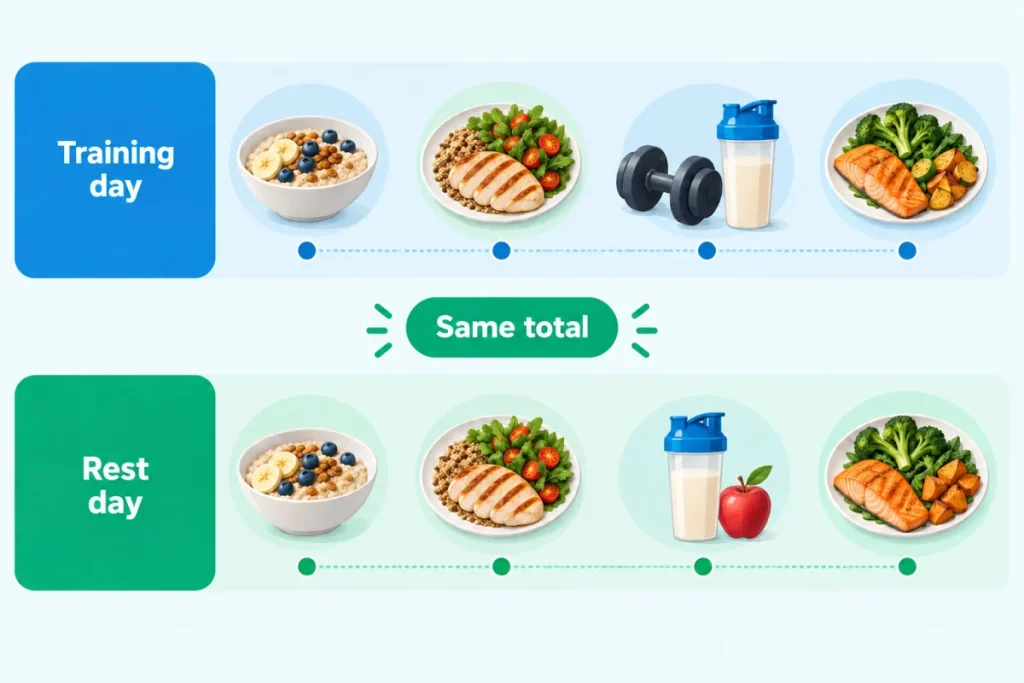
In practice, simply move the shake you would have had after your session to your afternoon snack. If you use an isolate, the same rules apply (see when to take whey isolate). If whey is just a convenient snack for you, a brand with a simple formula is all you need; Nutripure’s is one of those, and it ships from France:
🚫 When you can skip whey on your day off
- Your meals already hit your total: whey has no magic effect beyond your requirement.
- You are not trying to build or keep muscle: a varied diet is enough.
- You are on a long break (several weeks without training): the question then becomes one of whey without working out.
✅ Our verdict: a rest day is not a protein-free day
For us the rule is simple: the same protein total every day, and whey only to close the gap. On a rest day it is often more useful than people think, because without a session it is easier to skip a snack or eat lighter.
This advice is not for you if you already cover your needs at the table: keep your money. If you have kidney or liver disease, an allergy to milk proteins, or if you are pregnant or under 18, ask a doctor before increasing your intake. To place whey within a complete programme, see whey for weight training.
❓ Frequently asked questions
Is it good to take whey every day?
Yes, for a healthy adult whose diet does not cover their protein requirement. It tops meals up, it does not replace them. If you have kidney or liver disease, ask your doctor first.
Is it good to take whey in the morning on a rest day?
Yes, if your breakfast is low in protein. Toast or cereal on their own bring very little; a scoop of whey in a yoghurt or in porridge easily lifts that meal.
Can I take whey without doing any sport?
Yes, but how useful it is depends on your intake. Without training, whey only serves to top up a diet that is too low in protein; we go into that case in our article on whey without sport.
Should you take less whey on rest days?
Not necessarily: it is your protein total that should stay steady. If your day-off meals are richer in protein, you can cut the shake down or drop it.
Should you take creatine on rest days?
Yes, creatine is taken every day: its benefit comes from taking it consistently (about 3 g a day according to the ISSN). See our guide to whey and creatine.
📚 Sources
- Phillips et al., muscle protein synthesis 3, 24 and 48 h after exercise, 1997
- ISSN position stand on protein and exercise, 2017
- Morton et al., meta-analysis of 49 trials on protein supplementation, Br J Sports Med 2018
- Areta et al., distribution of whey servings and muscle protein synthesis, J Physiol 2013
- ANSES, Ciqual food composition table (in French)