
Contents 10 sections
- Step 1: choose a whey that suits you
- Step 2: take the right amount
- Step 3: make up your shaker
- Step 4: place your whey in your day
- Step 5: keep going over time, rest days included
- Mix it up: whey is not just for shakers
- The precautions to know about
- Should you stack other supplements with it
- Our verdict: the simplest routine
- Frequently asked questions
What is your main goal?
How do you digest dairy?
What matters most to you?
Summarise this article with:
💡 The essentials
To take whey properly: one 30 g scoop, mixed with about 250 ml of water or milk, at whichever time of day suits you best. What matters most is neither the hour nor the liquid, it is reaching your protein total every day.
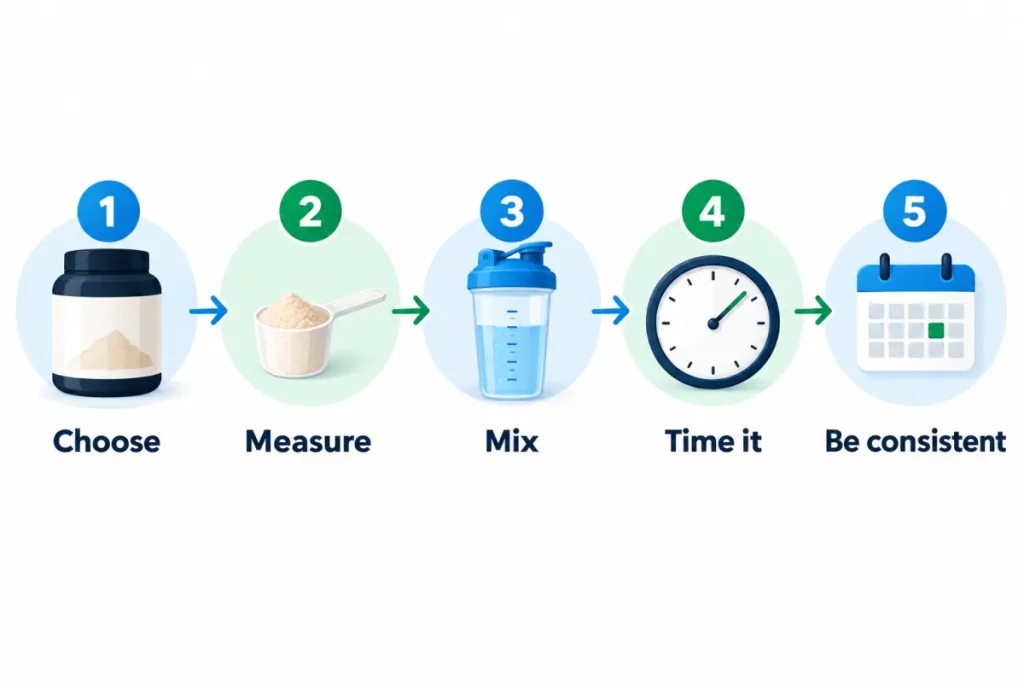
- Choose a whey that suits your digestion.
- Measure: usually 1 shaker a day.
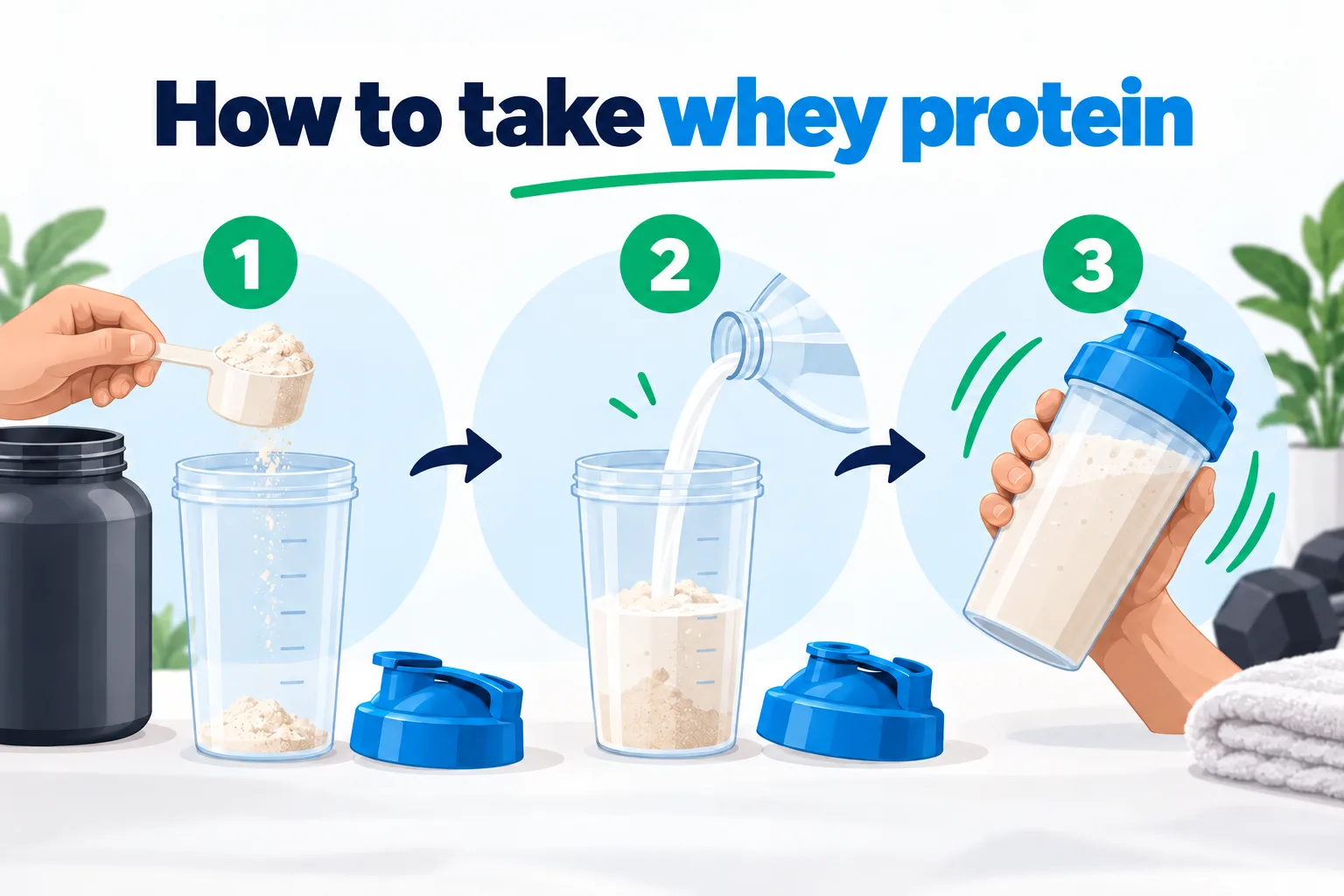
- Mix: liquid first, powder second, then shake.
- Place the serving in your day, training or not.
- Keep going over time, rest days included.
You have just bought your first tub of whey and you are not sure where to start? That is perfectly normal: between gym advice, labels and videos, everyone has an opinion. The good news is that taking whey is far simpler than people make out.
This guide gives you the method in 5 steps, from choosing the powder to the daily routine. Each step points to our detailed guide if you want to dig into one specific point: the dose, the liquid, the timing or the recipes.
🔬 Our method
This step-by-step method rests on verifiable sources: the ISSN position stand on protein and exercise (2017), the Schoenfeld et al. (2013) meta-analysis on protein timing, the ANSES recommendations, and the usage instructions published by the manufacturers (MyProtein, Nutrimuscle), which we checked in October 2026. We do not run laboratory tests.
🛒 Step 1: choose a whey that suits you
If you digest milk well, a whey concentrate will do; if lactose bothers you, go for an isolate, which is far lower in lactose. For a beginner, a simple flavour and a short ingredient list beat a product loaded with additives.
The differences between concentrate, isolate, native and hydrolysate are explained in our guide on which whey protein to choose, and our favourite products for getting started are in our ranking of the best whey protein for beginners. Just check the amount of protein per scoop on the label: that is the figure you will need for the next step.
⚖️ Step 2: take the right amount
For most gym-goers, one 30 g shaker a day is enough, two at the very most. The exact dose is worked out from your total protein needs (around 1.6 g per kilo of body weight for weight training) minus what your food already provides. The step-by-step calculation, with examples for 60, 80 and 100 kg, is in our guide to how much whey protein per day.
🥤 Step 3: make up your shaker
Pour in about 250 ml of cold liquid first, add the powder, close the lid and shake for 10 to 20 seconds. That is the method MyProtein and Nutrimuscle give on their product pages (30 g for 250 ml of water or milk). Putting the liquid in first stops the powder sticking to the bottom.
- How much water: textures, half scoops and clear whey in the whey to water ratio.
- Water, milk or a plant drink: the comparison is in what to mix your whey with.
- The right shaker: capacity, ball or mesh, and cleaning in our guide to the whey shaker.
When cutting, favour water; when bulking, milk is an ally. A shaker made with water stays around 115 kcal, while 250 ml of milk adds roughly 85 to 165 kcal depending on whether it is skimmed or whole (details in the calories in whey).
🕒 Step 4: place your whey in your day
There is no magic moment: your protein total across the day counts for more than the hour of your shaker. A meta-analysis by Schoenfeld et al. (2013) found no significant effect of timing on strength or muscle size once the total amount was taken into account. The ISSN mainly advises spreading your protein into servings of 20 to 40 g every 3 to 4 hours.
| Moment | Why it might suit you | Read more |
|---|---|---|
| At breakfast | It is often the meal lowest in protein | When to take whey protein |
| Before the session | Handy if you train a long way from a meal | Whey before training |
| After the session | The easiest habit to keep, shaker in your bag | When to take an isolate |
| As a snack | Fills the gap between two widely spaced meals | Spreading your doses |
| Before bed | Possible, but casein is better studied at that time | Whey before bed |
As for the evening, the studies on protein before bed are mostly about casein, which is slower to digest: according to a systematic review published in 2021, 20 to 40 g of casein about 30 minutes before sleep increases protein synthesis overnight in young adults. Whey can stand in, but if you are set on an evening shaker, read our comparison of casein vs whey.
📅 Step 5: keep going over time, rest days included
On rest days, keep the same total protein intake: your muscles rebuild precisely on those days, and the ISSN points out that the effect of a session on protein synthesis lasts at least 24 hours. Whey then simply tops up your meals, as explained in whey protein on rest days.
Do not judge whey after a fortnight: muscle gains are measured in months, and they depend first on your training and your diet. Our article on how long whey takes to work sets out what you can reasonably expect, and whey protein for bodybuilding puts the supplement back in its place within a programme.
🍳 Mix it up: whey is not just for shakers
If the shaker is wearing thin, whey slots easily into recipes: pancakes, crepes, porridge, bars or smoothies. For hot preparations, slake it in a little cold liquid first to avoid lumps. You will find ideas in our whey protein recipes, our whey protein pancakes and our whey shake recipes.
⚠️ The precautions to know about
- Food first: ANSES advises strength athletes to draw at least two thirds of their protein from food. Beyond 2 or 3 shakers a day, look at your meals instead.
- Per serving, 20 to 40 g of protein is enough (ISSN): doubling up the scoop does not achieve much.
- Lactose intolerance: an isolate, being very low in lactose, is often better tolerated than a concentrate.
- Allergy to milk proteins: whey is out, whatever the type.
⚠️ Watch out
Ask your doctor before taking whey if you are pregnant or breastfeeding, if you are under 18, if you have kidney or liver disease, a heart problem or any ongoing medication. ANSES advises against sports supplements for these groups without medical advice. The risks are set out in whey protein: what are the dangers?
➕ Should you stack other supplements with it?
Only one supplement has solid evidence alongside whey for weight training: creatine. According to the ISSN position stand, it improves performance in intense efforts, and around 3 g a day over the long term is well tolerated in healthy people. You can mix it into the same shaker: doses and practicalities in whey and creatine. For everything else, start with your sleep and your training before adding more tubs.
✅ Our verdict: the simplest routine
The routine we recommend for starting out: a 30 g shaker with water after your session, and at breakfast on rest days. It is easy to stick to, it covers the protein shortfall most people have, and it calls for no complicated maths. You can fine-tune it later with the dose calculation if your needs are higher.
Whey is of no use if your meals already cover your protein needs, and it replaces neither your training nor a decent diet. If you do not do any sport, the question is a different one: see taking whey protein without working out.
❓ Frequently asked questions
How much whey should you take per day?
Usually one 30 g shaker, sometimes two. The right amount matches whatever your diet is missing to reach around 1.6 g of protein per kilo of body weight if you do weight training. The full calculation is in how much whey protein per day.
How do you make up whey?
Pour about 250 ml of cold water or milk into a shaker, add 30 g of powder, then shake. That is the method most manufacturers give. For a thicker shake, cut the liquid to 180 or 200 ml.
Should you take whey with water or milk?
With water if you are watching your calories, with milk if you are trying to put on weight or you prefer a creamy texture. Both work: milk mainly adds calories, calcium and a few grams of protein.
What is the right time to take whey?
The one you can stick to every day. After your session, at breakfast or as a snack, the studies show no meaningful difference in results as long as your total intake for the day is reached.
📚 Sources
- ISSN position stand on protein and exercise (Jäger et al., 2017)
- Schoenfeld et al. (2013): meta-analysis on the timing of protein intake
- ANSES (2016): food supplements for athletes, risks and precautions
- Nutrimuscle Whey Native Isolate: usage instructions (30 g for 250 ml) (in French)
- ISSN position stand on creatine (Kreider et al., 2017)