Contents 9 sections
- Hydrolysed whey: definition and composition
- Hydrolysed, isolate or concentrate: the differences
- Why take hydrolysed whey
- Why does hydro whey cost so much
- The best hydrolysed wheys on the market
- Our verdict: which hydrolysed whey should you choose
- How should you take your hydrolysed whey
- Are there more affordable alternatives
- Frequently asked questions
What is your main goal?
How do you digest dairy?
What matters most to you?
Summarise this article with:
💡 The essentials
Hydrolysed whey is a whey whose proteins have been pre-cut into peptides by enzymes: it is digested faster, but it is neither richer in protein nor better at building muscle than a good whey isolate.
- Actual content: 75 to 89 g of protein per 100 g on the labels we recorded.
- Price: often €55 to €65 per kilo, well above a standard whey.
- Who it is for: sensitive stomachs and athletes stacking sessions back to back, not beginners on a tight budget.
You have heard of hydrolysed whey, often billed as the “premium” whey, and you are wondering whether it really deserves its price. This guide explains what it is, what it actually changes compared with an isolate or a concentrate, and which products are worth a look.
We went back to the official labels of the main hydrolysates sold in France and to the studies comparing them with other wheys. An honest verdict: it is a good product, but a comfort purchase rather than an accelerator of results.
🔬 Hydrolysed whey: definition and composition
What hydro whey is
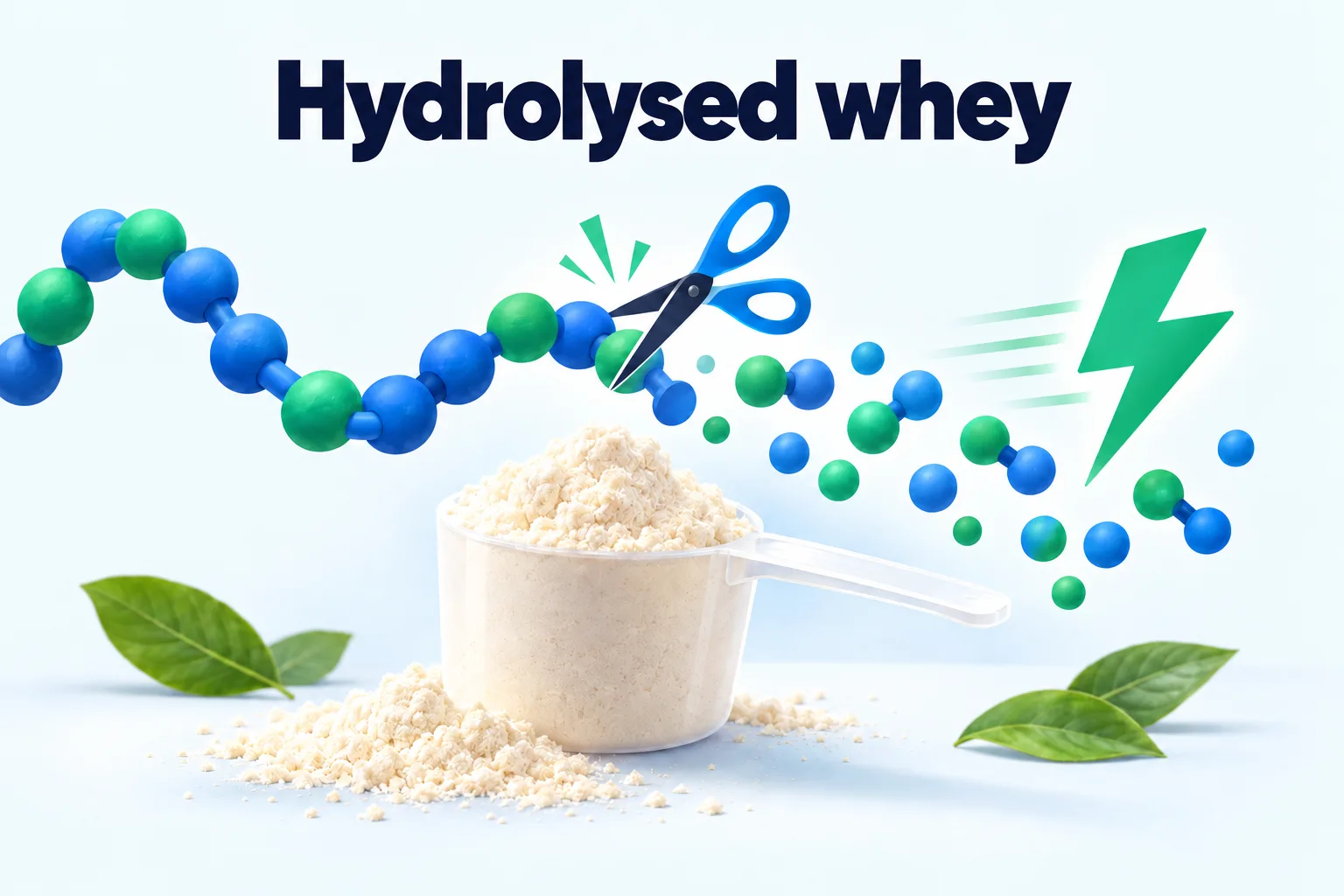
Hydrolysed whey (or whey hydrolysate) is a whey protein partly “pre-digested” by enzymes: the long protein chains are cut into shorter fragments, the peptides. MyProtein indeed describes its version as “partly pre-digested by enzymes”. The aim is to speed up digestion and the arrival of amino acids in the blood.
What hydro whey is made of
Like every whey, a hydrolysate is still made up of the whey proteins (beta-lactoglobulin, alpha-lactalbumin, immunoglobulins, serum albumin), simply cut up. Hydrolysis does not raise the protein content: a hydrolysed whey keeps roughly the composition of the whey it comes from, concentrate or, more often, isolate.
On the labels we recorded in October 2026, you find 75 g of protein per 100 g at Optimum Nutrition, 78 g at MyProtein and 80 g at BiotechUSA. The idea of a hydrolysed whey “at 90% protein” is therefore misleading: on a flavoured product as sold, you are closer to 75 to 80%.
⚖️ Hydrolysed, isolate or concentrate: the differences
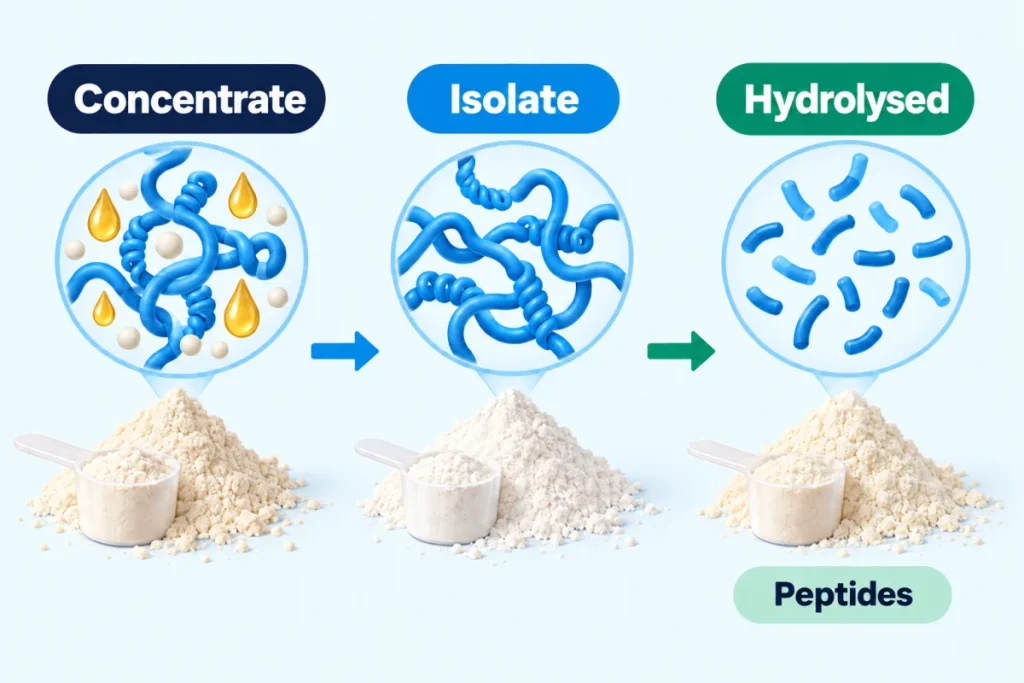
The only genuine difference with a hydrolysate is how fast it digests; for purity, what counts is the base used (isolate or concentrate). Here is our reading, built from the labels and the studies cited below. To go further on the other two forms, read our article on the differences between whey and isolate.
| Criterion | Whey concentrate | Whey isolate | Hydrolysed whey |
|---|---|---|---|
| Protein content | ★★★☆☆ | ★★★★★ | ★★★★☆ (depending on the base) |
| Speed of digestion | ★★★★☆ | ★★★★☆ | ★★★★★ |
| Low lactose | ★★☆☆☆ | ★★★★★ | ★★★★☆ (depending on the base) |
| Price per kilo | ★★★★★ | ★★★☆☆ | ★★☆☆☆ |
| Proven muscle results | ★★★★☆ | ★★★★☆ | ★★★★☆ |
The last row is the most important one: in an 8-week study on 56 trained men, the hydrolysate delivered no more muscle and no more strength than a whey concentrate (Lockwood et al., 2017). The hydrolysate group only lost slightly more fat mass than the placebo group, a result the authors say needs confirming.
🎯 Why take hydrolysed whey?
People who buy a hydrolysate are usually chasing one of two goals. In both cases, it is your total protein intake that produces the result, not the form of the whey.
1. For a controlled bulk
Building muscle takes three things: training properly, eating enough protein and sitting in a slight calorie surplus. The classic trap is pushing the surplus too hard and storing fat. A hydrolysed whey brings a lot of protein for few calories (141 kcal for 30 g of protein on the Platinum Hydrowhey), which helps keep the surplus in check. An isolate does the same job for less, though.
2. For cutting while holding on to muscle
When cutting, you stay in a calorie deficit while keeping protein high. The International Society of Sports Nutrition (ISSN) reckons 2.3 to 3.1 g of protein per kilo may be needed to preserve lean mass in a deficit in trained lifters (ISSN position stand, 2017). A low-calorie powder then makes that figure easier to reach, hydrolysed or isolate alike.
3. For recovering between two close sessions
This is the one area where a hydrolysate has a small argument of its own. In an Australian trial, muscle strength returned to normal within 6 hours with 25 g of hydrolysed isolate, but not with 25 g of standard isolate (Buckley et al., 2010). The study had only 6 people in the hydrolysate group: an interesting lead for anyone training twice a day, not definitive proof.
💶 Why does hydro whey cost so much?
If hydrolysed whey costs so much, it is mostly down to the extra manufacturing step. The whey is obtained from a concentrate or, more often, an isolate, whose proteins are then cut up by enzymes. That treatment adds cost without adding protein.
In practice, reckon on around €58 to €64 per kilo for the big brands (recorded in October 2026 on the official websites): about €103 for 1.6 kg of Optimum Nutrition’s Platinum Hydrowhey and about €105 for 1816 g of BiotechUSA’s Hydro Whey Zero. MyProtein is the exception with an unflavoured hydrolysate at around €41 per kilo on promotion (struck-through price around €55).
🏆 The best hydrolysed wheys on the market
We took the four hydrolysates from the first version of this article and compared their official product pages. Read the ingredients list carefully: some “hydro” powders are only partly hydrolysed.
| Product | Protein / 100 g | Share of hydrolysate | Price per kilo | Composition |
|---|---|---|---|---|
| Platinum Hydrowhey (Optimum Nutrition) | ★★★☆☆ (75 g) | ★★★★★ | ★★☆☆☆ | ★★★☆☆ |
| Hydrolysed Whey Protein (MyProtein) | ★★★★☆ (78 g) | ★★★★★ | ★★★★☆ | ★★★★★ |
| 100% Whey Hydro Isolate (Prozis) | ★★★★★ (89 g) | ★★☆☆☆ | not recorded | ★★★☆☆ |
| Hydro Whey Zero (BiotechUSA) | ★★★★☆ (80 g) | ★★★☆☆ | ★★★☆☆ | ★★★☆☆ |
Platinum Hydrowhey, by Optimum Nutrition
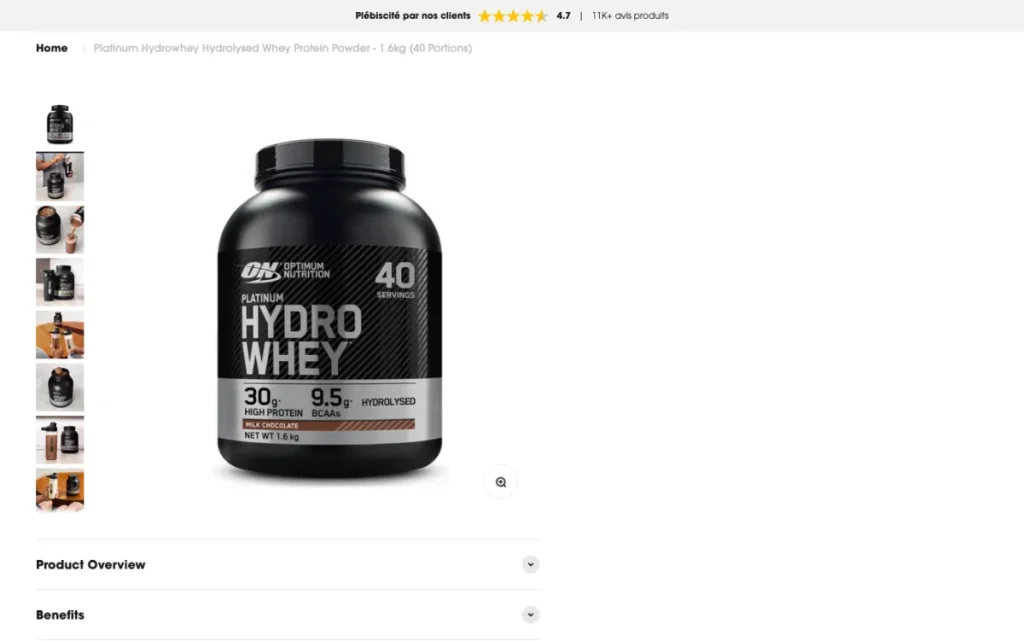
The long-standing benchmark in this segment: a 100% hydrolysed whey isolate, with 30 g of protein and 9.5 g of BCAAs per 40 g serving. In exchange, the content drops to 75 g per 100 g, it contains sucralose and acesulfame K, and it is among the dearest per kilo. See the Platinum Hydrowhey by Optimum Nutrition.
Hydrolysed Whey Protein, by MyProtein
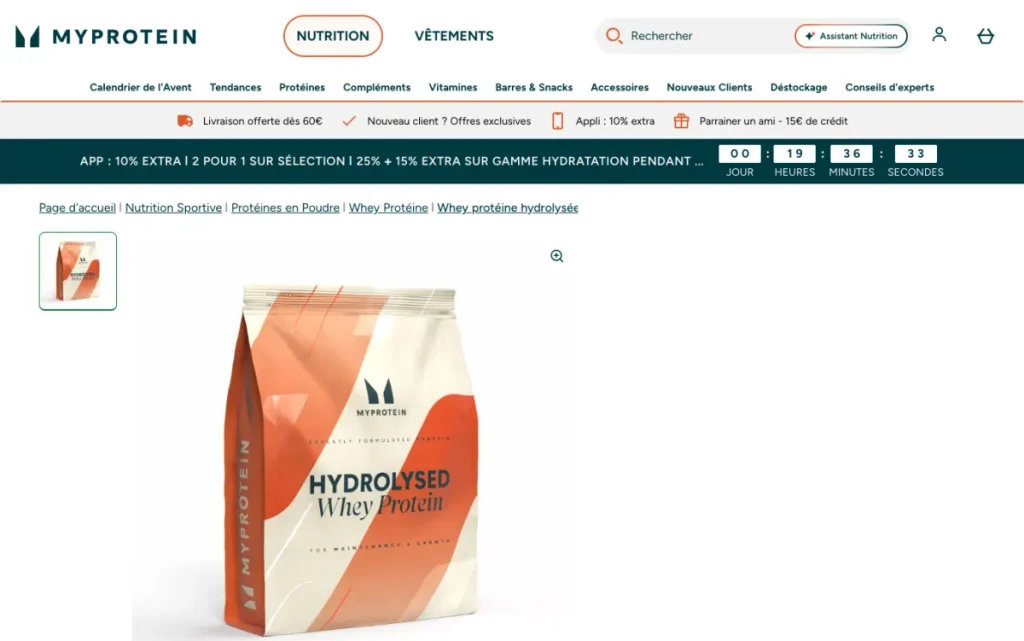
The best value in the category: a single protein ingredient (hydrolysed whey protein) plus sunflower lecithin, 23 g of protein per 30 g serving, with no flavouring or sweetener. As it is unflavoured, it is best mixed into a smoothie or a yoghurt. See the MyProtein hydrolysed whey.
100% Whey Hydro Isolate, by Prozis
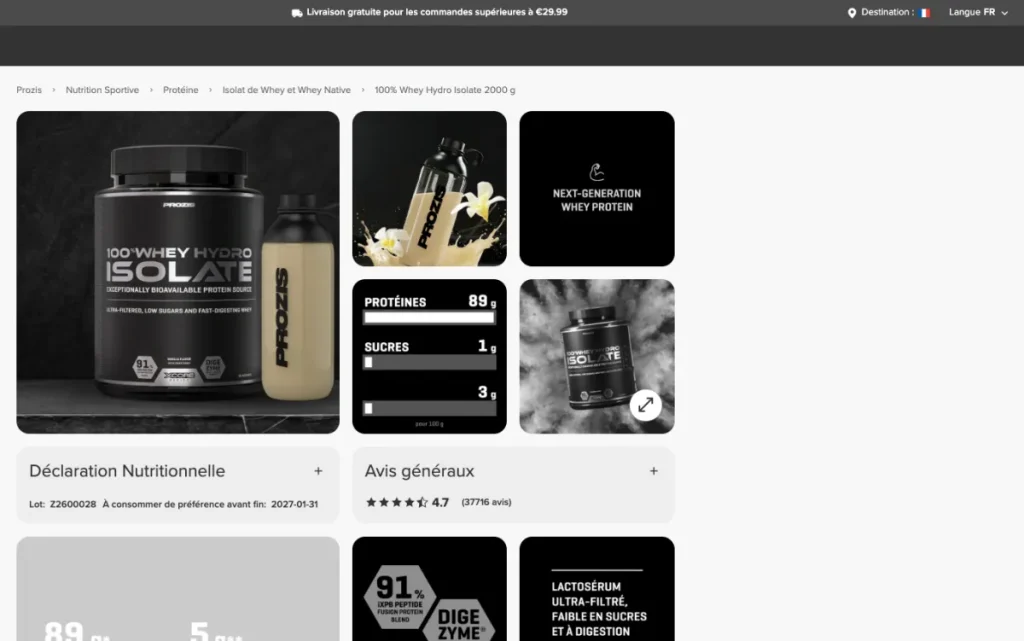
On paper, the highest dosed: 89 g of protein per 100 g according to its Open Food Facts entry. But its ingredients list mixes whey isolate, concentrate and hydrolysate: this is not a pure hydrolysate, more an isolate enriched with hydrolysate, with acesulfame K and sucralose. See the 100% Whey Hydro Isolate by Prozis.
Hydro Whey Zero, by BiotechUSA
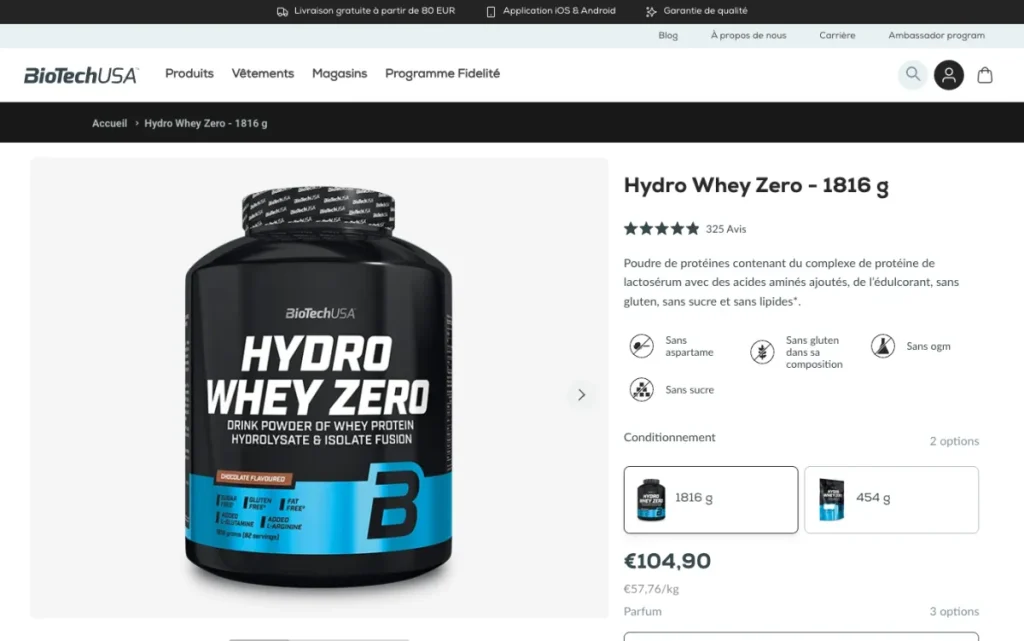
A sugar-free, gluten-free formula at 80 g of protein per 100 g (18 g per 22 g serving), enriched with L-glutamine and L-arginine. Here too, the hydrolysate accounts for only 41 to 43% of the formula, topped up with isolate; it is sweetened with sucralose. See the Hydro Whey Zero by BiotechUSA.
🔬 Our method
We did not have these powders analysed in a laboratory. We compared the official product pages as recorded in October 2026 (protein per 100 g, ingredients list, actual share of hydrolysate, sweeteners, price per kilo), plus the Open Food Facts entry for Prozis, whose own page did not show its composition. The effects on muscle come from the published studies cited in the article, not from our own impressions.
✅ Our verdict: which hydrolysed whey should you choose?
If you want a genuine hydrolysate at the best price, take MyProtein’s; if you want a flavoured hydrolysate ready to drink, the Platinum Hydrowhey is still the most accomplished. Prozis and BiotechUSA are good powders, but buy them knowing they are blends.
In our view, hydrolysed whey is not for you if you are starting out, if your budget is tight or if a standard whey already suits you: you will pay more for an identical muscle result. It makes sense if an isolate bloats you, or if you stack sessions very close together. And it is still a milk protein: if you are allergic to milk protein, it is ruled out, like every whey.
🥤 How should you take your hydrolysed whey?
You use it exactly like a standard whey. Work out what you are short of first: (body weight in kg x 1.6) minus the protein in your diet, then divide by the grams of protein in one serving. The 1.6 g per kilo benchmark comes from a meta-analysis of 49 studies: beyond that, lean mass gains stopped increasing (Morton et al., 2018). The detail is in our article on how much whey protein per day.
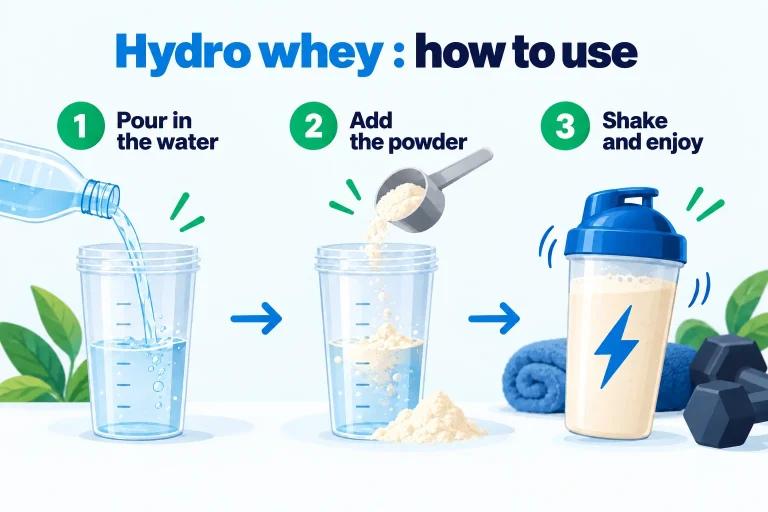
As for timing, do not overthink it: before or after your session both work, as long as you hit your daily total. On the liquid side, water keeps the shake light; milk adds calories, which works against the point of a hydrolysate when cutting (see our guide to the shaker and to the whey to water ratio). The full step-by-step instructions are here:
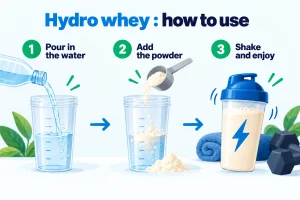 Read nextHow to Use Hydrolysed Whey: The 4-Step Guide
⚠️ Watch out
Anses advises against sports supplements for children, teenagers, pregnant or breastfeeding women and people with kidney, liver or heart disease. If any of that applies to you, or if you are on medication, ask a doctor before taking whey, hydrolysed or not.
🔄 Are there more affordable alternatives?
Whey isolate
A hydrolysate may be made from isolate, or not. A good isolate often offers a better protein to calorie ratio for less money, with very little lactose. It is the alternative we recommend to most readers: compare the best whey isolates, or see whether native whey or isolate suits you better.
Whey concentrate
A concentrate does not really compete with a hydrolysate on purity: it carries more calories and less protein. But if your goal is to put on mass without paying much and you digest milk well, it is the most cost-effective choice, and the Lockwood study shows equivalent muscle gains. To decide, our guide on which whey protein to choose helps you by profile.
❓ Frequently asked questions
What is the difference between hydrolysed whey and whey isolate?
An isolate is a heavily filtered whey, a hydrolysate is a whey (often an isolate) whose proteins have also been cut into peptides. The isolate stands out for its purity, the hydrolysate for its speed of digestion. On muscle over the long run, studies show no clear advantage for the hydrolysate.
What is hydrolysis for?
Hydrolysis pre-digests the proteins using enzymes, so the amino acids reach the blood faster after your shake. It does not make the powder richer in protein, and it adds a manufacturing step that explains the price.
Is hydrolysed whey dangerous?
For a healthy adult sticking to the stated doses, there is nothing to suggest it is riskier than any other whey. In people without kidney disease, Anses notes that harmful effects of a high protein intake on the kidney have not been demonstrated. If you have kidney disease or diabetes, are pregnant or are on medication, ask your doctor.
Is hydrolysed whey suitable for lactose intolerant people?
Often yes, if it is made from isolate, because isolate contains very little lactose. Check the lactose content on the label, because hydrolysis itself does not remove lactose. A milk protein allergy, on the other hand, remains a contraindication.
📚 Sources
- Lockwood et al. (2017), hydrolysed whey versus other wheys over 8 weeks of resistance training
- Buckley et al. (2010), whey hydrolysate and strength recovery
- ISSN position stand on protein and exercise (2017)
- Morton et al. (2018), meta-analysis on protein supplementation
- Anses opinion on food supplements for athletes (2016) (in French)