Contents 10 sections
- Is whey protein dangerous? The risks at a glance
- Is whey protein dangerous for the kidneys
- Is whey protein dangerous for the liver
- Digestion, lactose and milk allergy
- Does whey protein cause acne
- Contaminants, additives and powder quality
- How to take whey protein safely
- Low-lactose and milk-free protein powders
- Our verdict: should you be afraid of whey protein
- Frequently asked questions
What is your main goal?
How do you digest dairy?
What matters most to you?
Summarise this article with:
💡 The essentials
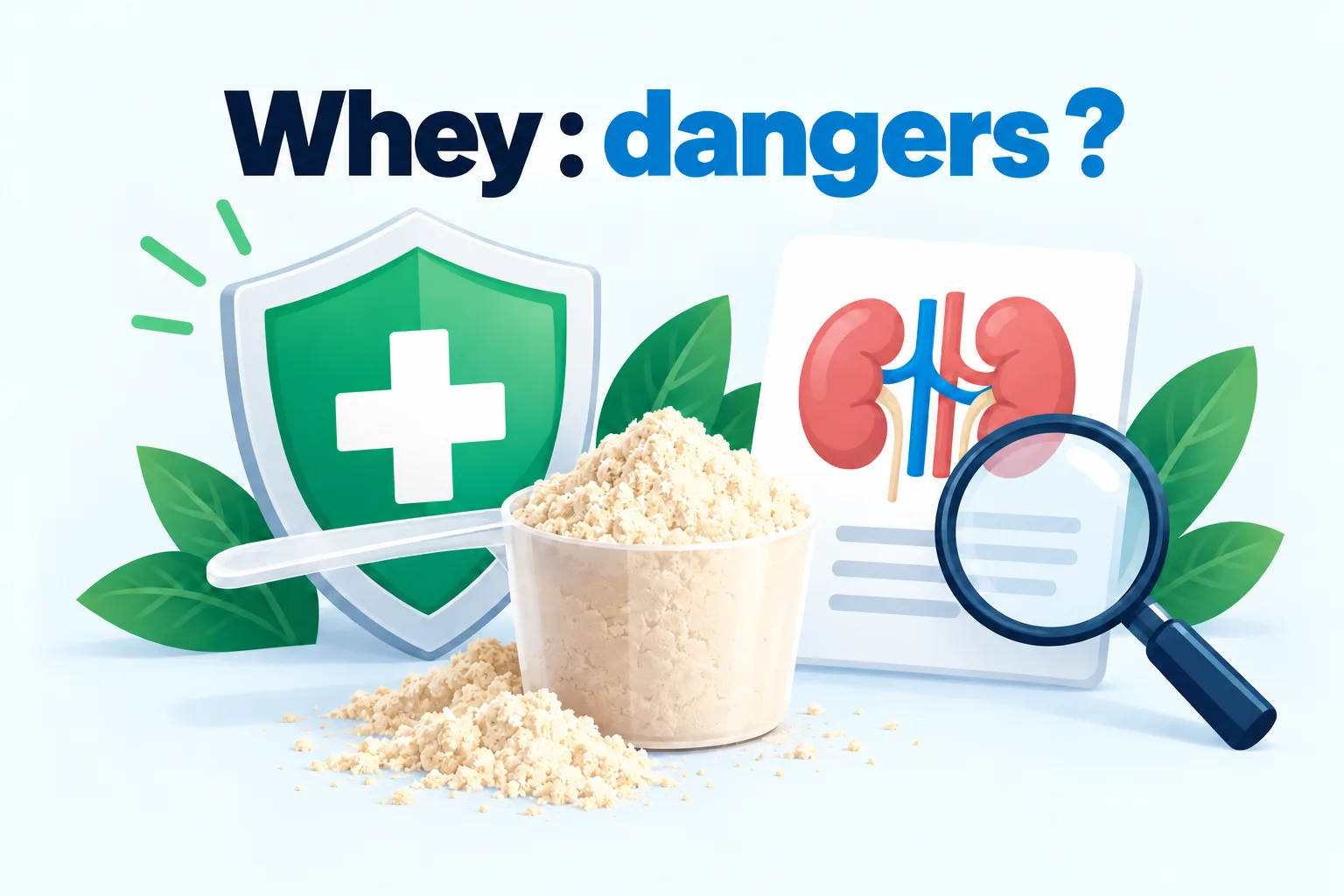
In a healthy adult who sticks to a sensible dose, the studies show no danger from whey protein for the kidneys. The real risks lie elsewhere, and they mainly concern certain profiles.
- Avoid without medical advice: kidney disease or liver disease, heart disease, pregnancy, breastfeeding, children and teenagers.
- Avoid full stop if you are allergic to milk proteins.
- Points to watch: chronic excess, digestive trouble (lactose), acne in some people, contaminants depending on the brand.
“Whey wrecks your kidneys.” Every lifter has heard it at some point. Whey, or whey protein, is a milk protein concentrated into a powder: there is nothing of the doping product about it, but that does not mean it suits everybody, or that any dose will do.
This guide sorts the picture out, risk by risk, between what the studies actually show, what is no more than an association and what is a myth. If you use an isolate, the points specific to that type of whey are set out in whey isolate: what are the dangers.
🔬 Our method
We carried out no laboratory analysis and no trial of our own. We read the opinions of ANSES, the French food safety agency (protein reference intakes from 2007, sports supplements in 2016 and 2024), the EFSA reference values, meta-analyses and reviews published in peer-reviewed journals (kidneys, acne, adverse effects of whey), a randomised trial on acne and the results of the Consumer Reports tests. Every figure in this article comes from one of those sources.
⚖️ Is whey protein dangerous? The risks at a glance
| Risk | What the sources say | Who is concerned |
|---|---|---|
| Kidneys | No adverse effect of a high protein intake in a healthy adult | People with kidney disease |
| Liver | Effects reported above all with chronic, excessive and unsupervised use | Prolonged excess, liver disease |
| Digestion | Bloating, gas and diarrhoea linked to lactose | People who are lactose intolerant |
| Allergy | Reaction to milk proteins, not to lactose | People allergic to milk proteins |
| Acne | Associated with dairy products in observational studies, no worsening in a 6-month trial | People prone to acne |
| Contaminants | Lead detected in protein powders, with no immediate risk | Daily use of a poorly controlled product |
🫘 Is whey protein dangerous for the kidneys?
This is the most widespread fear, and the best studied one. A meta-analysis of 28 trials published in 2018 (1,358 participants) concludes that high-protein diets (at least 1.5 g/kg/day, or 100 g a day) do not impair kidney filtration in a healthy adult. That finding does not apply to people living with kidney disease.
The agencies point the same way. EFSA considers an intake equal to twice the reference value (around 1.7 g/kg/day) to be safe in adults, and ANSES (in French) judges intakes of up to 2.2 g/kg/day satisfactory in an adult under 60 whose kidney function is normal. Those figures cover your whole diet, not just the powder: see how much whey protein per day to work out your own share.
🧪 Is whey protein dangerous for the liver?
There is less data here than for the kidneys. A systematic review from 2021 went back over 11 pieces of work: most of them link the harmful effects of whey to chronic, excessive and unsupervised use, with the kidneys and the liver as the organs most affected. The authors note that those effects are made worse by a sedentary lifestyle, and they call for further studies.
So the message is not “whey damages your liver”, but “prolonged excess with no sporting reason behind it is not harmless”. ANSES does in fact advise against sports supplements without medical advice where liver or kidney function is impaired.
🥛 Digestion, lactose and milk allergy
The most common side effect is digestive. According to the French national health insurance service (in French), 30% to 50% of adults in France digest lactose incompletely, which can bring on gas, bloating, cramps or diarrhoea 30 minutes to 2 hours after a serving. A whey concentrate contains lactose; a whey isolate, filtered more finely, typically contains only 0.5% to 1% of it under the American Dairy Products Institute standard.
Allergy is a different matter. An allergy to cow’s milk proteins involves the immune system and can produce respiratory or skin symptoms, on top of digestive trouble. Removing the lactose achieves nothing in that case: every whey, isolate included, is to be avoided, and only milk-free proteins will do (see the list further down).
😣 Does whey protein cause acne?
Dairy products are among the dietary factors associated with acne in a 2021 review, and a meta-analysis of observational studies (2019) links a high intake of milk, even skimmed milk, to more acne. But an association does not prove that milk causes acne, and those studies are not about whey powder itself.
The only randomised trial we found on the question is rather reassuring: 30 g of whey a day for 6 months did not make acne worse in men who already had acne, compared with a whey-free supplement (trial published in 2024). It is still small (49 participants) and limited to men: if you get a flare-up, talk to a dermatologist about it.
☣️ Contaminants, additives and powder quality
In October 2025, Consumer Reports tested 23 protein powders and drinks: more than two thirds went over its own alert threshold of 0.5 µg of lead a day, per serving, and plant proteins contained on average nine times more of it than dairy proteins. No product came close to a level able to do immediate harm: the issue is repeated exposure over months.
These American tests do not target specific French brands, but they do show that the label tells you nothing about contaminants: only analyses published by the brand can do that. On additives, read the ingredients list: flavourings, sweeteners and thickeners can also explain digestive discomfort. The detailed results of the contamination tests are in our article on the dangers of whey isolate.
⚠️ Watch out
ANSES advises against sports supplements without medical advice for people with cardiovascular risk factors or heart disease, impaired kidney or liver function, neuropsychiatric disorders, as well as for children and teenagers and for women who are pregnant or breastfeeding. If you are allergic to milk proteins, whey is to be ruled out altogether.
✅ How to take whey protein safely
- Work out your total requirement: ANSES advises strength athletes who want to build muscle not to go beyond 2.5 g/kg/day, for six months at most, with two thirds of that coming from food.
- Choose a product that complies with the European standard EN 17444, as ANSES recommended in 2024, and a brand that publishes its analyses.
- Avoid stacking several supplements, or combining them with medicines, without advice.
- Be wary of buying online outside controlled channels; see our guide to where to buy whey protein.
- Keep whey in its place: it is a supplement, not a meal replacement. The label is explained line by line in the composition of whey protein.
🌱 Low-lactose and milk-free protein powders
If lactose bothers you, an isolate is often enough; if you are allergic to milk, you need a milk-free protein. Here are the main families, with one example of each:
- Plant proteins (milk-free): for example the Protéine Végétale Bio from NUTRIPURE. Since the Consumer Reports tests found more lead on average in plant powders, check that the brand publishes its analyses.
- Whey isolate (very low in lactose but still made from milk: avoid it if you have an allergy): for example the Whey Isolate Premium from YAM NUTRITION.
- Beef proteins (milk-free): for example the Beef Protein Isolate 97 from BULK.
- Egg proteins (milk-free, to be avoided if you are allergic to egg): for example Egg Protein from NUTRIMUSCLE.
To compare specific isolates, see our ranking of the best whey isolate, and for powder-free options, our guide to whey protein alternatives.
🎯 Our verdict: should you be afraid of whey protein?
No, not if you are a healthy adult, you dose it according to your needs and you pick a properly controlled brand. The fears about the kidneys are not confirmed in that context, and whey remains a practical way of topping up your protein. The real danger is prolonged excess, poor quality and self-medication in people who are vulnerable.
Whey is not for you if you are allergic to milk proteins, and it is not to be taken without medical advice if you have kidney, liver or heart disease, if you are pregnant or breastfeeding, or if you are under 18. We also think it is pointless if you already cover your needs at the table. The other received ideas have articles of their own: whey protein and cancer and does whey protein make you fat.
❓ Frequently asked questions
Is it good to take whey protein every day?
Yes, for a healthy adult whose diet does not cover their protein requirement. Taking it daily is not a problem in itself; what you need to keep an eye on is your total protein for the day.
Is whey protein good for your health?
It is a quality protein source, not a “health” product in its own right. The only claims authorised in the European Union for proteins concern the maintenance and growth of muscle mass and the maintenance of normal bones.
Is whey protein chemical or natural?
Whey comes from the liquid left over once cheese has been made, with part of the non-protein components stripped out of it. Flavoured versions add flavourings and sweeteners, listed on the label. The process is set out in detail in what is whey protein.
Is whey protein dangerous for the heart?
The cardiovascular effects reported to ANSES mostly concern sports supplements in general, bulking and weight-loss products in particular, rather than whey specifically. If you have heart disease or risk factors, the agency advises against these supplements without medical advice.
Does whey protein cause cancer?
No study in humans shows that whey powder causes cancer. The data we have is about dairy products in general and remains a set of associations; we go into it in our article on whey protein and cancer.
📚 Sources
- Devries et al., high-protein diets and kidney function, meta-analysis, J Nutr 2018
- Vasconcelos et al., potential adverse effects of whey protein, systematic review, 2021
- Sompochpruetikul et al., whey protein and acne in men, randomised trial, J Dermatol 2024
- ANSES, food supplements for athletes: risks to health and uncertain benefits, 2016
- Consumer Reports via KPBS, lead in protein powders, 2025