Contents 5 sections
What is your main goal?
How do you digest dairy?
What matters most to you?
Summarise this article with:
💡 The essentials
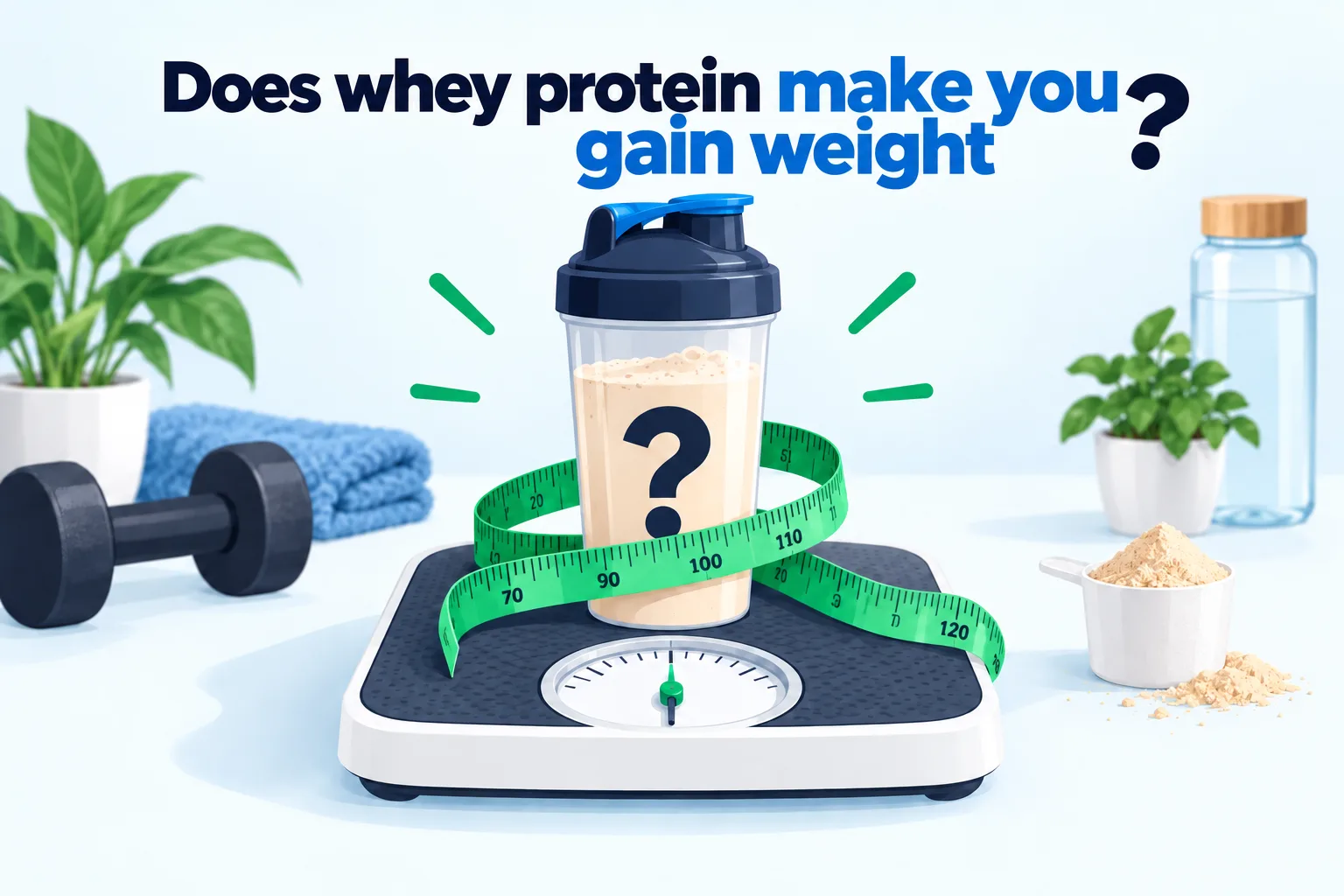
No, whey does not make you fat in itself: what puts fat on is a calorie surplus across the day, whatever it comes from. A 30 g serving brings around 115 kcal.
- Added on top of meals that were already enough, it can feed a surplus, exactly like any other food.
- Used instead of a sugary snack, it tends to help you stick to a diet.
- Alongside weight training, the scales can go up because you are gaining muscle, not fat.
“Careful, whey makes you fat!” You have almost certainly heard that line, usually from someone who mistakes a protein powder for a miracle product. Whey is nothing more than concentrated milk protein: it has no special power to store fat.
And yet the line is not completely wrong. Depending on how you use it, whey can send the scales up, send them down, or change nothing at all. Here is how to tell the three cases apart, with what the studies actually show.
⚖️ Does whey make you fat? What really drives weight gain
You put on fat when you eat more calories than you burn, over several weeks. This energy balance principle applies to whey just as it does to bread, cheese or chocolate: no single food makes you fat on its own, it is the day’s total that counts.
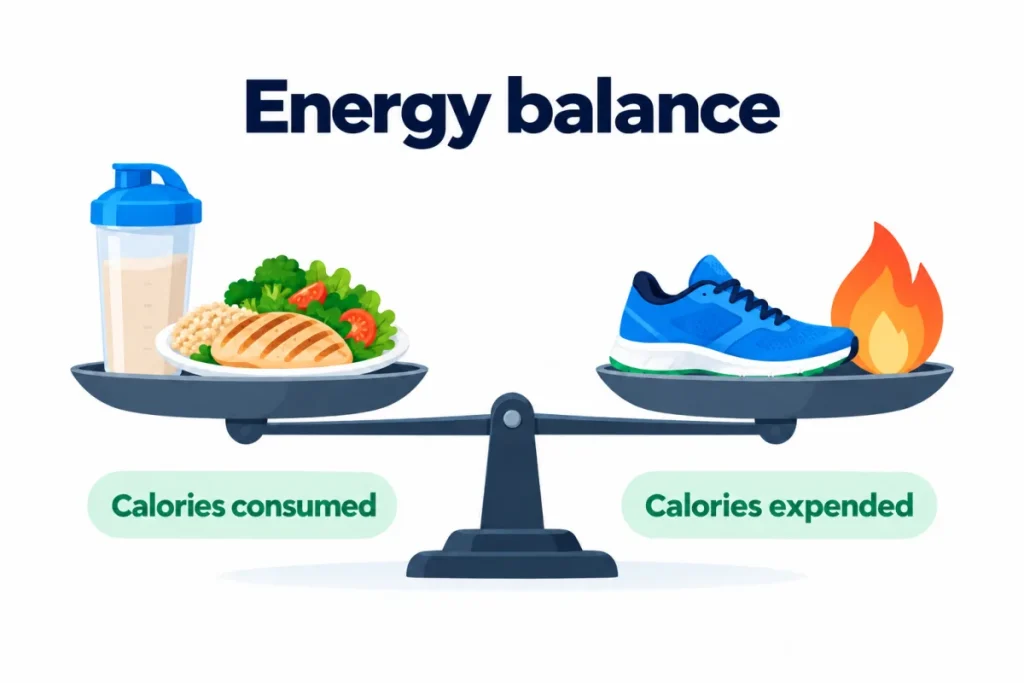
A 30 g serving of whey with water comes to roughly 115 kcal. Add two shakes a day to a diet that was already in balance and you create a surplus of about 230 kcal a day: over time, part of that will end up as fat if you are not training. The full calorie breakdown by type of whey and by liquid is in our article on whey protein calories.
💪 Why the scales can go up (and it is not fat)
If you lift weights, part of the weight you gain is muscle. That is exactly why so many lifters take whey in the first place: hitting their protein target more easily while bulking.
The effects stay measured, though. In the meta-analysis by Morton et al. (2018, 49 trials), adding protein to a resistance training programme brought an average of 0.30 kg of extra lean mass over the length of the studies, with a plateau around 1.6 g of protein per kilo per day. Nobody balloons in a few weeks thanks to a powder: if the scales are running away with you, look at the rest of your plate.
What about the belly? Whey does not target abdominal fat, but a bloated stomach after a shake usually comes down to lactose, which is mostly found in concentrate wheys. If that is you, an isolate, which contains far less of it, often solves the problem. The other possible side effects are set out in our guide to whey protein: what are the dangers?
📉 When whey actually helps you lose weight
Used inside a controlled diet, whey is linked to a small loss of fat and to better muscle retention. The meta-analysis by Wirunsawanya et al. (2018), which pools 9 trials in overweight or obese people, finds an average of 0.56 kg less body weight and 1.12 kg less fat mass compared with the control groups.
Two mechanisms explain part of that. Protein is the nutrient whose digestion “costs” the most energy, after alcohol, according to the review by Westerterp (2004), and that effect feeds into satiety. On appetite, a 2017 meta-analysis concludes there is a modest drop in hunger over the long run, with no clear difference from carbohydrates in the short term.
Let us stay honest: in 2010 the EFSA rejected the claims that whey helps with satiety or with maintaining a normal body weight, for lack of sufficient evidence. Whey makes a high-protein diet easier to run, it does not make you slim on its own. For how to put that into practice, read whey protein and weight loss.
A word on insulin, which often gets blamed for fat storage. Whey does push insulin up, but it raises blood glucose less than white bread does: in the study by Nilsson et al. (2004), a meal with whey produced a much lower blood glucose response than the reference bread, with higher insulin. That mechanism is not enough to prove an effect on fat storage, in either direction.
🔬 Our method
We ran no test of our own: we rely on published meta-analyses and reviews (Morton 2018, Wirunsawanya 2018, Mollahosseini 2017, Westerterp 2004, Nilsson 2004), on the EFSA position on whey health claims, and on manufacturers’ labels for the calorie figures.
🥛 Which whey and which liquid to avoid putting on fat?
Your choice of liquid matters more than your choice of whey. A serving in 250 ml of semi-skimmed milk adds about 120 kcal, in whole milk about 165 kcal, against 0 with water (Ciqual values). If you are watching your waistline, water remains the best option, while milk keeps its place when you are bulking.
On the powder itself, a whey isolate brings slightly more protein and slightly fewer carbohydrates for the same calories than a concentrate: the gap is real but modest. Our round-up of the best whey protein for weight loss ranks the most suitable options, and our selection of the best whey isolate goes into the isolates in detail. A hydrolysed whey is not any lower in calories: its selling point is digestion, not your waistline.
- To avoid putting on fat: let the whey replace a snack, rather than sitting on top of everything you already eat.
- To build muscle: a slight surplus, regular training and enough protein, see how much whey protein per day.
- To gain weight fast: that is a mass gainer’s job, not a whey’s, see whey vs mass gainer.
💡 Our verdict
In our view, whey is one of the least “fattening” supplements there is, as long as you count it in your calories. It makes sense if you struggle to hit your protein target from food alone, whether you are cutting or bulking. It makes far less sense if you already eat plenty of protein and you add it “for your health” without training: you are paying for calories you do not need. We cover that case in taking whey protein without working out.
❓ Frequently asked questions
Does whey give you a belly?
No, whey does not store fat around the stomach in particular. A bloated belly right after a shake is more likely to come from lactose, or from drinking it down too fast. An isolate, lower in lactose, is often better tolerated.
Why do people say whey makes you lose weight?
Because a high-protein diet helps you hold on to muscle and can take the edge off your appetite during a diet. The studies show a modest effect in overweight people, and the EFSA has authorised no “slimming” claim for whey. The calorie deficit is what makes you lose weight.
Is it fine to take whey every day?
Yes, for a healthy person, one or two servings a day counted into your diet poses no problem. The EFSA considers a protein intake of up to twice the 0.83 g per kilo reference value to be safe in adults. If you have kidney disease, ask your doctor first.
Can I take whey without doing any sport?
Yes, if your diet is short on protein, but without training it will not build any muscle. Taken on top of meals that were already enough, it simply adds calories. We go into that case in whey without exercise.
📚 Sources
- Wirunsawanya et al. (2018), meta-analysis of whey and body composition in overweight people
- Morton et al. (2018), meta-analysis of protein and muscle gains in resistance training
- Westerterp (2004), review of diet-induced thermogenesis
- Nilsson et al. (2004), blood glucose and insulin after milk protein meals
- NutraIngredients (2010): whey claims rejected by the EFSA (satiety, normal body weight)