Contents 8 sections
What is your main goal?
How do you digest dairy?
What matters most to you?
Summarise this article with:
💡 The essentials
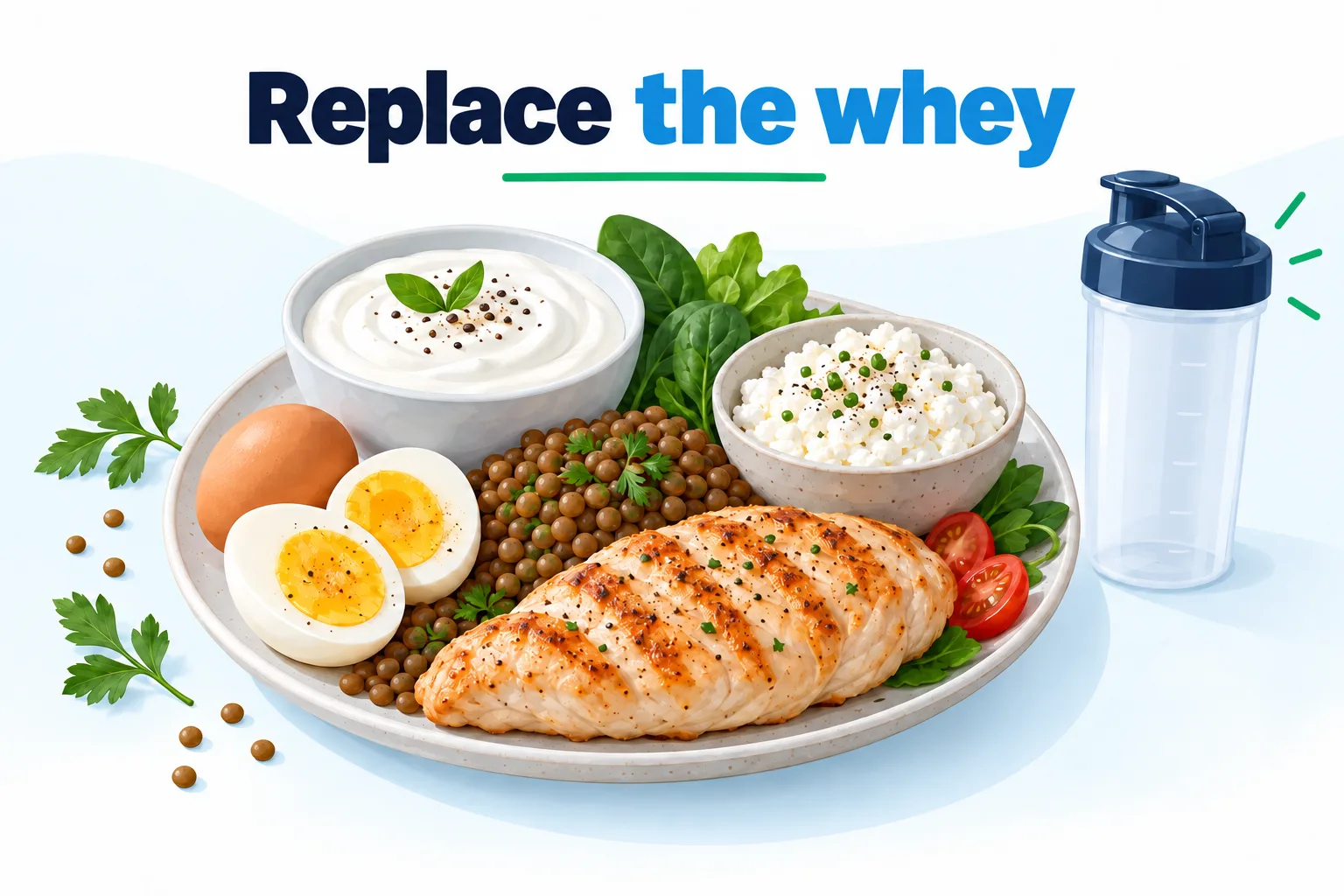
You can replace whey with food or with another powder: whey is not essential, it is your total protein intake that counts.
- Closest foods: chicken breast, tinned tuna in water, fromage blanc 0% (a plain French fresh white cheese, close to quark): plenty of protein, few calories.
- Powders: casein if you tolerate milk, a plant blend (pea plus rice) if you are vegan, egg white powder.
- Avoid as a substitute: BCAAs on their own and mass gainers, which do not replace a real protein source.
Difficult digestion, a vegan choice, a tight budget or simply the urge to eat “real” food: there are serious alternatives to whey, as long as you compare what they actually deliver. This guide puts a protein-per-100-g figure on every option, taken from the official ANSES Ciqual table (in French) and from the manufacturers’ own labels.
🎯 What a whey protein alternative has to deliver
Whey has four strengths: a lot of protein for very few calories, a complete set of essential amino acids, a drink ready in 30 seconds and a reasonable cost. One serving of Myprotein Impact Whey (30 g), for instance, gives you 22 g of protein for 114 kcal. To understand where those strengths come from, read what whey protein does.
The ISSN position stand on protein and exercise puts it plainly: supplements are a convenient way of reaching your requirements, but whole food remains the first choice. Replacing whey with food is therefore no second-best option.
🍗 Foods that replace whey: protein per 100 g
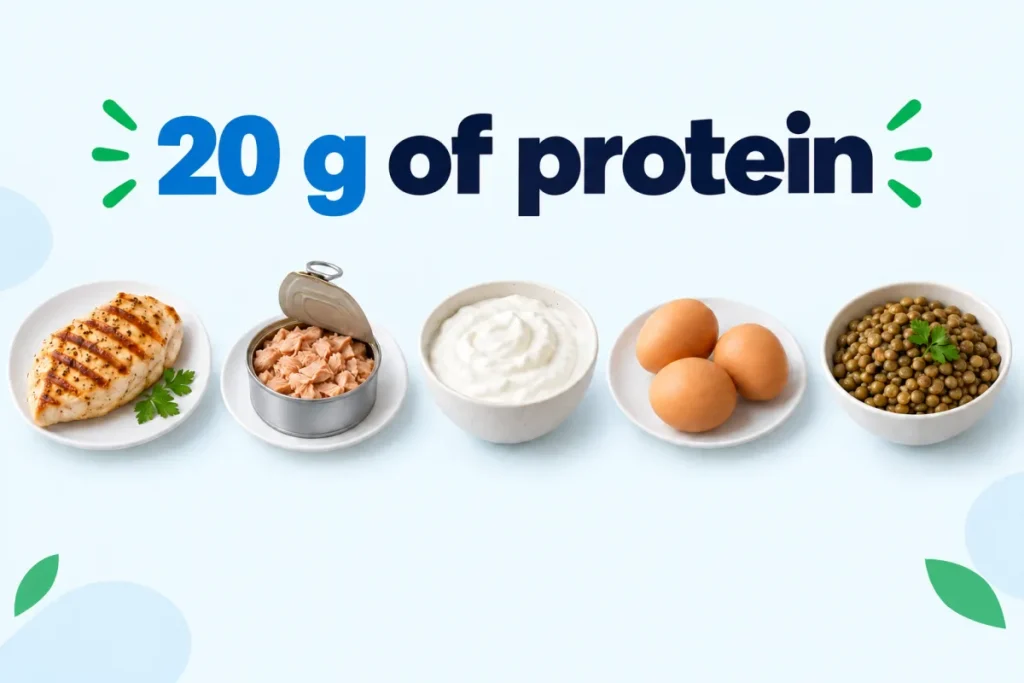
For each food, the table gives the amount you need to eat to get 20 g of protein, the equivalent of one serving of whey, and the calories in that portion. Ciqual 2020 values, per 100 g of food as eaten.
| Food | Protein / 100 g | kcal / 100 g | Portion for 20 g of protein | kcal in the portion |
|---|---|---|---|---|
| Whey concentrate (reference, Impact Whey label) | 72 g | 380 | 27 g of powder | 104 |
| Skinless chicken breast, pan-fried | 30.1 g | 141 | 66 g | 94 |
| Tinned tuna in water, drained | 26.8 g | 111 | 75 g | 83 |
| Beef mince, 5% fat, cooked | 25.5 g | 155 | 78 g | 122 |
| Salmon, grilled or pan-fried | 25.5 g | 223 | 78 g | 175 |
| Premium cooked ham, rind and fat removed | 20.3 g | 119 | 99 g | 117 |
| Emmental | 27.9 g | 373 | 72 g | 267 |
| Hard-boiled egg | 13.5 g | 134 | 148 g (about 3 eggs) | 199 |
| Fromage blanc, plain, 0% | 7.95 g | 49 | 252 g | 124 |
| Seitan | 20.6 g | 134 | 97 g | 130 |
| Plain tofu | 13.4 g | 148 | 149 g | 221 |
| Green lentils, cooked | 10.1 g | 127 | 198 g | 251 |
| Chickpeas, cooked | 8.3 g | 147 | 241 g | 354 |
| Plain soy drink | 3.3 g | 37 | 604 ml | 224 |
The best stand-ins “calorie for calorie” are tinned tuna in water, chicken breast and fromage blanc 0%: they come close to whey, and in places beat it. Pulses and tofu are valuable too, but you need bigger portions, and therefore more calories, for the same protein hit.
🥄 The powders that can replace whey
Casein
This is the other milk protein, digested more slowly than whey, which makes it the classic alternative for the evening. Myprotein’s micellar casein lists 82 g of protein per 100 g, so 23 g per 30 g serving for 107 kcal. It does contain milk: not an option if you have the allergy. The full head-to-head: casein or whey.
Plant protein (pea, rice, soy)
An analysis by Gorissen et al. (2018) shows that plant proteins contain fewer essential amino acids than whey (43% for whey, 21 to 22% for oat, lupin or wheat), and are often short of lysine or methionine. The good news: a blend of several sources, typically pea plus rice, gets close to the profile of animal proteins. Dose for dose, whey still beats soy on muscle protein synthesis after training (+31% in the Tang et al. study, 2009).
Egg white and milk powder
Egg white powder is the most concentrated substitute of all: 81.2 g of protein per 100 g (Ciqual), with no lactose, and it is ideal for baking. Skimmed milk powder works as well, but it is far less dense: 35.3 g of protein and 361 kcal per 100 g, which comes out at roughly 57 g of powder and 205 kcal for 20 g of protein, carrying all the lactose of milk with it.
BCAAs and mass gainers: false substitutes
BCAAs deliver only 3 of the 9 essential amino acids, when it is the full set of essential amino acids that drives muscle protein synthesis: on their own, they do not replace a protein source. A mass gainer, meanwhile, is mostly a carbohydrate hit; it answers a different need, which we set out in whey or mass gainer.
📊 The whey alternatives compared
| Alternative | Protein / 100 g | Low in calories | Convenience | Amino acids |
|---|---|---|---|---|
| Whey (reference) | ★★★★★ | ★★★★★ | ★★★★★ | ★★★★★ |
| Casein | ★★★★★ | ★★★★★ | ★★★★★ | ★★★★★ |
| Egg white powder | ★★★★★ | ★★★★★ | ★★★☆☆ | ★★★★☆ |
| Plant protein (blend) | ★★★★☆ | ★★★★☆ | ★★★★★ | ★★★☆☆ |
| Tinned tuna in water / chicken breast | ★★★☆☆ | ★★★★★ | ★★★☆☆ | ★★★★★ |
| Fromage blanc 0% | ★☆☆☆☆ | ★★★★☆ | ★★★★☆ | ★★★★★ |
| Eggs | ★★☆☆☆ | ★★★☆☆ | ★★★☆☆ | ★★★★★ |
| Lentils, tofu | ★★☆☆☆ | ★★☆☆☆ | ★★☆☆☆ | ★★★☆☆ |
| BCAAs on their own | ☆☆☆☆☆ | ★★★★★ | ★★★★★ | ★☆☆☆☆ |
Casein matches whey point for point on these criteria; its only difference is the slower digestion, which changes nothing at all as long as you hit your total intake.
💶 What does 20 g of protein cost?
To compare honestly, work out the price of 20 g of protein: price per kilo × 2 ÷ protein per 100 g. With Myprotein Impact Whey listed at €38.99 for 900 g (72 g of protein per 100 g), 20 g of protein costs you around €1.20. With the same brand’s micellar casein (€44.99 for 900 g, 82 g per 100 g), around €1.22 (promotional prices checked in October 2026).
Apply the same formula to the prices in your own shop: dried pulses, eggs and fromage blanc are often very competitive, but prices swing too much from one retailer to the next for us to hand you a single figure.
🍳 A sample high-protein day, with no whey
- Breakfast: a 3-egg omelette (about 150 g of egg): roughly 19 g of protein.
- Lunch: 120 g of pan-fried chicken breast, rice and vegetables: roughly 36 g of protein from the chicken alone.
- Snack: 250 g of fromage blanc 0% and a piece of fruit: roughly 20 g of protein.
- Dinner: 100 g of grilled salmon and 200 g of cooked green lentils: roughly 45 g of protein.
Those sources alone add up to about 120 g of protein (Ciqual calculation), before you even count the bread, the rice or the vegetables: enough to cover 1.6 g/kg/day for a 75 kg person. To set your own target, see how much whey protein per day, and for your cooking, try our homemade protein bars without whey, protein pancakes without whey or protein shake without whey.
🔬 Our method
The food values come from the ANSES Ciqual 2020 table (protein and energy per 100 g). The powders are costed from the official Myprotein product sheets (checked in October 2026) and from Ciqual for egg white and milk powder. The portions for 20 g of protein are our own calculations. The stars compare these data, with no connection to our partnerships.
🏆 Our verdict: the best alternative to whey
If you tolerate milk, casein is the most direct replacement; if you are vegan, go for a pea plus rice blend. On the plate, our winning trio is tinned tuna in water, chicken breast and fromage blanc 0%: the same ballpark of calories as whey for 20 g of protein.
Let us be honest: for anyone who needs a fast, low-calorie, portable protein hit, whey is still hard to beat. Replacing whey makes no sense if the only reason is to follow a trend: if it suits you, keep it and choose it well with our guide to which whey protein to choose. For our overall take on whey, read our whey protein review.
⚠️ Watch out
If you are allergic to milk protein, casein, milk powder and fromage blanc are off the table just as much as whey is; if you are allergic to egg or to soy, adjust in exactly the same way. If you have kidney disease, if you are pregnant or if you follow a medically prescribed diet, ask your doctor before you increase your protein intake.
❓ Frequently asked questions
Can you build muscle without whey protein?
Yes, whey is only a convenient way of reaching your protein intake. Regular training and a diet that covers your requirements (meat, fish, eggs, dairy, pulses) are enough to keep making progress.
Can you replace whey protein with milk powder?
Yes, but you need roughly twice as much: skimmed milk powder contains 35.3 g of protein per 100 g, against more than 70 g for a whey. It also brings all the lactose of milk, so avoid it if you digest lactose badly.
What can you use instead of whey protein in a recipe?
Fromage blanc (or skyr) and egg white are the best substitutes in the kitchen, with milk powder or a plant protein working too. Our recipes in their whey-free versions: protein crepes without whey and protein pancakes without whey.
Can BCAAs replace whey protein?
No: they deliver only 3 essential amino acids out of 9. Without the other six, muscle protein synthesis cannot be stimulated in any lasting way. A real protein source is still essential.
What can you drink instead of a whey shake after training?
A bowl of fromage blanc 0%, a tin of tuna or a homemade shake built on milk and fromage blanc all do the job. Our recipe ideas: protein shake without whey and, for bulking, the whey-free mass gainer shake.
📚 Sources
- ANSES: Ciqual 2020 food composition table (in French)
- Gorissen et al. 2018 (Amino Acids): amino acids in plant and animal proteins
- ISSN 2017: position stand on protein and exercise
- Tang et al. 2009 (J Appl Physiol): whey, casein and soy on muscle protein synthesis
- Myprotein: official micellar casein product sheet (in French)