Contents 8 sections
- Typical whey protein composition: concentrate vs isolate
- Amino acids: leucine, BCAAs and essential amino acids
- Lactose: how much is in one serving
- Flavourings, sweeteners, additives: what else is in the tub
- How to read a whey protein label in 6 points
- What the composition changes for you
- Our verdict on the composition to look for
- Frequently asked questions
What is your main goal?
How do you digest dairy?
What matters most to you?
Summarise this article with:
💡 The essentials
Whey protein is first and foremost milk protein: at least 80% for a concentrate (WPC 80) and at least 90% for an isolate, on a dry matter basis. Everything else is shared between lactose, fat, minerals and, in the finished product, flavourings and sweeteners.
- Leucine: 25 g of whey protein delivers roughly 2.7 g, more than the same amount of casein, soy or pea protein.
- Lactose: 4 to 10% in a concentrate, 0.5 to 1% in an isolate.
- On the label: check the protein per 100 g, the real size of the scoop, the sugars and the ingredients list.
Two tubs of whey can carry the same photo of bulging muscles and hold quite different things inside. This guide takes apart what is really in a whey protein, nutrient by nutrient, then teaches you to read a label in two minutes. If what you want first is a definition (milk serum, how it is made), start with our article on what whey protein is.
📊 Typical whey protein composition: concentrate vs isolate
The reference figures are the ones set by the dairy industry standards (ADPI), which define the raw ingredient before any flavouring is added. These are typical values: every brand publishes its own on its product page.
| Per 100 g of raw ingredient | Whey concentrate (WPC 80) | Whey isolate (WPI) |
|---|---|---|
| Protein (on dry matter) | 80 to 82 g (minimum 79.5 g) | 90 to 92 g (minimum 89.5 g) |
| Lactose | 4 to 10 g | 0.5 to 1 g |
| Fat | 4 to 8 g (maximum 10 g) | 0.5 to 1 g (maximum 1.5 g) |
| Minerals (ash) | 3 to 5 g | 2 to 3 g |
| Moisture | 3.5 to 5 g | 4 to 5 g |
A flavoured whey always holds slightly less protein than the raw ingredient, because the cocoa, the flavourings and the sweeteners all take up room in the scoop. A protein level of 70 to 80% on a chocolate tub is therefore nothing out of the ordinary; a figure well below that is your cue to read the ingredients list.
The calories in one serving
A serving of whey gives you mostly the calories of its protein, at 4 kcal per gram. A 30 g serving of an isolate at 90% protein therefore works out at roughly 27 g of protein, so about 110 kcal, and a little more for a fattier concentrate. A real example: the Nutripure whey isolate lists 382 kcal per 100 g, which is around 115 kcal per 30 g serving. The full breakdown by type of whey and by mixing liquid is in our article on whey protein calories.
🧬 Amino acids: leucine, BCAAs and essential amino acids
Whey is a complete protein: it contains all nine essential amino acids, the ones your body cannot make for itself. In a study from Maastricht University that analysed around fifteen protein powders, whey came out on top with 43% essential amino acids, against 39% for milk protein, 34% for casein and 32% for egg (Gorissen et al., Amino Acids, 2018).
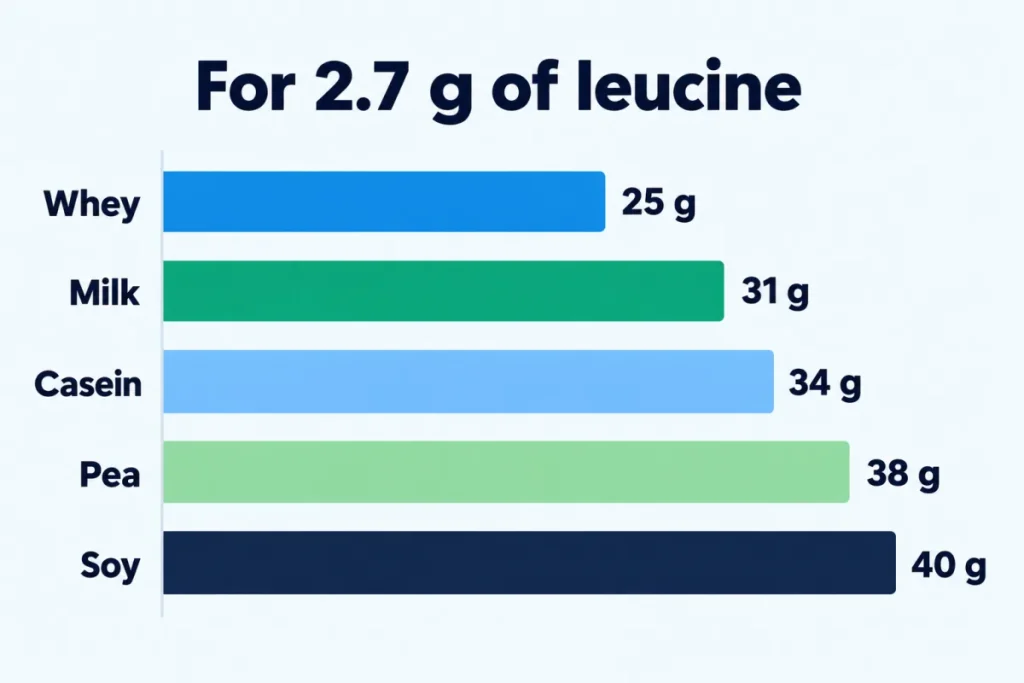
Leucine is the amino acid that acts as the starting signal for muscle building, and it is exactly where whey shines. According to the same study, 25 g of whey protein delivers roughly 2.7 g of leucine and 10.9 g of essential amino acids. To get that much leucine from anything else, you would need about 31 g of milk protein, 34 g of casein, 38 g of pea protein or 40 g of soy protein.
The official ISSN position stand on protein recommends 700 to 3,000 mg of leucine per serving, alongside 20 to 40 g of protein. A standard scoop of whey ticks that box without even trying. The BCAAs (leucine, isoleucine, valine) are naturally part of those amino acids, so there is no point buying them separately if you already take whey.
🥛 Lactose: how much is in one serving?
Lactose is the one difference between concentrate and isolate that you actually feel. Applying the ADPI values to a 30 g serving of the raw ingredient, a WPC 80 concentrate brings roughly 1.2 to 3 g of lactose and an isolate around 0.15 to 0.3 g. For comparison, the ANSES Ciqual food composition table lists 4.66 g of lactose per 100 g of semi-skimmed UHT milk, which is more than 9 g in a 200 ml glass.
If lactose leaves you bloated, an isolate is the logical choice: some of them list less than 0.2% lactose, like the Nutripure one according to its product page. The whole story is in our article on whey isolate and in our comparison of the best whey isolates.
⚠️ Watch out
Lactose intolerance and a milk protein allergy are two different things. An isolate that is almost lactose free still contains milk protein: if you have the allergy, whey is off the table, isolate included. If you have kidney disease, if you are pregnant, or for a teenager, ask your doctor before taking any supplement. The risks are set out in detail in our feature on the dangers of whey protein.
🧂 Flavourings, sweeteners, additives: what else is in the tub
An unflavoured whey can come down to a single ingredient; a flavoured one often runs to five or six. Here is what you will meet most often on an ingredients list:
- Flavourings and cocoa: they give the taste and slightly dilute the protein content.
- Sweeteners (sucralose, acesulfame K, stevia): they sweeten without calories; if you dislike them, unflavoured versions exist.
- Emulsifier (soy lecithin or sunflower lecithin): it helps the powder dissolve; take care if you are allergic to soy.
- Thickeners (xanthan gum, guar gum): they make the shake creamier.
- Sugar or maltodextrin: rare in a pure whey, common in mass gainers; they push the calories up.
Be wary of added isolated amino acids (glycine, taurine, glutamine) sitting high up the list: they can inflate the protein figure on the front of the tub without carrying the value of a complete protein. A good whey has no need for them.
🔎 How to read a whey protein label in 6 points
- The first ingredient must be a milk serum protein (“whey protein concentrate” or “whey protein isolate”).
- The protein per 100 g is what lets you compare two products; the protein “per serving” depends on the scoop size the brand has chosen.
- The carbohydrates, of which sugars line tells you whether there is lactose or added sugar in there.
- The amino acid profile (when the brand publishes it) gives you the leucine: aim for at least 2 g per serving.
- The allergens in bold: milk, and sometimes soy (lecithin) or traces of other allergens.
- The anti-doping standard NF V94-001, now EN 17444, which ANSES advises you to favour, above all if you compete.
ℹ️ Good to know
A “94% protein” claim is usually calculated on dry matter, meaning without the residual water in the powder. That is the convention used by the industry standards, but the “per 100 g” nutrition table shows the powder exactly as it is: reading a slightly lower figure there is perfectly normal.
🎯 What the composition changes for you
A composition rich in protein and in leucine makes whey a convenient way to hit your protein target, and nothing more than that. The European Union in fact only authorises general claims about protein (muscle mass, bones): the whey-specific claims submitted to EFSA, such as immunity or recovery, were rejected back in 2010. For the practical uses, read what whey protein does; for the amount, how much whey protein per day; for its place in a training programme, whey protein and bodybuilding; and for how long before you see anything, how long whey protein takes to work.
🏆 Our verdict on the composition to look for
🔬 Our method
We cross-checked the ADPI WPC and WPI composition standards, the amino acid analysis from Gorissen et al. (2018), the ISSN position stand on protein, the ANSES Ciqual table for milk, the ANSES opinion on sports supplements and the brands’ own official product sheets, all checked in October 2026. We compare labels, we do not run laboratory analyses.
Our verdict: a good whey comes down to a short ingredients list, more than 80% protein and zero added sugar. A concentrate is plenty if you digest milk well and want the best price per kilo; an isolate earns its keep if lactose bothers you or if you count every calorie. A whey is not for you, on the other hand, if you are allergic to milk protein, and it will never replace a varied diet.
For a whey isolate with a clean composition, our pick is the Nutripure one (94% protein and less than 0.2% lactose according to its product page), shipped from France:
To weigh up other products, our ranking of the best whey proteins scores every tub on exactly these composition criteria, and our guide to choosing your type of whey helps you decide between concentrate, isolate, native and hydrolysed.
❓ Frequently asked questions
What is whey protein made of?
Mainly milk serum protein: at least 80% in a WPC 80 concentrate and at least 90% in an isolate. The rest is lactose, fat, minerals and residual water, with flavourings and sweeteners on top of that in the flavoured versions.
Is whey protein a chemical product?
No, the base is a milk protein separated out by filtration and drying. It is the added ingredients (flavourings, sweeteners, emulsifiers) that vary from one brand to the next. An unflavoured whey contains none of them.
Does whey protein contain sugar?
A pure whey mostly contains the natural sugar of milk, lactose, in small amounts. The ADPI standards give 4 to 10% lactose in a WPC 80 concentrate and 0.5 to 1% in an isolate. Products with added sugar or maltodextrin are edging towards mass gainer territory.
How much leucine is in a serving of whey protein?
Roughly 2.7 g of leucine per 25 g of whey protein, according to the analysis by Gorissen et al. (2018). That sits inside the 700 to 3,000 mg per serving range recommended by the ISSN.
Should you take BCAAs on top of whey protein?
No, whey already contains the BCAAs naturally, leucine included. Adding isolated BCAAs on top of a scoop of whey mostly hands you leucine you have had already. If you want a second supplement, creatine alongside whey has far better evidence behind it.
📚 Sources
- ADPI: whey protein concentrate (WPC) standard, 2023 and whey protein isolate (WPI) standard, 2023
- Gorissen et al., amino acid composition of protein powders, Amino Acids, 2018
- ISSN position stand: protein and exercise (Jäger et al., 2017)
- ANSES, Ciqual food composition table (in French)
- ANSES, food supplements for athletes (2016)