Contents 6 sections
What is your main goal?
How do you digest dairy?
What matters most to you?
Summarise this article with:
💡 The essentials
Whey protein acts fast in your bloodstream, but slowly in the mirror.
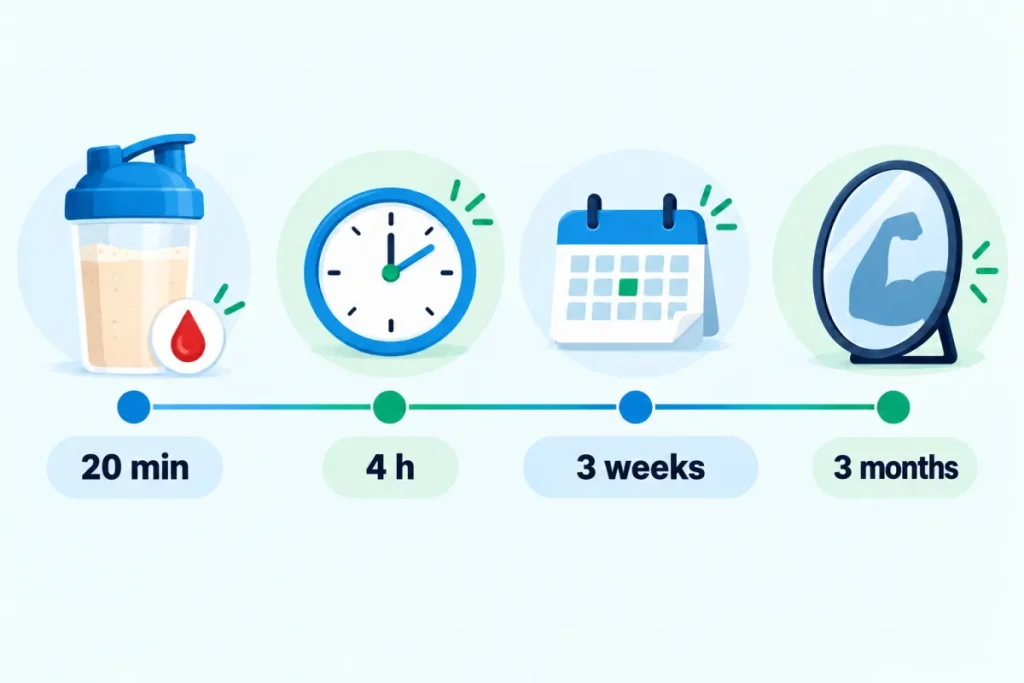
- 20 minutes: the first amino acids from the whey reach your blood.
- 4 to 5 hours: the peak has passed and the amino acids return to their baseline level.
- 3 weeks and beyond: the first changes in muscle size become measurable, with serious training.
- 2 to 3 months: that is the realistic horizon for seeing a difference with the naked eye, and whey only accounts for a small part of it.
You have just bought your first tub and you are wondering when the whey will “kick in”? The answer depends on which effect you mean: digestion is counted in hours, muscle in weeks. Here is the timeline, step by step, with what the studies actually measure.
One useful point: what a whey does for you also depends on its quality. For a pure, well tolerated whey, we recommend the one from Nutripure.
🕒 In the first few hours: digestion and absorption
Whey is what is known as a “fast” protein: its amino acids show up in the blood roughly 20 minutes after the shake. That is what the landmark study by Boirie et al. (PNAS, 1997) showed, following volunteers after 30 g of labelled whey.
The peak is high but brief: it lasts 4 to 5 hours, then most of the amino acids return to their starting level. In the same study, casein (the other milk protein) instead produced a moderate plateau lasting 6 to 7 hours, because it leaves the stomach more slowly. Whey stimulated the body’s protein synthesis more strongly (+68%, against +31% for casein), but casein did a better job of limiting protein breakdown.
That timing shifts a little depending on what you take your whey with. On its own with water, it passes through quickly; mixed into milk (which contains casein) or swallowed alongside a meal, you can expect digestion to be spread out more. That is not a problem: what matters for muscle is the amount of protein across the day. If you are after slow digestion overnight, read casein or whey and whey protein before bed.
📅 The 24 to 48 hours after your session
It is the weight training session, not the shake, that opens the window in which muscle rebuilds, and that window lasts at least 24 hours. The official ISSN position stand states that the anabolic effect of exercise persists for at least 24 hours, tailing off over time, and that taking protein before or after your session can work equally well depending on your own tolerance.
The famous 30 minute “anabolic window” is therefore far less strict than people claim. A meta-analysis on protein timing finds no effect of when you take it on strength or muscle size once the total amount is taken into account. Have your whey whenever it suits you; the detail is in when to take whey protein, whey protein before training and whey protein on rest days.
📈 Weeks and months: when the muscle shows
In the first few weeks, your muscle is mainly busy repairing the damage from training, not yet growing. A study that followed ten untrained men (Damas et al., 2016) only measured an increase in muscle fibre size at week ten; before that, protein synthesis went first into repair, then “redirected” itself towards growth from the third week onwards.
With intense training, a gain in size can be measured as early as three weeks, but only on a scanner. In the study by Seynnes et al. (2007), seven volunteers training three times a week gained 3.5 to 5.2% in quadriceps cross-section after 20 days, and 6.5 to 7.4% after 35 days. A few per cent of size is real, but rarely visible in the mirror.
And whey’s share in all of this stays modest. The meta-analysis by Morton et al. (2018), which pools 49 trials of at least six weeks, credits protein supplements with an average of 0.30 kg of lean mass and 2.49 kg of strength on top of what training alone delivers. That is why we settle on 2 to 3 months as the realistic horizon for a visible change, with regular training and enough food: it is an estimate, not a promise.
| Time frame | What is happening | What you can notice |
|---|---|---|
| 20 minutes | The amino acids reach your blood | Nothing visible |
| 4 to 5 hours | Amino acids back to baseline | Nothing visible |
| 24 to 48 hours | Muscle repair after the session | Soreness fading |
| 3 to 10 weeks | First gains in size, measurable in a lab | Mostly gains in strength |
| 2 to 3 months and beyond | Gains accumulating | A visible change, if the training keeps up |
Your physical results also depend on the quality of the protein you take. Go for well formulated products, such as this range of whey protein made in France, and compare the labels using our guide to whey protein composition.
👉 Our full Protéalpes review: range, price per kilo, customer ratings and a comparison with Nutripure.
⚖️ Why some people see results faster than others
- Training volume: more sets per muscle per week produce more growth, according to a dose-response meta-analysis. Without progressive training, whey has nothing to build.
- Total protein: beyond roughly 1.6 g per kg per day, Morton et al. find no further gain. If you are already there, whey speeds nothing up; see how much whey protein per day.
- Age and training level: in the same meta-analysis, the effect of protein is weaker with age and more pronounced in people who are already trained.
- Sleep: a single sleepless night cuts muscle protein synthesis by 18% the following day (Lamon et al., 2021).
- Calories: in a deficit, the goal becomes keeping your muscle rather than gaining any; in a surplus, building muscle is easier.
In practice, if you see nothing after three months, look at your programme and your plate before you blame the whey. Whey’s place in a complete routine is set out in our guide to whey protein and bodybuilding, and its uses outside the gym in what whey protein is for.
⚠️ Watch out
Upping the doses to speed things along achieves nothing and is not harmless. ANSES, the French food safety agency, advises strength athletes who increase their intake not to exceed 2.5 g of protein per kg per day, and not for longer than six months. If you have kidney disease, are pregnant, are allergic to milk protein or are a teenager, ask your doctor before taking whey protein.
🏆 Our verdict: how much patience to plan for
🔬 Our method
We built this timeline from studies measuring each stage: amino acid kinetics (Boirie 1997), protein synthesis and fibre size week by week (Damas 2016, Seynnes 2007), meta-analyses on supplementation and timing (Morton 2018, Schoenfeld 2013), the ISSN position stand and the ANSES recommendations. The 2 to 3 month window for a visible change is our own estimate drawn from that data.
Our verdict: count in months, not days, and judge whey on how practical it is rather than on a quick transformation. It is worth it if it helps you hit your protein target every day for weeks on end. It will disappoint you if you expect a visible effect in a fortnight, or if you take it without a training programme.
❓ Frequently asked questions
When do you see the effects of whey protein?
In your blood within 20 minutes, in your muscle within a few weeks, in the mirror after roughly 2 to 3 months. And only if you train regularly: whey supplies the materials, training gives the signal.
How long does whey protein stay in your body?
The amino acids from a 30 g serving return to baseline in roughly 4 to 5 hours. That does not mean they “disappear”: some went into building proteins, the rest was used as energy.
Do you have to take your whey within 30 minutes of training?
No, that is not necessary. The effect of the session lasts at least 24 hours and the studies show no advantage to timing once your total protein is met. Take it whenever suits you.
Is 30 g of whey protein a day enough?
It depends on what else you eat: the daily total is what counts. A serving of 20 to 40 g per sitting is the ISSN’s range; the rest should come from your meals. The sum based on your own body weight is in our guide to how much whey protein per day.
Is whey protein really effective?
Yes, but modestly: around 0.30 kg of extra lean mass on average in trials of six weeks or more, according to Morton et al. Its real value is in making your protein needs easier to hit; our full whey protein review sums it all up.
📚 Sources
- Boirie et al., slow and fast dietary proteins (whey and casein), PNAS, 1997
- Seynnes et al., early hypertrophy after intense training, J Appl Physiol, 2007
- Damas et al., protein synthesis and hypertrophy over a training programme, J Physiol, 2016
- Morton et al., meta-analysis of protein and resistance training, Br J Sports Med, 2018
- ISSN official position stand: protein and exercise (Jäger et al., 2017)