Contents 7 sections
What is your main goal?
How do you digest dairy?
What matters most to you?
Summarise this article with:
💡 The essentials
For whey, a 600 to 700 ml shaker with a mixing ball or mesh screen, a leak-proof lid and dishwasher clearance is more than enough: a model costing a few euros does the job perfectly well. The real secret is rinsing it within the minute.
- Capacity: 500 ml for one scoop, 700 ml for two scoops or a shake made with milk.
- Mixing: a ball or a mesh screen breaks up the lumps, a plain beaker does not.
- Care: rinse straight away, dry it open, and the smell never sets in.
The shaker is the one accessory you genuinely cannot do without when you take whey. A good shaker mixes the powder without lumps, does not leak in your gym bag and does not smell of off milk after a week. A bad one does precisely the opposite.
This guide is about the accessory itself: how to choose it, use it properly and keep it clean. If you are after the drink instead (how to make a shake, plus recipes), head to our guide to the whey shake.
🔬 Our method
We compared the types of shaker on their design (capacity, mixing system, closure, material, maintenance) and recorded the specifications the brands publish on their product pages (October 2026). The scorecard below is our assessment of those specifications, not the result of a laboratory test. The liquid quantities come from the usage instructions of the whey manufacturers.
📏 What capacity should you choose?
Pick a shaker two to three times bigger than the liquid you put in it: you need air for the powder to mix when you shake. Manufacturers recommend around 250 ml of liquid for 30 g of whey (MyProtein, Nutrimuscle), which gives the following benchmarks.
- 400 to 500 ml: one scoop with water, a handbag or desk format.
- 600 to 700 ml: the all-rounder, one scoop with room to spare or a shake made with milk.
- 800 ml to 1 l: two scoops, clear whey (400 ml of water for 25 g at MyProtein) or mass-gaining shakes.
The powder to water ratios brand by brand are in our guide to whey and water dosing. Choose a model marked in millilitres: you measure the water straight into the shaker, with no measuring jug.
⚖️ Ball, mesh, electric or stainless steel: the types of shaker
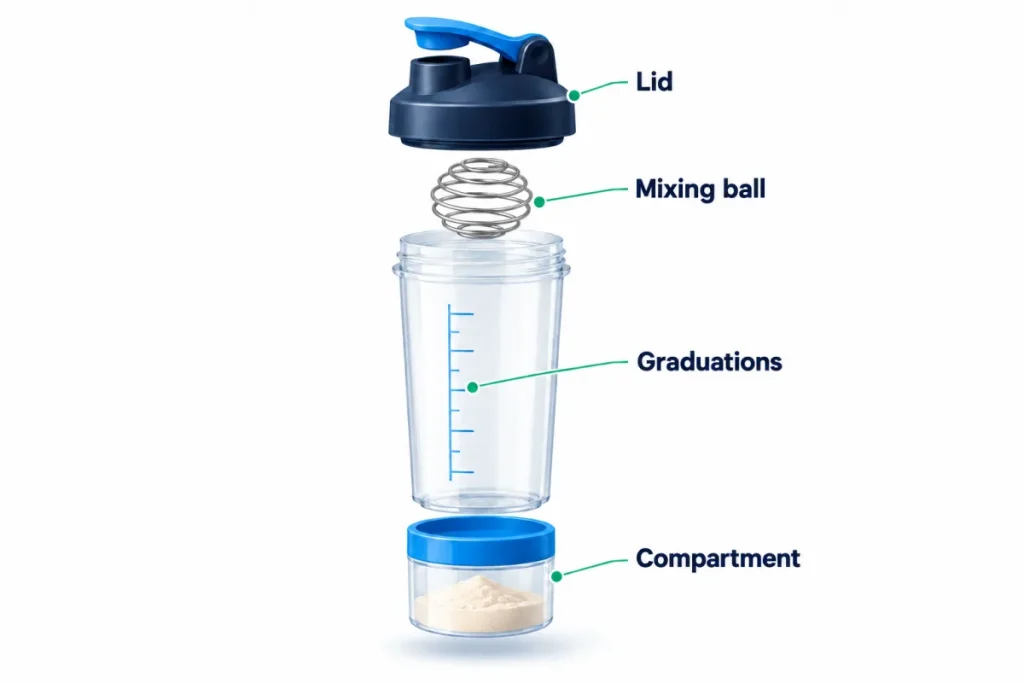
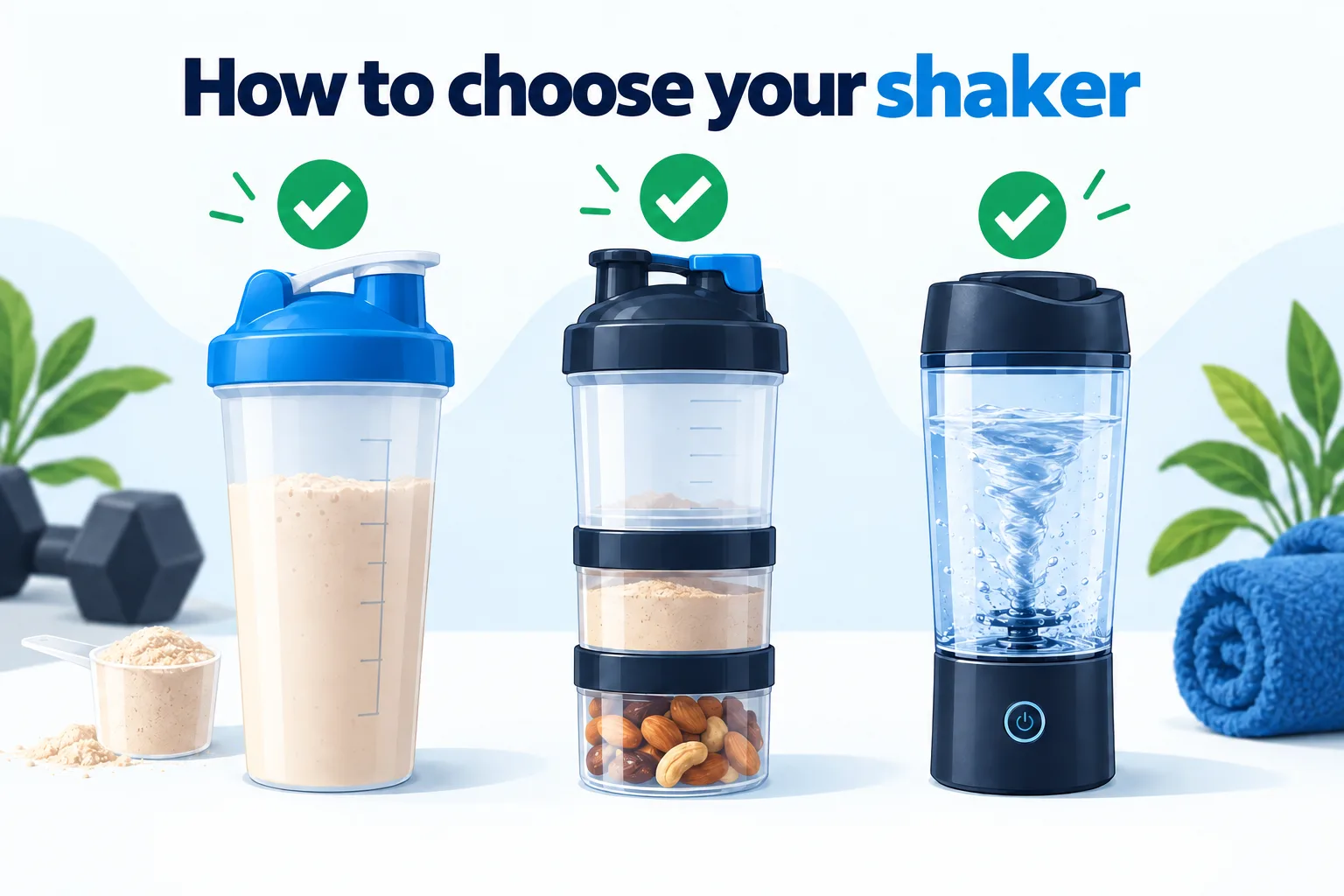
The mixing system is what makes all the difference on lumps. A ball (often a stainless steel spring) or a mesh screen fixed under the lid breaks up the clumps of powder as you shake. Without them, you have a beaker that leaves lumps at the bottom.
| Type of shaker | Mixing | Cleaning | Portability | Price | Who it suits |
|---|---|---|---|---|---|
| Plastic with a ball | ★★★★☆ | ★★★★☆ | ★★★★☆ | ★★★★★ | Most people, the best value for money |
| Plastic with a mesh screen | ★★★☆☆ | ★★★☆☆ | ★★★★☆ | ★★★★★ | Fine whey that dissolves easily |
| With a powder compartment | ★★★★☆ | ★★★☆☆ | ★★★★★ | ★★★★☆ | A shake to make at the gym or at the office |
| Stainless steel | ★★★★☆ | ★★★★☆ | ★★★☆☆ | ★★★☆☆ | Stubborn smells, or wanting something that lasts |
| Electric | ★★★★★ | ★★☆☆☆ | ★★★☆☆ | ★★☆☆☆ | Thick shakes (oats, fromage blanc), without a blender |
For a classic powdered whey, the plastic shaker with a ball wins: it mixes well, washes easily and costs very little. The mesh screen is enough for highly soluble isolates but traps more residue. The powder compartment is handy for making your shake away from home, at the cost of one more part to wash. Stainless steel does not hold onto smells the way plastic does, but you cannot see the liquid level. The electric shaker blends better than all the others, but its motor section cannot go in the dishwasher.
🔒 Lid, material, dishwasher: the details that count
- Screw lid: the most leak-proof in a bag, but slightly less convenient to drink from.
- Flip-top lid: you can drink one-handed, but the flap has to clip shut properly or it leaks.
- Material: go for a plastic labelled BPA-free, or stainless steel if you keep your shaker a long time.
- Dishwasher: check for the mention on the product page, it really does simplify the cleaning.
A basic shaker is enough in the vast majority of cases. The MyProtein plastic shaker, for instance, lists 600 ml, a mixing ball and dishwasher clearance for €5.99 (product page, checked October 2026). These are the models we list, all sold by shops that ship from France or the EU:
- Gorilla Sports shaker: 500 ml with a powder compartment, sold on Decathlon, for taking your scoop with you.
- MyProtein shaker: 600 ml, mixing ball, dishwasher safe, the budget choice.
- Prozis Shaker X: the alternative if you already order from Prozis.
🥤 Using your shaker properly
Liquid first, powder second, lid screwed on tight, then 20 to 30 seconds of shaking: that is the order Nutrimuscle gives, and it stops a block of powder sticking to the bottom. With a clear whey or an isolate that foams, let it settle for a minute before you open it. The full preparation and six recipes are in our guide to the whey shake, and the choice of liquid in what to mix your whey with.
ℹ️ Good to know
Never shake a hot liquid in a closed shaker: the pressure can blow the lid off. For whey in a coffee or in porridge, stir it in with a spoon, after slackening the powder in a little cold liquid first. And to take your shake with you, carry the powder dry and add the liquid at the last moment.
🧼 Cleaning your shaker and getting rid of smells
Rinse your shaker in lukewarm water within the minute, that is most of the job done. Milk and whey residue drying at the bottom is what causes the bad smells, not the shaker itself.
- Rinse it immediately, lid and ball included, even if you only wash it properly once you are home.
- Wash in hot water with washing-up liquid and a bottle brush, or in the dishwasher if the product page allows it.
- Take the lid apart (flap, mesh screen, compartment): that is where the residue hides.
- Leave it to dry open, upside down: a shaker closed up while damp holds onto smells.
If a smell has settled in, soak the shaker for a few hours in hot water with bicarbonate of soda or a little white vinegar, then wash it normally. If the smell comes back anyway, or if the plastic is scratched and cloudy, replace it: at this price, there is no point persevering.
✅ Our verdict: which whey shaker should you buy?
Our advice: a 600 to 700 ml plastic shaker with a ball, with measurement markings and dishwasher clearance. It is the best compromise for the vast majority of uses, and it only costs a few euros. Add a powder compartment if you make your shake at the gym, move up to stainless steel if smells annoy you.
An electric shaker is not worth it if you drink your whey with water or milk: a model with a ball does the same job for far less. It is only justified for thick shakes, when you have no blender. And a shaker cannot rescue a bad powder: if your whey goes lumpy in every shaker, look at its quality instead. We recommend the Nutripure Whey Isolate Native, an isolate with no sweetener in its unflavoured version, sold from France; to compare, see our ranking of the best whey.
❓ Frequently asked questions
How do you make a shake with whey?
Pour in around 250 ml of cold water or milk, add 30 g of whey, close it and shake for 20 to 30 seconds. That is the preparation most manufacturers recommend. The variations and recipes are in our guide to the whey shake.
What size shaker for whey?
600 to 700 ml is the most versatile size. It leaves enough air to mix 250 ml of liquid and one scoop of powder. Go for 800 ml or more for two scoops or a clear whey.
How do you get the smell out of a shaker?
Soak it for a few hours in hot water with bicarbonate of soda or white vinegar, then wash it again. After that, rinse it right after each use and leave it to dry open so the smell does not come back.
When should you drink your whey shake?
Whenever suits you: your protein total for the day counts more than the hour. After your session and at breakfast are the easiest slots to stick to. The details are in when to take whey, and the number of shakes a day in how much whey per day (often just one).
📚 Sources
- MyProtein plastic shaker: capacity, mixing ball, dishwasher safe (in French)
- Nutrimuscle Whey Native Isolate: usage instructions (liquid first, 30 g for 250 ml) (in French)
- MyProtein Clear Whey Isolate: suggested use (25 g for 400 ml) (in French)
- Schoenfeld et al. (2013): meta-analysis on protein timing