Contents 9 sections
- Building and keeping muscle
- Recovering between two sessions
- ⏱ Saving time (its real superpower)
- Satiety and weight loss: a small bonus, not a solution
- After 60: slowing muscle loss
- What whey protein does not do
- What whey protein does for your goal
- Our verdict: what whey protein is really for
- Frequently asked questions
What is your main goal?
How do you digest dairy?
What matters most to you?
Summarise this article with:
💡 The essentials
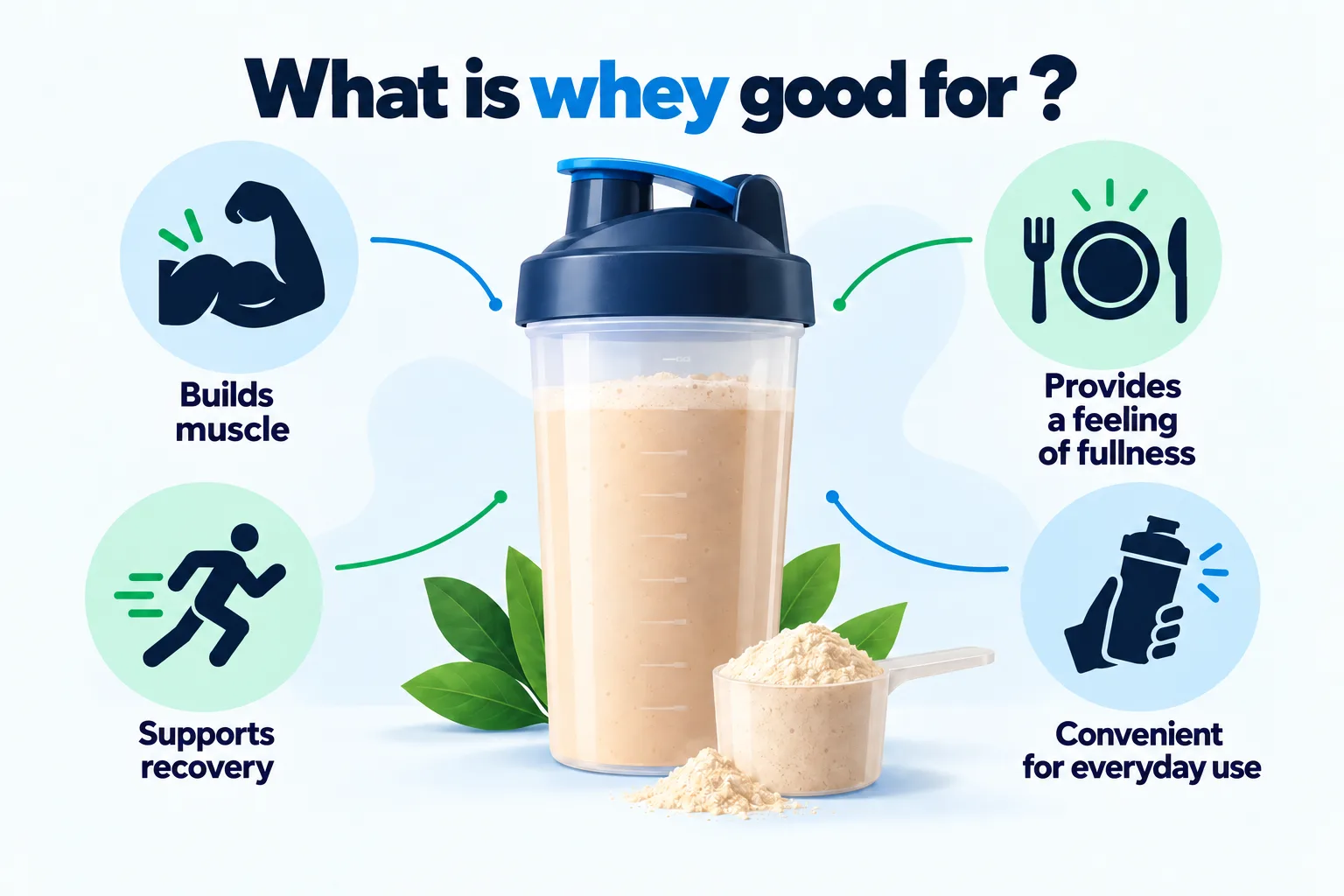
Whey protein does one thing: it delivers very high quality protein, fast, and with few calories. Everything else follows from that:
- Muscle: a small helping hand, real but modest, when you lift weights.
- Convenience: hitting your protein target without cooking, especially when dieting or when your appetite is low.
- Satiety and older adults: measurable effects, but limited ones.
- What it does not do: build muscle without training, make you lose weight on its own, or boost your immune system.
Whey protein gets credited with all sorts of powers: muscle gain, weight loss, immunity, metabolism… Here we sort out what the studies actually show, use by use, and we say plainly what whey does not do. For the definition (whey liquid, how it is made), see our article on what whey protein is; for exactly what sits in one scoop, read our guide to whey protein composition.
💪 Building and keeping muscle
This is the best demonstrated use, provided you actually do resistance training. A meta-analysis of 49 trials (Morton et al., 2018) shows that adding protein to a resistance training programme of at least six weeks brings an average of 0.30 kg of extra lean mass and 2.49 kg of extra strength. Useful, but a long way from a “product that makes you blow up”.
Why whey rather than another protein? Because it is digested quickly and is rich in leucine. For the same amount of essential amino acids, it stimulates muscle protein synthesis more than casein or soy (Tang et al., 2009). The same meta-analysis does point out, however, that beyond roughly 1.6 g of protein per kg per day the extra lean mass gain disappears: it is your daily total that counts. How to fit it around your sessions: our guide to whey protein and weight training.
🔄 Recovering between two sessions
Whey supplies the amino acids your muscle needs to repair itself, just like any protein-rich meal. It has no “recovery” effect of its own: in 2010 the EFSA rejected the whey-specific claims on recovery, strength and muscle repair, for lack of sufficient evidence.
There is no need to sprint to the changing room with your shaker either: a meta-analysis on protein timing finds no effect of when you take it on strength or muscle size once the total amount is taken into account. The topic is covered in detail in when to take whey protein.
⏱️ Saving time (its real superpower)
The first service whey renders is convenience: 20 to 30 g of protein in thirty seconds, with no cooking and no fridge. The official ISSN position stand puts it in these terms: supplements are a practical way to reach the quantity and quality of protein you need with few calories, while whole food remains the preferred option.
You still have to need it. According to ANSES, the average French adult eats 1.4 g of protein per kg per day, and their needs are already covered. For strength athletes aiming higher, ANSES recommends that two thirds of the intake come from food, with the final third allowed to come from supplements. Your own amount according to your body weight: how much whey protein per day.
🍽️ Satiety and weight loss: a small bonus, not a solution
Whey does help you feel full, but the effect is modest. A meta-analysis (Mollahosseini et al., 2017) finds a modest drop in appetite over the long term, with no clear difference against carbohydrates in the short term. Protein also has the highest digestion cost after alcohol, which plays a small part in satiety without transforming your metabolism.
On the scales, the average effect is real but small. In people living with excess weight, a meta-analysis of 9 trials (Wirunsawanya et al., 2018) finds an average of 0.56 kg less body weight and 1.12 kg less fat mass with whey than with a control, along with better muscle retention. No “makes you lose weight” claim is authorised for protein in Europe, in any case. The rest plays out in our guide to whey protein and weight loss and, on the product side, in our pick of whey proteins for weight loss.
👵 After 60: slowing muscle loss
As you age, your protein needs go up while your appetite goes down: whey can help close the gap. The PROT-AGE expert group recommends at least 1.0 to 1.2 g of protein per kg per day after 65. In the PROVIDE trial, 380 older adults with sarcopenia took a leucine and vitamin D enriched whey twice a day for 13 weeks: they gained slightly more muscle mass than the control group (0.17 kg) and stood up from a chair faster (Bauer et al., 2015).
But without exercise, more protein is not enough. A meta-analysis of 28 trials in older adults (Kirwan et al., 2022) finds no benefit at all on lean mass or strength without resistance training, whereas a benefit does appear when exercise is part of the plan. A few strengthening exercises (resistance bands, sit-to-stands, light loads) matter just as much as the shaker.
🚫 What whey protein does not do
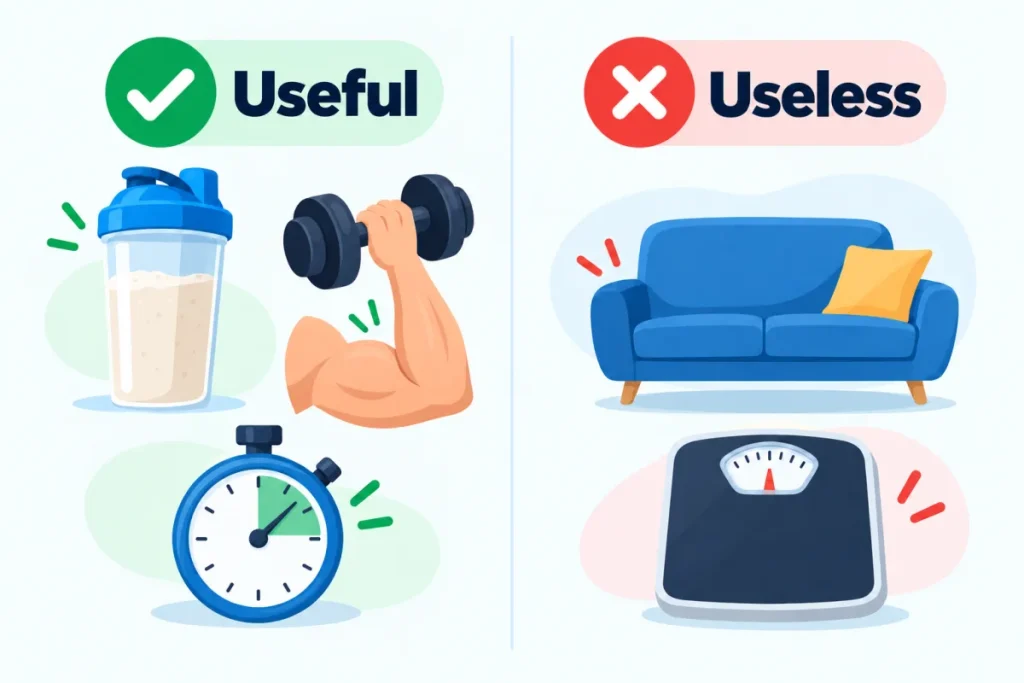
- Build muscle without training: it is exercise that triggers the adaptation, whey only supplies the raw materials. See taking whey protein without working out.
- Make you slim or make you gain weight by itself: it is your daily calorie balance that decides (see does whey protein make you fat?).
- Strengthen your immune system or reduce inflammation: these avenues are being studied, but no claim of that kind has been accepted. If you live with a chronic inflammatory disease, whey is not a replacement for treatment: talk to your doctor about it.
- Replace a meal: one serving brings protein, not the fibre, vitamins and useful fats of a real meal.
- Work within a few days: the effects are counted in weeks, see how long whey protein takes to work.
🎯 What whey protein does for your goal
| Your goal | What whey does | Our guide |
|---|---|---|
| Mass gain | Top up protein, in a calorie surplus | Whey protein and mass gain |
| Cutting, weight loss | Keep muscle with few calories | Whey protein and weight loss |
| Day-to-day weight training | Reach your protein total easily | Whey protein and weight training |
| Older adult, low appetite | Limit muscle loss, alongside exercise | How much whey protein per day |
| No training | Only if your diet is short on protein | Whey without working out |
For the type of whey that suits each goal (concentrate, isolate, native, hydrolysed), everything is in our guide to choosing your whey. And if you are still hesitating, our overall verdict on whey protein weighs up the pros and cons.
⚠️ Watch out
Ask your doctor before taking whey protein if you have kidney disease, if you are pregnant or breastfeeding, if you are allergic to milk proteins, or for a teenager. ANSES advises against sports supplements without medical advice for these groups. After 65, severe kidney failure is also an exception to the high intake recommendations. The risks are detailed in our file on the dangers of whey protein.
🏆 Our verdict: what whey protein is really for
🔬 Our method
We graded each use by its level of evidence: meta-analyses (Morton 2018, Schoenfeld 2013, Wirunsawanya 2018, Mollahosseini 2017, Kirwan 2022), the randomised PROVIDE trial, the ISSN position stand, the PROT-AGE recommendations, ANSES opinions and the list of health claims authorised by the European Union. Uses with no solid evidence are flagged as such.
Our verdict: whey protein is a convenience tool, effective for reaching your protein target, not an accelerator of results. It makes sense if you lift weights and struggle to eat enough protein, if you are dieting and want to keep your muscle, or if you are getting older with a small appetite. It is useless if your diet already covers your needs, and it is not for you if you are counting on it to lose weight or build muscle without moving.
❓ Frequently asked questions
What is the point of taking whey protein?
Reaching your protein needs easily, with a fast protein that is rich in leucine. That is mostly useful if you train, if you are dieting or when your appetite is low. If you already eat enough protein, the benefit is small.
Is it good to take whey protein every day?
Yes for a healthy adult, as long as your protein total stays sensible. The EFSA considers an intake of up to double the 0.83 g per kg per day reference to be safe in adults, and rest days count for recovery too (see whey protein on rest days).
What are the drawbacks of whey protein?
Mostly digestive (lactose in concentrates) and financial. It must be ruled out if you are allergic to milk proteins, and discussed with a doctor if you have kidney disease. The detail is in our file on the dangers of whey protein.
What is the difference between whey protein and creatine?
Whey supplies protein, creatine increases the muscle’s energy stores for intense efforts. They are two different supplements that combine well; doses and benefits are detailed in our article on whey protein and creatine.
Can whey protein replace a meal?
No, not on a regular basis. A shake brings protein but very little fibre, vitamins or good fats. As a snack or a stopgap, yes; in place of a real meal every day, no.
📚 Sources
- Morton et al., meta-analysis of protein and resistance training, Br J Sports Med, 2018
- Wirunsawanya et al., whey protein and body composition in people with excess weight, 2018
- Bauer et al., PROVIDE trial in older adults with sarcopenia, JAMDA, 2015
- ISSN, official position stand: protein and exercise (Jäger et al., 2017)
- European Commission, register of authorised health claims