Contents 8 sections
What is your main goal?
How do you digest dairy?
What matters most to you?
Summarise this article with:
💡 The essentials
The best time to take whey is the one that helps you hit your protein intake for the day. The exact hour matters far less than the total amount.
- Around your session: before or after, both work, so there is no need to sprint to the changing room.
- Across the day: spread your protein into servings of 20 to 40 g every 3 to 4 hours.
- Every day, rest days included.
Whey, or milk serum protein, is the fraction of milk recovered during cheesemaking. It comes in three main forms (concentrate, isolate, hydrolysate), but for the question of “when”, they are all handled in exactly the same way: they are fast-digesting proteins.
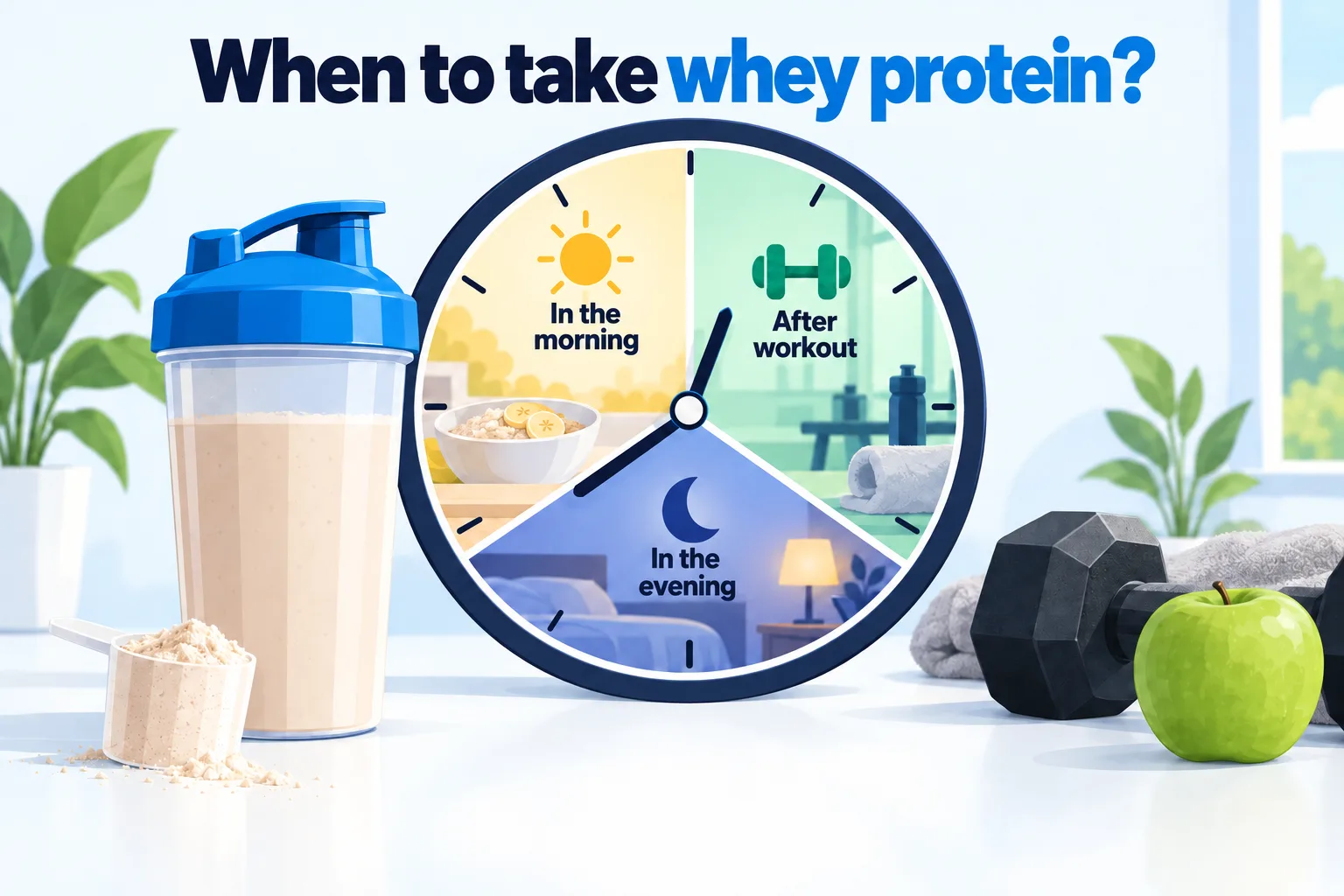
Morning, snack time, before or after your session, evening: every school of thought has its arguments. This guide sorts out what the studies actually show and how to place your shaker according to your goal. For how to make it up and how much to use, see also how to take whey protein.
🔬 Our method
We ran no trials of our own. We read the official position stand of the International Society of Sports Nutrition (ISSN) on protein, a meta-analysis on protein timing, a study on how whey servings are spread out, and a review on the useful amount per meal. The recommendations below follow directly from them.
🕒 Timing matters less than your total intake
A 2013 meta-analysis on protein timing pooled more than 20 trials. Once the other factors were accounted for, taking your protein right around the session brought no significant gain in strength or muscle. The best predictor of muscle gain was total protein intake.
In practice, start by checking that you are hitting your daily requirement: the ISSN puts that requirement between 1.4 and 2 g of protein per kilo per day for most active people. For the calculation that fits your profile, see how much whey protein per day. Once that total is reached, choosing the moment becomes fine-tuning.
🏋️ Whey before or after training?
According to the ISSN position stand on protein (2017), exercise and protein work together whether you take it before or after your session. The choice mostly comes down to your digestive comfort.
- Before the session: useful if your last meal was a long time ago. If a shaker sits heavily on your stomach while you train, move it. More detail in taking whey protein before a workout.
- After the session: the simplest habit, especially if your next meal is several hours away.
There is no need to rush: the ISSN states that the anabolic effect of exercise lasts at least 24 hours, even though it fades over time. The famous 30-minute “anabolic window” is therefore far wider than people claim.
📅 How to spread your whey across the day
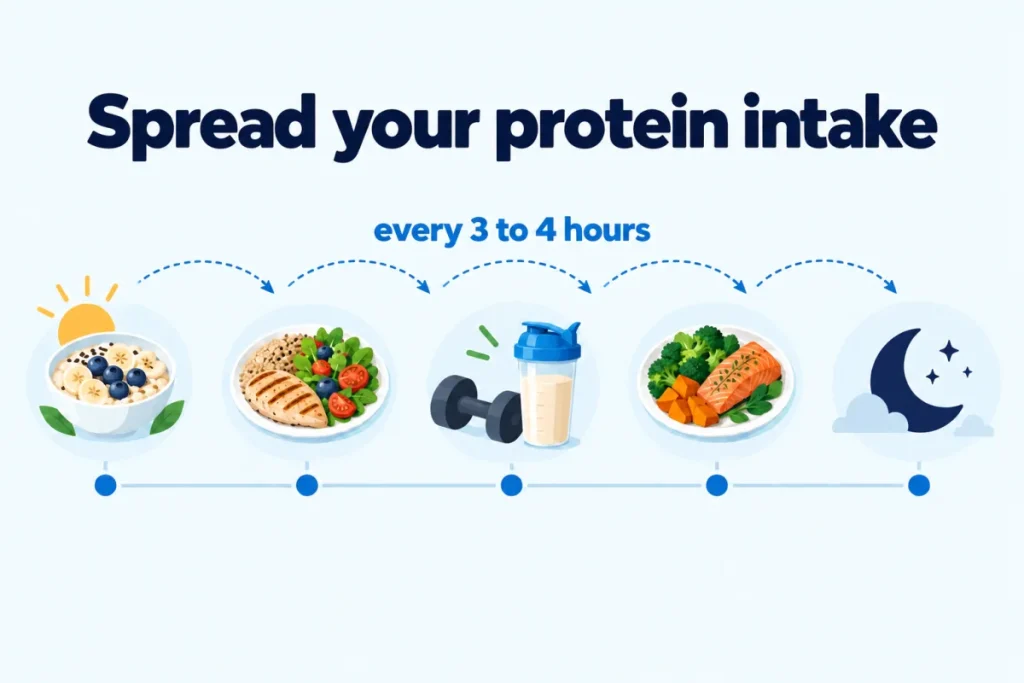
The ISSN recommends servings of 20 to 40 g of protein (or about 0.25 g per kilo), spread evenly every 3 to 4 hours. A 2013 study in 24 trained men illustrates the point: over the 12 hours following a session, 4 servings of 20 g of whey every 3 hours stimulated muscle protein synthesis more than 8 servings of 10 g or 2 servings of 40 g.
A 2018 review offers a simple benchmark: around 0.4 g of protein per kilo per meal, across at least four meals. Whey then serves to top up the meal or the snack that falls short, often breakfast or the afternoon snack.
| Moment | What it does for you | Who it suits |
|---|---|---|
| Morning | Lifts a breakfast that is low in protein | Anyone who has toast, or nothing, in the morning |
| Before the session | Delivers protein when your meal was a long time ago | Anyone training fasted or late after lunch |
| After the session | Simple and convenient, with the next meal far off | Most gym-goers |
| Afternoon snack | Fills the long gap between lunch and dinner | Anyone who picks at food or gets hungry around 5pm |
| Evening | Tops up a dinner that is light on protein | Anyone training in the evening |
🌙 In the evening and before bed
Taking whey in the evening poses no problem at all, especially if you train at the end of the day. For the serving taken right before bed, the ISSN points instead to casein (30 to 40 g), a slow protein that raises muscle protein synthesis overnight. Whey is still an option, but it is digested faster.
To go further, read taking whey protein before bed and our comparison of casein vs whey. If the evening shaker makes you skip dinner, that is not a good idea: it is no substitute for a real meal.
😴 Should you take whey on rest days?
Yes, if your diet does not cover your protein requirement that day. Muscle rebuilds on days without training too, and the goal stays the same: reaching your daily intake. Simply place the shaker at the meal or the snack with the least protein. All the detail is in whey protein on rest days.
🎯 When to take your whey according to your goal
Mass gain
Take your whey after the session and use it to top up the meals that are too light on protein. In a calorie surplus, its main job is helping you reach your target without eating enormous volumes of food. See our guide to whey protein for mass gain.
Weight loss and cutting
Put the shaker in place of a sugary snack, often in the afternoon. Added to your meals without removing anything, it simply adds calories; used as a replacement, it helps you keep protein intake high during the deficit. It is all explained in whey protein and weight loss.
A low-protein diet, with no sporting goal
Take it at the meal that is shortest on protein, usually breakfast. It is a convenient way of raising your intake without eating more, as we set out in taking whey protein without working out.
✅ Our verdict: the simple rule that works
For us, the best strategy fits in one sentence: a shaker after your session on training days, and at the meal lowest in protein on the other days. It is simple, it respects what the studies say, and you do not need to set an alarm for your whey shaker.
This guide is not for you if your food already covers your needs: in that case whey is not necessary, whatever the time of day. And if you have kidney or liver disease, an allergy to milk proteins, or you are pregnant, ask a doctor before increasing your protein intake.
❓ Frequently asked questions
Should you take whey before or after weight training?
Both work. The ISSN states that the benefits are there before as well as after the session; choose according to your digestion and the time of your last meal.
How long after a session should you take your whey?
There is no minute-by-minute urgency. The anabolic effect of exercise lasts at least 24 hours, even as it fades. Taking your shaker in the hours that follow, or eating a protein-rich meal, is enough.
Can you take whey in the morning?
Yes, and it is actually a good moment if your breakfast is low in protein. A shaker, or a scoop of whey stirred into a yoghurt or some porridge oats, easily lifts your morning intake.
Can you take whey in the evening?
Yes, with no problem at all. For the serving taken right before sleep, casein is the best-studied protein, but whey is still an option if it helps you reach your daily total.
How many whey shakers a day?
One to two shakers are enough for most people. The rest of your protein should come from food; whey is only there to close the gap with your requirement.
📚 Sources
- ISSN position stand on protein and exercise, Journal of the International Society of Sports Nutrition, 2017
- Schoenfeld et al., meta-analysis on protein timing, 2013
- Areta et al., distribution of whey servings and muscle protein synthesis, Journal of Physiology, 2013
- Schoenfeld and Aragon, how much protein is useful per meal, 2018