Contents 7 sections
What is your main goal?
How do you digest dairy?
What matters most to you?
Summarise this article with:
💡 The essentials
To get started, the best whey is a simple one, easy to digest and easy to measure out: our first choice is Nutripure’s Whey Isolate Native in the unflavoured version.
- Tight budget, bought in store: Decathlon’s Whey Protein, €34.99 for 900 g.
- Want plenty of flavours: MyProtein’s Impact Whey, if you digest milk well.
- The right dose: a serving of 20 to 40 g of protein, and most of the time a single shaker a day is enough.
You are starting out in the gym and wondering which whey to choose as a beginner? Good news: you do not need a complicated or wildly expensive product. A good beginner’s whey comes down to three criteria: a short ingredient list, digestion without bloating and a sensible price. Here is our selection, followed by the mistakes to avoid.
🤔 Do you really need whey when you are starting out?
Whey is not compulsory: it is simply a convenient way of hitting your protein needs. For someone who trains, the ISSN position stand (International Society of Sports Nutrition) recommends 1.4 to 2 g of protein per kilo of body weight per day. For a 70 kg person, that works out at roughly 100 to 140 g a day.
If your diet (meat, fish, eggs, dairy, pulses) already gets you there, whey is just a bonus. If you struggle to get there, a shaker after your session or at breakfast makes life easier. To find out what it really does (and what it does not), read our guide to what whey protein does.
🥛 Concentrate or isolate: which one to start with?
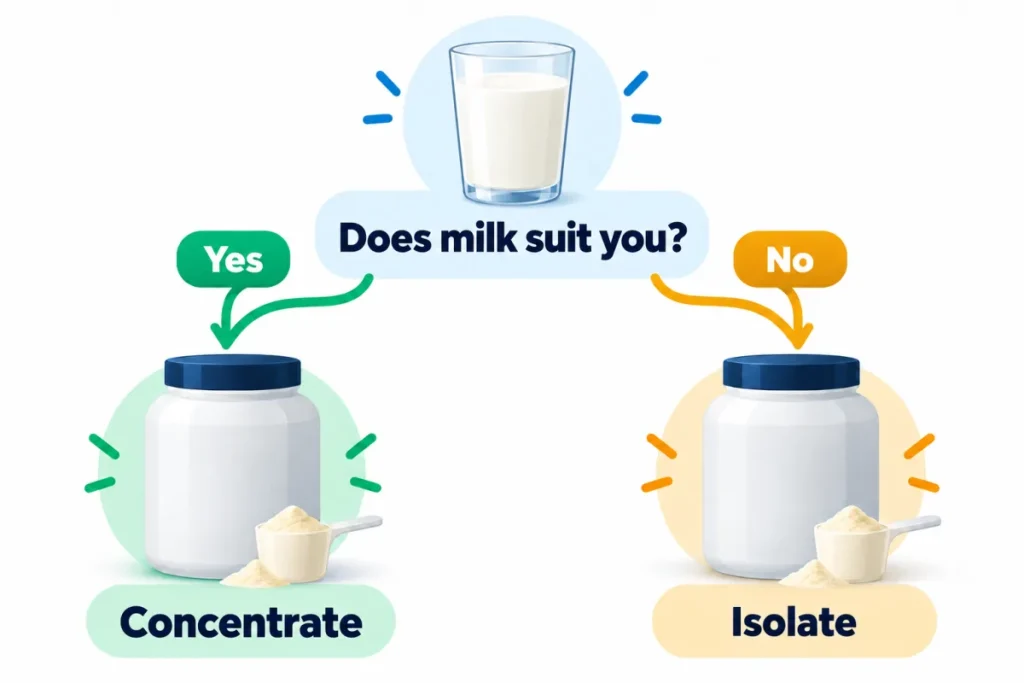
- Whey concentrate: around 70 to 80 g of protein per 100 g. It is the cheapest, but it holds more lactose. Ideal if you digest milk well.
- Whey isolate: roughly 80 to 92 g of protein per 100 g as sold, with very little lactose. The right choice if milk leaves you bloated.
- Native whey: cold-filtered straight from milk, so its proteins are not denatured. Often sold as an isolate, and a little dearer.
Hydrolysed whey holds no particular interest for a beginner: it costs more for a benefit you will not notice at your level. To go further, read our comparison of whey isolate vs standard whey.
🏆 Our pick of whey proteins for beginners
🔬 Our method
We tested nothing in a laboratory: we compared the official product pages (Nutripure, Decathlon, MyProtein) as consulted in October 2026, against four criteria that matter when you are starting out: a simple formula, easy digestion (type of whey and lactose), the price and the choice of flavours. The doses quoted come from the ISSN and ANSES.
| Whey | Formula | Digestibility | Price | Flavours | Beginner score |
|---|---|---|---|---|---|
| Nutripure Whey Isolate Native | ★★★★★ | ★★★★★ | ★★★☆☆ | ★★★☆☆ | 4/5 |
| MyProtein Impact Whey | ★★★☆☆ | ★★★☆☆ | ★★★★☆ | ★★★★★ | 3.75/5 |
| Decathlon Whey Protein | ★★★★☆ | ★★★☆☆ | ★★★★☆ | ★★★☆☆ | 3.5/5 |
1. Nutripure Whey Isolate Native: the best choice on quality
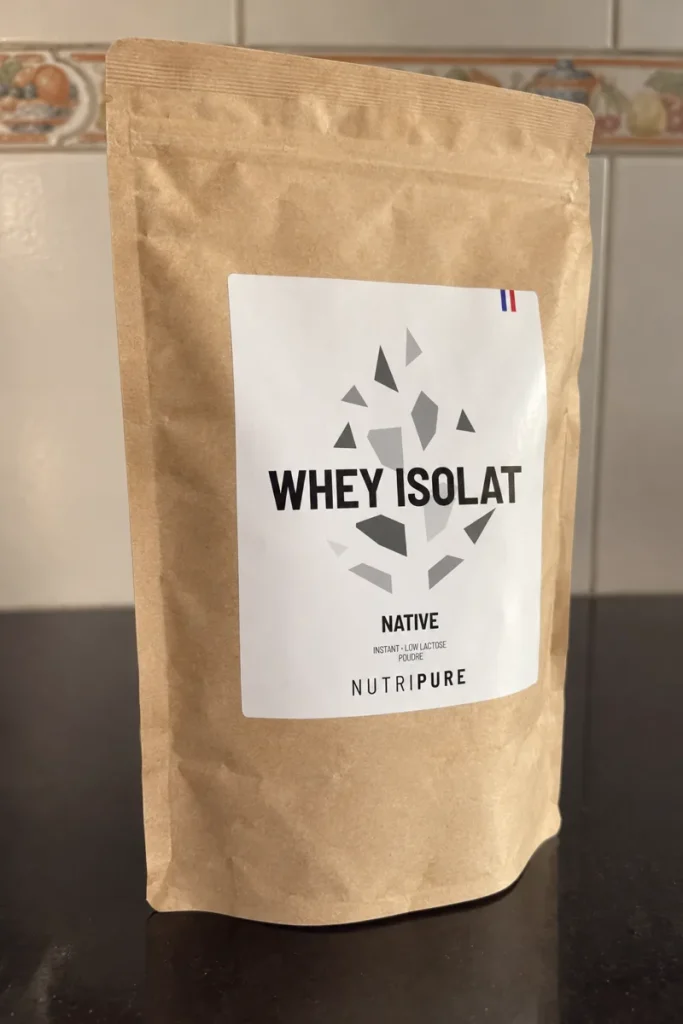
86.8 g of protein per 100 g as sold (94 g on a dry basis), and only two ingredients in the unflavoured version: French milk isolate and sunflower lecithin. A 30 g serving brings 26 g of protein for 115 kcal, with less than 0.2% lactose. Budget around €47 per kilo on the large formats (checked in October 2026), or €44.90 for the 750 g pouch if you just want to try it; the brand ships from France.
This is our recommendation if you want to start straight away with a clean product that goes down easily. The unflavoured version (a faint milky taste) also stirs into a yoghurt or a bowl of porridge; if you want a treat of a shake, go for a flavoured version instead.
2. Decathlon Whey Protein: the best budget buy in store
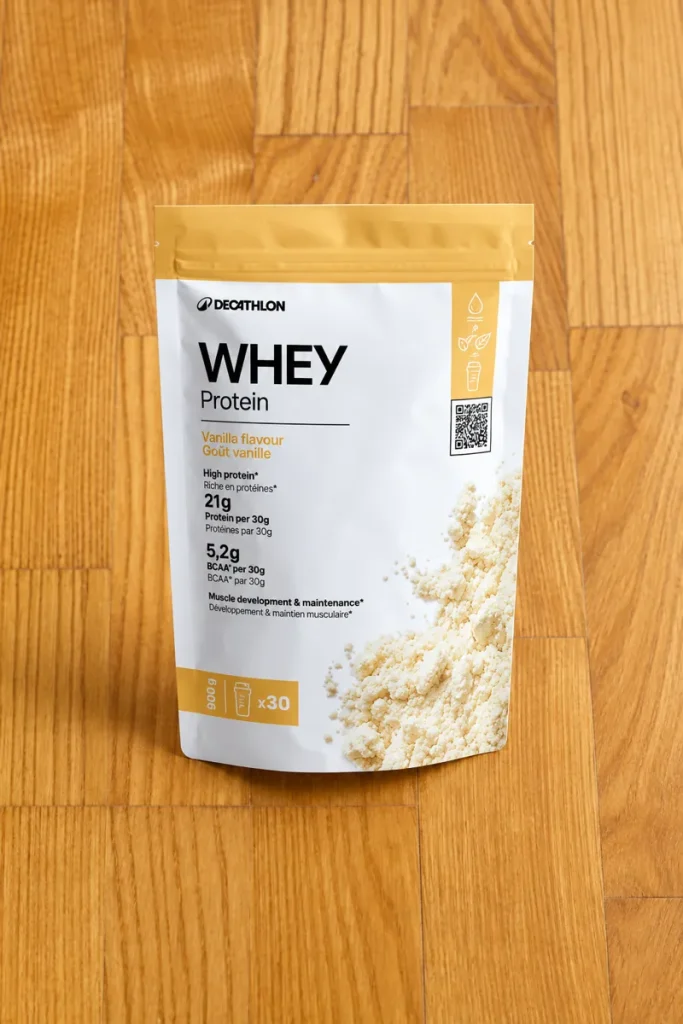
To try whey without spending much, Decathlon’s Whey Protein costs €34.99 for 900 g (checked in October 2026 on the Decathlon Pro shop), which is around €39 per kilo. It is a whey concentrate: 70 g of protein per 100 g and 21 g per 30 g serving, sweetened with stevia, made in France from European Union whey proteins.
Its real strength is that you can buy it in store, with no online order. It does, on the other hand, contain more carbs (17 g per 100 g, of which 8 g sugars) than an isolate, and an isolate version exists for sensitive stomachs. Our full review of the Decathlon whey sets out the differences between the ranges.
3. MyProtein Impact Whey: the widest choice of flavours
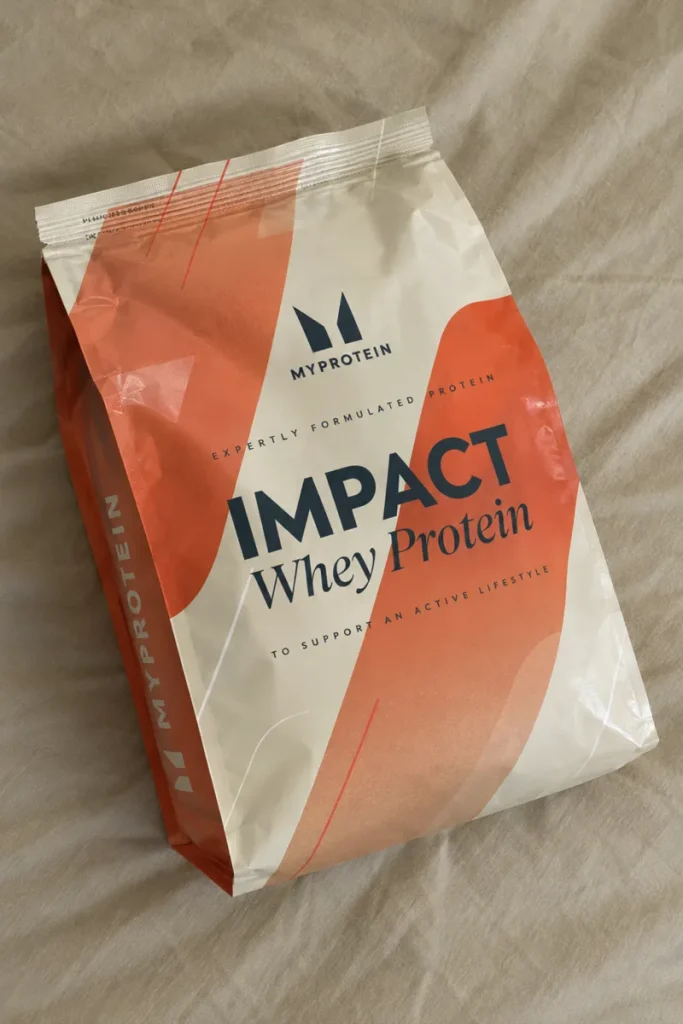
A whey concentrate (72 g of protein per 100 g, 22 g per 30 g serving) available in dozens of flavours and often on offer: around €38 per kilo when the 2.5 kg format is discounted (checked in October 2026). Handy if flavour is what will keep you going in the long run. It is sweetened with sucralose, and its lactose can upset sensitive stomachs. See also our ranking of the best MyProtein flavours.
Want to compare more brands? Our comparison of the best whey proteins puts nine products under the microscope, and our rankings of the best whey protein for bulking and the best whey protein for weight loss cover the more specific goals.
🕒 How much whey, and when, when you are starting out?
A dose of 20 to 40 g of protein per serving is enough, which usually means one shaker made with 30 g of powder. What matters most is your protein total across the day rather than the exact time of your shake: before or after training, both work. Our guides to how much whey per day and when to take whey set out the sums, and how to take whey explains the preparation step by step.
⚠️ The classic beginner mistakes
- Replacing meals with shakes: whey tops up your diet, it does not replace it.
- Taking far too much of it: beyond your needs, extra protein does not build extra muscle. For strength athletes, ANSES advises not going over 2.5 g of protein per kilo per day, and for six months at most.
- Choosing on the marketing: look at the protein content per 100 g as sold, the ingredient list and the price per kilo.
- Buying a big tub straight away: start with a small format to check the taste and the digestion before moving up to the large one, which is cheaper per kilo.
- Confusing lactose intolerance with milk allergy: an isolate helps if you are intolerant, but not if you are allergic to milk proteins.
⚠️ Watch out
If you have a kidney or liver problem, if you are pregnant or breastfeeding, or if you are on medical treatment, ask your doctor before starting whey. ANSES also advises against sports supplements for teenagers without medical advice. Our file on the dangers of whey takes stock of the real risks.
💬 Our verdict: which whey to start with?
To get started, a whey concentrate is enough if you digest milk well, and an isolate if you do not. Aim for 20 to 40 g per serving, keep an eye on your protein total for the day, and favour a product with a simple formula. If you would rather not think about it at all, the unflavoured Nutripure ticks every box; if budget comes first, Decathlon or MyProtein do the job perfectly well.
This selection is not for you if your diet already covers your protein needs: in that case there is no point buying whey at all. Still unsure which type of whey? Our guide on which whey protein to choose helps you make the call.
❓ Frequently asked questions
Which whey should you take when you start lifting?
A whey concentrate or isolate with a short formula, in a small format to begin with. Choose an isolate if milk leaves you bloated. The type of whey counts for less than how consistently you train and your total protein intake.
How much whey per day for a beginner?
Generally one shaker made with 30 g of powder a day is enough, which is 20 to 28 g of protein depending on the whey. The rest of your protein comes from food. Your own need depends on your body weight and your training.
How can you tell whether a whey is good quality?
Look at the protein per 100 g as sold, the ingredient list and the origin of the milk. A good whey shows at least 70 g of protein (concentrate) or 80 g (isolate) and few additives. Our guide to whey protein composition explains how to read the label.
Is whey dangerous for a beginner?
No, not for a healthy adult at the usual doses. A meta-analysis of 28 trials found no adverse effect of high-protein diets on kidney function in healthy adults. If you have kidney disease, if you are pregnant, or for a teenager, ask a doctor for advice.
📚 Sources