Contents 6 sections
What is your main goal?
How do you digest dairy?
What matters most to you?
Summarise this article with:
💡 The essentials
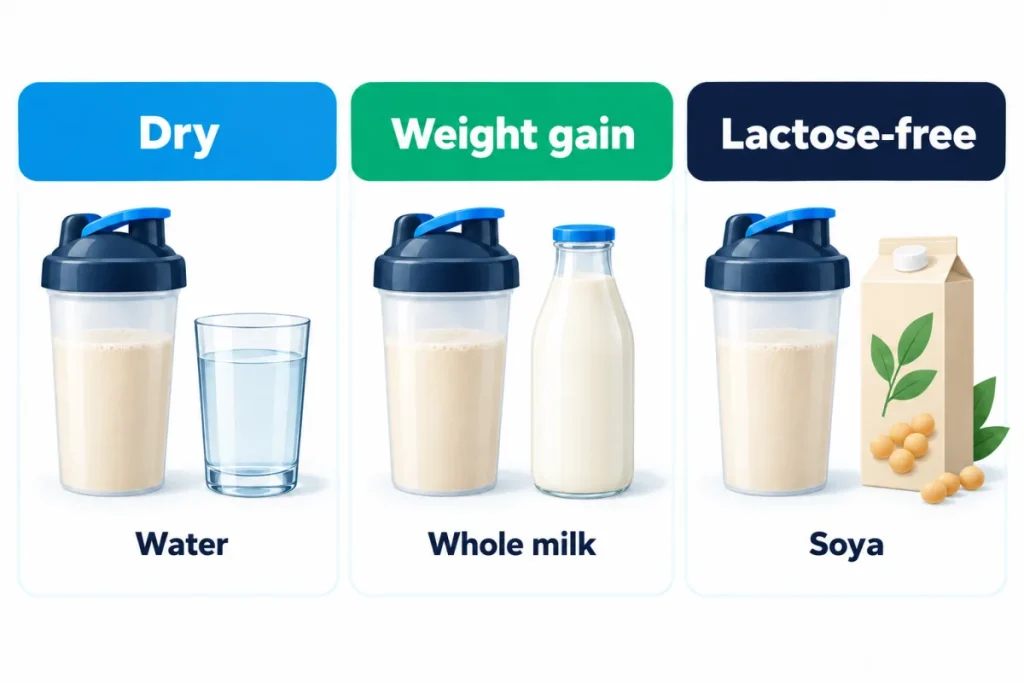
Take your whey with water if you are watching your calories, with milk if you want to put weight on or want a smoother shake, and with a soya drink if lactose bothers you. No liquid makes whey “work better”: it changes the calories, the texture and the digestion.
- Cutting: water (about 115 kcal for a 30 g shake).
- Bulking: whole milk, oats, banana.
- Lactose-free: a soya drink, which brings as much protein as milk.
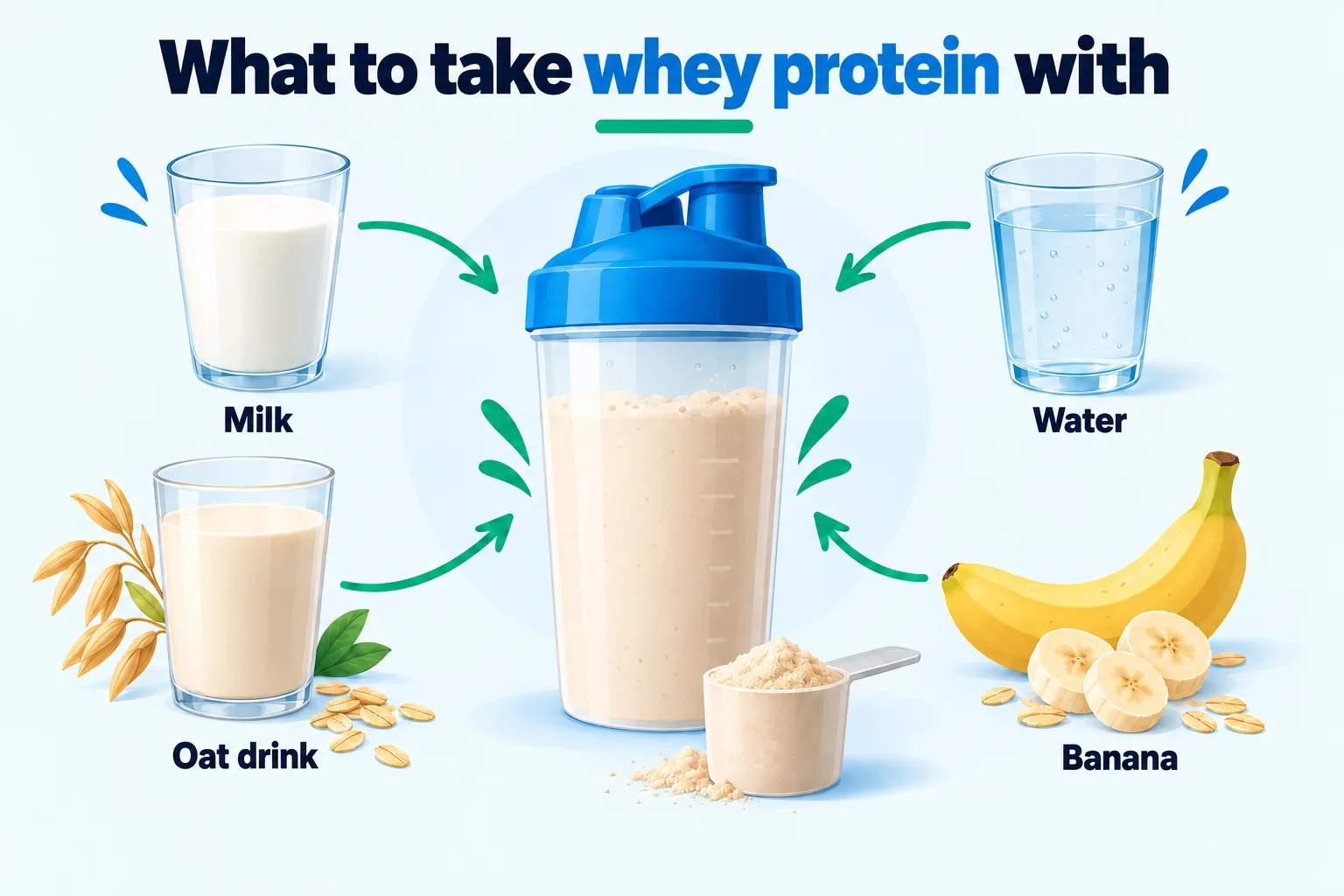
Water, milk, a plant drink, juice, coffee: you can put almost anything in a whey shaker. The right question is not “which is best?” but “which fits my goal?”, because from one liquid to the next, the same shake can double in calories.
This guide compares the liquids you can mix whey with, then the foods to pair it with, depending on whether you are cutting, bulking or maintaining. For how much liquid per serving, see our guide to the whey to water ratio (in short: about 250 ml for 30 g).
🔬 Our method
We compared the liquids using the ANSES Ciqual table (calories, protein and sugars per 100 g, scaled to 250 ml on the basis that a millilitre weighs about a gram) and a whey at around 115 kcal and 22 g of protein per 30 g (MyProtein Impact Whey product page, October 2026). The stars in the table translate those figures; creaminess is our own judgement. The verdicts on supplements rest on the EFSA and on published reviews.
🥛 Which liquid should you mix your whey with? The comparison
Water is unbeatable on calories, milk and soya drink add 8 to 9 g of protein, and the other plant drinks and the juices mostly add calories. Here is what each liquid adds to a serving of whey, per 250 ml.
| Liquid (250 ml) | Kcal added | Protein added | Sugars added | Shake total (30 g of whey) |
|---|---|---|---|---|
| Water | 0 | 0 g | 0 g | about 115 kcal, 22 g of protein |
| Coconut water | about 40 | under 1 g | about 6 g | about 155 kcal |
| Skimmed milk | about 85 | about 9 g | about 12 g (lactose) | about 200 kcal, 31 g of protein |
| Unsweetened almond drink | about 90 | about 3 g | not stated | about 205 kcal, 25 g of protein |
| Plain soya drink | about 95 | about 8 g | under 1 g | about 210 kcal, 30 g of protein |
| Orange juice (not from concentrate) | about 115 | about 1.5 g | about 24 g | about 230 kcal |
| Semi-skimmed milk | about 120 | about 8 g | about 12 g (lactose) | about 235 kcal, 30 g of protein |
| Plain rice drink | about 135 | under 1 g | about 14 g | about 250 kcal |
| Whole milk | about 165 | about 8 g | about 11 g (lactose) | about 280 kcal, 30 g of protein |
Our ranking by use, drawn from the table above: the more stars, the better the liquid meets the criterion.
| Liquid | Low in calories | Extra protein | Creaminess | Lactose-free | Best for |
|---|---|---|---|---|---|
| Water | ★★★★★ | ☆☆☆☆☆ | ★★☆☆☆ | ★★★★★ | Cutting, every day |
| Plain soya drink | ★★★★☆ | ★★★★★ | ★★★☆☆ | ★★★★★ | Lactose intolerance |
| Skimmed milk | ★★★★☆ | ★★★★★ | ★★★☆☆ | ★☆☆☆☆ | A tastier cut |
| Semi-skimmed milk | ★★★☆☆ | ★★★★★ | ★★★★☆ | ★☆☆☆☆ | Maintenance |
| Whole milk | ★★☆☆☆ | ★★★★★ | ★★★★★ | ★☆☆☆☆ | Bulking |
| Unsweetened almond drink | ★★★★☆ | ★★☆☆☆ | ★★★☆☆ | ★★★★★ | Taste, lactose-free |
| Orange juice | ★★★☆☆ | ★☆☆☆☆ | ★★☆☆☆ | ★★★★★ | Occasional, after a long session |
Fruit juice is not off-limits, but it is the least interesting liquid of the lot: around 24 g of sugars per 250 ml of pure orange juice, almost no protein, and a taste that sits badly with a chocolate whey. The full calorie breakdown by type of whey and by liquid is in our article on whey protein calories.
🎯 Which liquid for your goal?
Cutting: water, or skimmed milk for the taste
When cutting, water keeps your shake around 115 kcal; skimmed milk adds roughly 85 kcal but also 9 g of protein, a fair compromise if you cannot stand it with water. Do not count on whey to “kill your hunger”: the EFSA rejected the satiety claim for whey, and a meta-analysis (Mollahosseini et al., 2017) finds only a modest drop in appetite over the long term. The full strategies are in whey protein and weight loss and, for women specifically, in whey protein for women and weight loss.
Bulking: whole milk
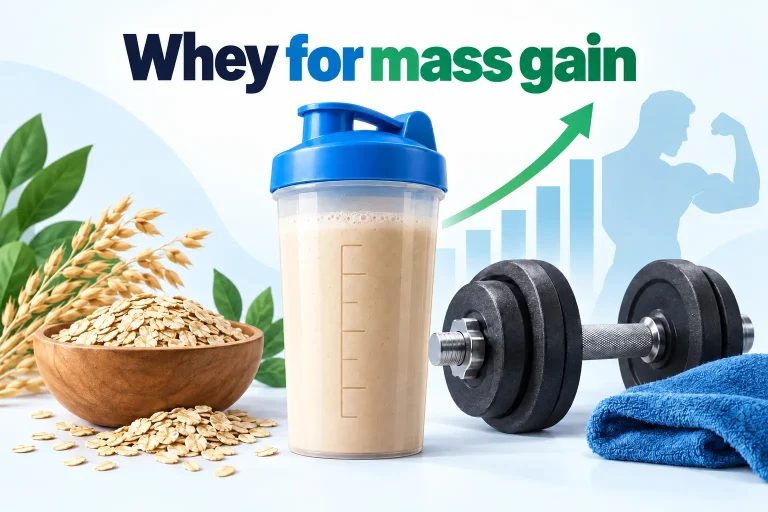
When bulking, whole milk adds about 165 kcal and 8 g of protein per shake, with no effort for anyone who struggles to eat much. You can push the shake further with oats, a banana or a spoonful of peanut butter. To pick your powder, see our ranking of the best whey protein for bulking.
Lactose intolerance: soya drink and an isolate
If milk bloats you, take a whey isolate with water or with a soya drink: plain soya brings about 8 g of protein per 250 ml, the same as milk, with no lactose. Almond and rice drinks work too, but bring little protein. The choice between concentrate and isolate is explained in which whey protein to choose. With a milk protein allergy (which is not the same as lactose intolerance), the whey itself is off the table.
🍌 Which foods should you pair your whey with?
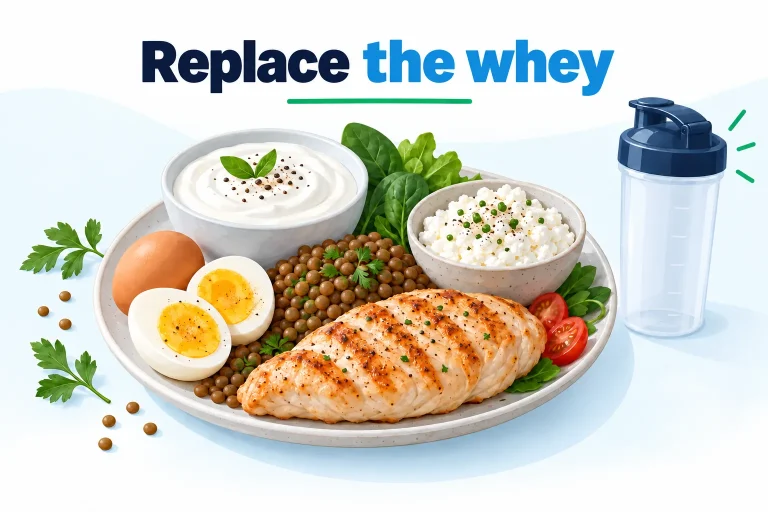
Whey pairs best with what it lacks: carbohydrates and fibre. It brings protein and almost nothing else; pairing it with a piece of fruit or with cereals turns it into a real snack or a breakfast.
- Oats: as porridge or blended into the shake, 40 g adds about 145 kcal and 5 g of protein (Ciqual).
- Banana: a 120 g banana adds about 110 kcal, handy before or after a session.
- 0% fat fromage blanc: 150 g adds about 12 g of protein for 75 kcal, for a spoonable cream.
- Red berries: flavour and fibre for few calories, about 75 kcal for 150 g of raspberries.
- Cold coffee: virtually calorie-free, and it turns a chocolate whey into an iced mocha.
Six full recipes with their calories are in our guide to the whey protein shake, and for cooking with the powder (pancakes, crepes, bars), see our whey protein recipes and our whey protein pancakes. To mix it, a shaker with a ball is enough, or a blender as soon as you add oats or whole fruit: see our protein shaker guide.
💊 What about other supplements?
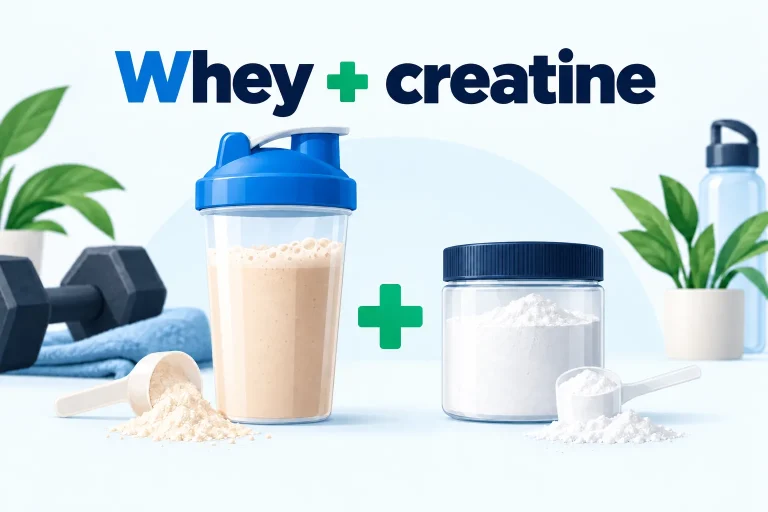
The only supplement that has proved itself alongside whey for weight training is creatine, which mixes into the same shaker without any trouble (doses and advice in whey protein and creatine). For the rest, the evidence is thin or the claims have been refused:
- BCAAs: pointless if you already take whey, which contains them; a 2017 review concludes that BCAAs alone are not enough to stimulate muscle protein synthesis (Wolfe, 2017).
- Glutamine: its effects on immunity and recovery have found little support in well-controlled studies of healthy, well-fed athletes (Gleeson, 2008).
- Carnitine: often sold as a “fat burner”, but the EFSA concluded that no cause and effect relationship with fat metabolism had been established (EFSA, 2018).
- Green tea extracts: no weight-loss claim is authorised in the EU, and the EFSA noted signs of liver injury from 800 mg of EGCG a day (EFSA, 2018).
- Caffeine: up to 400 mg a day (200 mg in a single dose) raises no concern in healthy adults according to the EFSA, and no more than 200 mg a day during pregnancy (EFSA).
⚠️ Watch out
If you are pregnant, on any medication or living with a health condition (heart, liver, kidneys, blood pressure), ask your doctor before taking these supplements. ANSES, the French food safety agency, also recommends against stacking several sports supplements at once. The risks specific to whey are set out in whey protein: what are the dangers?
✅ Our verdict: what should you mix your whey with?
For us, water stays the default choice, and milk a deliberate one when you want calories or creaminess. Soya drink is the best plant alternative because it keeps milk’s protein without the lactose. Fruit juice and rice drink are the least useful: plenty of sugar, almost no protein.
This guide will not help you if your whey gives you trouble whatever the liquid: persistent bloating comes more often from the lactose in the powder itself, and an isolate usually settles it. And if you are wondering how many shakes to take, the short answer is usually one a day: the calculation is in how much whey protein per day.
❓ Frequently asked questions
Should you take whey with water or with milk?
With water to keep the calories down, with milk for a smooth texture and extra protein. 250 ml of semi-skimmed milk adds about 120 kcal and 8 g of protein. Both work: pick according to your goal.
Can you mix whey with fruit juice?
Yes, but it is the least rewarding liquid: about 115 kcal and 24 g of sugars per 250 ml of pure orange juice, for almost no protein. Save it for a fruit-flavoured whey or for the end of a long session.
Which plant drink should you choose for your whey?
Plain soya drink, because it brings about 8 g of protein per 250 ml, the same as milk. Almond drinks (about 3 g) and rice drinks (under 1 g) mainly bring flavour and calories.
Can you put whey in a coffee?
Yes, preferably in a cold or lukewarm coffee: in a hot liquid, whey clumps easily. Slacken it first in a little cold milk or water, then pour the coffee in.