Contents 6 sections
What is your main goal?
How do you digest dairy?
What matters most to you?
Summarise this article with:
💡 The essentials
The right whey to water ratio is roughly 250 ml of water per 30 g serving of whey, which is what most manufacturers recommend. You can drop to 180 ml for a thicker shake or go up to 300 ml for a lighter drink.
- Simple rule of thumb: 6 to 8 ml of water per gram of powder.
- Clear whey: a lot more water, 400 ml for 25 g at MyProtein.
- No lumps: water first, powder second, and keep the water cold.
Too little water and your shake turns into paste, too much and it tastes like vaguely flavoured water. The amount of liquid changes nothing about the protein you swallow, it only changes the texture and the taste. So it is a matter of preference, but there is a reliable place to start.
This guide focuses on the powder to water ratio, in millilitres per serving, and on the texture tricks that go with it. To work out how many servings to take across the day, see how much whey protein per day (in short: one 30 g shake is often enough).
🔬 Our method
We collected the directions for use published by four manufacturers on their product pages (October 2026): MyProtein Impact Whey, Nutrimuscle Whey Native Isolate, Optimum Nutrition Gold Standard 100% Whey and MyProtein Clear Whey Isolate. There is no official standard on dilution: these brand recommendations are the best reference available. The texture tips that follow are practical advice, not laboratory measurements.
⚖️ Which whey to water ratio should you follow?
The manufacturers all converge on 180 to 250 ml of water for 30 g of standard whey. The only exception is clear whey, a see-through isolate you drink like a soft drink or a juice, which needs noticeably more water.
| Product (brand’s directions for use) | Powder serving | Recommended liquid | Approximate ratio |
|---|---|---|---|
| MyProtein Impact Whey Protein | 30 g | 250 ml of water or milk | about 8 ml per gram |
| Nutrimuscle Whey Native Isolate | 30 g (about 2 scoops) | 250 ml of water or milk | about 8 ml per gram |
| Optimum Nutrition Gold Standard 100% Whey | 31 g (one rounded scoop) | 180 to 240 ml of cold water | about 6 to 8 ml per gram |
| MyProtein Clear Whey Isolate | 25 g | 400 ml of cold water | about 16 ml per gram |
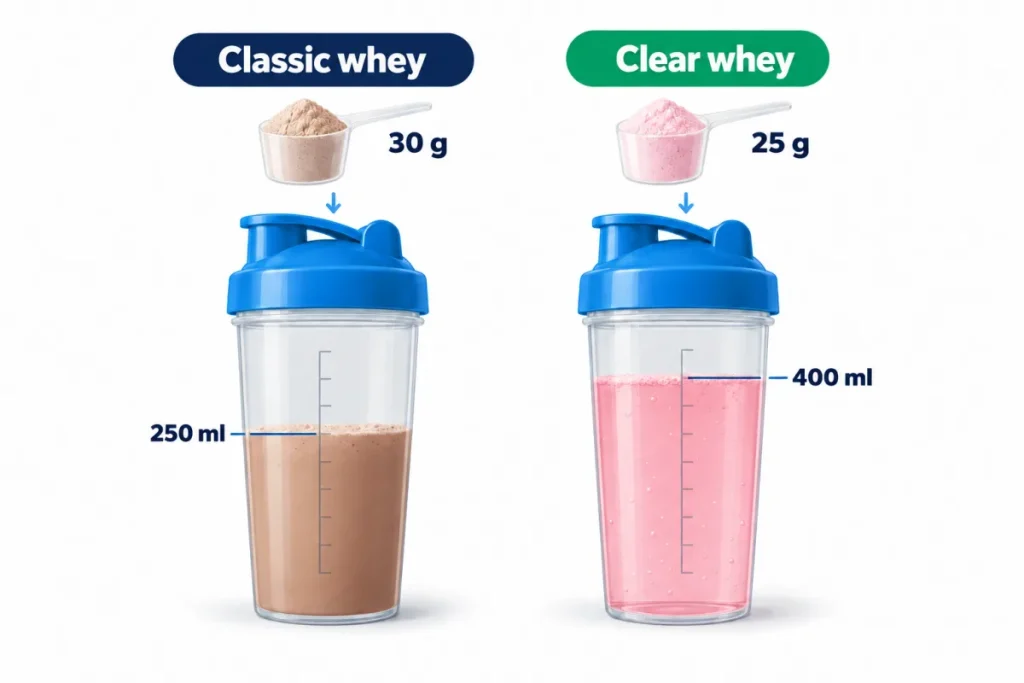
If your scoop is not 30 g, keep the proportion: around 6 to 8 ml of water per gram of powder. A half serving of 15 g goes into 100 to 120 ml, a double serving of 60 g into roughly 500 ml, which calls for a shaker of at least 700 ml if you want room to shake it. Picking the right capacity is covered in our protein shaker guide.
🥤 Thick or light: tuning the water to your taste
Less water gives a thicker shake that tastes sweeter in the mouth, more water a lighter and more refreshing one. The protein stays exactly the same, so you can set the texture however you like without losing anything.
- 150 to 200 ml: creamy texture, strong flavour. Good for a chocolate or vanilla.
- 250 ml: the brands’ standard, the balance between texture and taste.
- 300 ml and up: a light drink, handy after a session where you sweated a lot, or for a whey that is too sweet for your taste.
- Just a few spoonfuls: with very little liquid, whey turns into a cream you eat with a spoon, pudding-style.
The first time, weigh the powder and measure the water, then note which graduation line on your shaker suits you. After that you can make your shake by eye in seconds. For richer variations (fruit, oats, coffee), move on to our whey protein shake recipes.
🧊 Avoiding lumps: the order and the temperature
Always pour the liquid in before the powder: that is the order Nutrimuscle gives in its directions for use, and it is what stops a block of powder caking at the bottom. Then close it, shake for 10 to 20 seconds, and it is ready.
- Cold water: Optimum Nutrition and MyProtein both recommend cold water, the powder disperses well in it and the taste is nicer.
- A mixer ball or mesh: a shaker fitted with one breaks lumps up far better than a plain glass.
- Clear whey: let the foam settle for a moment after shaking, as MyProtein advises.
- Weigh rather than count scoops: powder settles over time, and MyProtein itself recommends weighing for an accurate measure.
ℹ️ Good to know
In a hot liquid, whey tends to clump. To add it to a coffee or a porridge, slacken it first in a little cold liquid, then pour the rest in. For ideas on cooking with the powder, see our whey protein recipes.
🥛 Why water stays the default liquid
Water adds no calories at all: your shake stays at around 115 kcal for 30 g of whey. It is also free, available everywhere (gym, office) and needs no refrigeration before you mix. It is the right choice if you are watching your weight or drinking your shake away from home.
Milk gives a smoother texture but adds roughly 85 to 165 kcal per 250 ml depending on whether it is skimmed or whole (ANSES Ciqual table), along with some lactose. Manufacturers allow it at the same ratio as water. The full calorie breakdown by liquid is in our article on whey protein calories, and the choice between water, milk, plant drinks or juice is in what to mix whey protein with.
✅ Our verdict on the whey to water ratio
Our advice: start from 250 ml of cold water for 30 g, then take away or add 50 ml to suit your taste. That is the manufacturers’ setting and it works with almost every standard whey. The only exceptions are clear whey, which needs around 400 ml, and “meal” shakes loaded with oats or fruit, which are better made in a blender with milk.
This guide will not help you if your problem is digestion rather than texture: bloating after a shake comes more often from the lactose in concentrate whey than from how much water you used. In that case an isolate is usually better tolerated, see which whey protein to choose. For the whole routine, from picking the powder to putting the shaker away, read how to take whey protein.
❓ Frequently asked questions
How much water for 30 g of whey?
Around 250 ml of water for 30 g of whey, which is what MyProtein and Nutrimuscle recommend. Optimum Nutrition gives 180 to 240 ml for its 31 g scoop: below 200 ml, the shake starts to thicken up.
How much water for 2 servings of whey?
Count on roughly 500 ml for 60 g, keeping the same proportion. You will then need a shaker of at least 700 ml. Before you double the serving, check that you actually need to: 20 to 40 g of protein per serving is enough for most people who train.
Is the ratio the same with milk?
Yes, manufacturers give the same volume for water and for milk, 250 ml per 30 g. Milk makes the shake thicker at the same volume, so you can use slightly less if you find it too heavy.
Why does my whey go lumpy?
Usually because the powder went in before the liquid, or into a hot liquid. Put the cold water in first, use a shaker with a ball or a mesh, and shake for at least 10 seconds.
📚 Sources
- MyProtein Impact Whey Protein: suggested use (30 g in 250 ml) (in French)
- Nutrimuscle Whey Native Isolate: directions for use (in French)
- Optimum Nutrition Gold Standard 100% Whey: recommended use (in French)
- MyProtein Clear Whey Isolate: suggested use (25 g in 400 ml) (in French)
- ANSES Ciqual food composition table (milks) (in French)