

Contents 9 sections
- Casein vs whey: the comparison at a glance
- What is casein
- What is whey
- The one big difference between whey and casein
- Choosing between whey and casein by the moment
- Taking both whey AND casein
- Quick how-to guide for casein and whey
- Our verdict: casein or whey, which should you take
- Frequently asked questions
What is your main goal?
How do you digest dairy?
What matters most to you?
Summarise this article with:
💡 The essentials
Neither casein nor whey is “better”: whey is a fast protein, ideal around training, and casein is a slow protein, useful in the evening before bed.
- Only buying one powder? Go for whey, it is far more versatile.
- Want a shake in the evening? Take 30 to 40 g of casein before bed.
- Either way: your total protein across the day is what does most of the work.
Casein or whey: both come from milk, both are complete proteins, and yet they behave nothing alike once they are inside you. The whole difference comes down to how fast they release their amino acids, and that is what decides the right moment for each one.
For this comparison we went back to the landmark studies on the question rather than to the marketing claims. In a couple of minutes you will know which one to take, when, and at what dose.
⚖️ Casein vs whey: the comparison at a glance
| Criterion | Whey | Casein |
|---|---|---|
| Share of milk protein | Around 20% | Around 80% |
| Digestion speed | ★★★★★ (fast, short peak) | ★★☆☆☆ (slow, drawn-out plateau) |
| Stimulation of muscle protein synthesis | ★★★★★ | ★★★☆☆ |
| Braking of protein breakdown | ★★☆☆☆ | ★★★★★ |
| Leucine content | ★★★★★ (11%) | ★★★★☆ (9.3%) |
| Use before bed | ★★☆☆☆ | ★★★★★ |
| Day-to-day versatility | ★★★★★ | ★★★☆☆ |
The stars summarise the studies cited in this article (Boirie 1997, Tang 2009, ISSN 2017, Res 2012). Remember one simple rule: whey when you want protein quickly, casein when you are about to go a long stretch without eating.
🧀 What is casein?
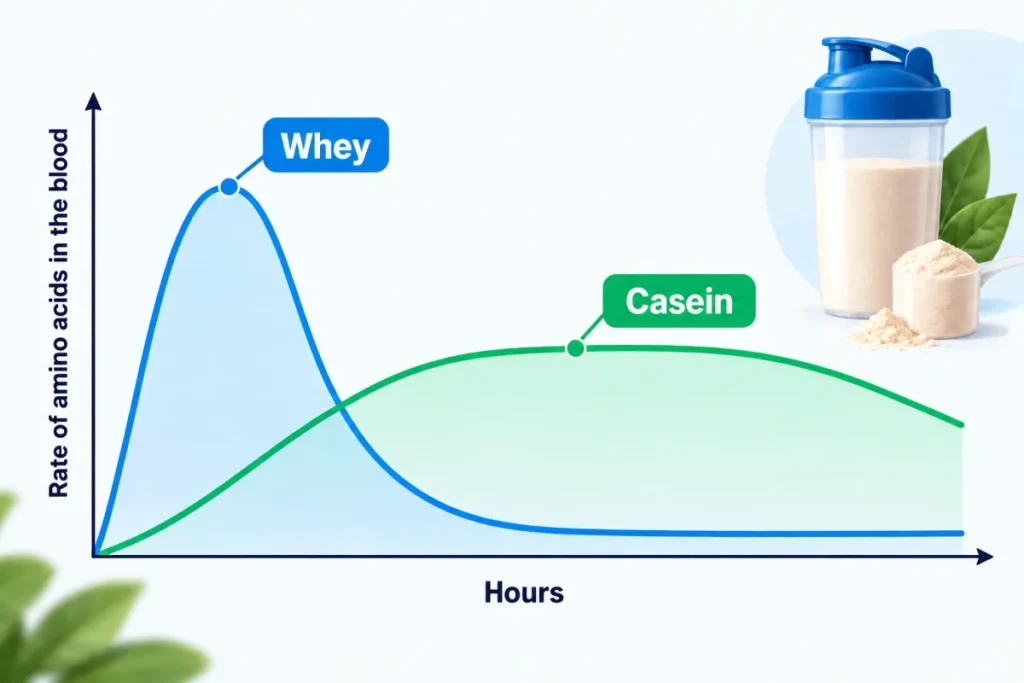
Casein is the dominant protein in cow’s milk, around 80% of its protein, and the main protein in cheese. Its defining trait: it clots in the stomach, which slows gastric emptying and spreads the arrival of amino acids in the blood over several hours (Boirie et al., 1997).
🥛 What is whey?
Whey is the liquid part left over once milk has curdled during cheesemaking. It accounts for roughly 20% of milk protein and moves quickly from the stomach into the gut: it is a fast-digesting protein. For the basics, see our article on what whey protein is.
🔬 The one big difference between whey and casein
Although whey and casein are both milk proteins, the pace at which your body takes them up makes them very different tools. The landmark study, run in Clermont-Ferrand, measured both in healthy adults: whey raised protein synthesis by 68%, against 31% for casein, but only casein slowed protein breakdown, by 34% (Boirie et al., 1997).
Over the 7 hours that followed the meal, the net leucine balance was in fact slightly better with casein. Put another way, whey builds fast and casein protects for longer: neither one wins on every count.
After a weights session, though, whey has a clear edge. In a Canadian study, muscle protein synthesis was about 122% higher with whey hydrolysate than with micellar casein, at an equal dose of essential amino acids (Tang et al., 2009). These readings cover a few hours, not months of training.
🎯 Choosing between whey and casein by the moment
When should you take casein?
Casein is the better option when you want a slow, steady release of amino acids, typically before bed, when your body is about to go several hours without food. In a Dutch study, 40 g of casein taken 30 minutes before sleep was digested well overnight and improved the night-time protein balance (Res et al., 2012).
Over the longer run the effect holds up: across 12 weeks of resistance training, young men who took 27.5 g of protein every evening before bed gained more strength and more muscle cross-sectional area than the placebo group (Snijders et al., 2015). Note that this group was also getting more protein than the other, which explains part of the gap.
When should you take whey?
Whey is the one to reach for when you want a fast, easy-to-digest protein source, above all after training. It is also the right pick if you simply want to lift your daily intake: it works at any time of day and mixes easily. Our guide to when to take whey protein goes through every possible slot.
🤝 Taking both whey AND casein
Taking both is a sensible strategy: whey after the session, casein in the evening. Whey delivers a fast arrival of amino acids, and casein takes over through the night. That is the logic behind the ISSN position stand, which recommends spreading intake every 3 to 4 hours and names casein before bed as a useful tactic.
Keep the priorities in order, though: a meta-analysis of 23 studies concluded that total protein intake is the main driver of muscle gain, well ahead of when you take it (Schoenfeld et al., 2013). If your budget only stretches to one powder, a single well-used whey is enough. To work out that total, see how much whey protein per day.
🕒 Quick how-to guide for casein and whey
Casein
Take 30 to 40 g of casein roughly 30 minutes before you go to bed: that is the range the ISSN settles on for raising muscle protein synthesis overnight. Mix it in your shaker with water or milk, depending on whether you are watching your calories.
Whey
To get the most out of your whey powder, take a serving of 20 to 40 g of protein within the 2 hours that follow your session, with water or milk depending on your goal. For the rest of the day it simply tops up what your meals do not provide. If you are unsure about the timing, this guide will help:
 Read nextWhen Should You Take Whey Protein?
🔬 Our method
We did not run a trial ourselves. We compared whey and casein using the published studies that measure them head to head (Boirie 1997, Tang 2009, Res 2012, Snijders 2015), the ISSN position stand on protein (2017) and a meta-analysis on timing (Schoenfeld 2013). The stars in the table reflect those results, not a taste preference.
✅ Our verdict: casein or whey, which should you take?
If you are only going to buy one powder, buy whey: it stimulates muscle protein synthesis better after a session, it is richer in leucine and it works at any hour. Casein is a very good evening add-on, but it is a second purchase, not a first.
In our view, casein is not for you if you already eat a protein-rich meal in the evening or if your budget is tight. And neither powder is suitable if you are allergic to milk protein. If you want to lose weight, bear in mind that no protein makes you slim on its own: the calorie deficit is what counts (see whey protein and weight loss).
⚠️ Watch out
ANSES, the French food safety agency, advises against protein supplements for anyone with kidney disease or diabetes, or who has had a nephrectomy, as well as for children, teenagers and women who are pregnant or breastfeeding. In those situations, or if you are on any medication, ask your doctor before taking whey or casein.
❓ Frequently asked questions
When should you take casein?
The most studied slot is the evening, about 30 minutes before sleep, at a dose of 30 to 40 g. It can also work before a long stretch without a meal. After training, whey remains the better fit.
What are the benefits of casein?
Its main strength is releasing amino acids slowly, which slows protein breakdown for several hours. Taken before bed, it raises protein synthesis overnight. Like any protein, it contributes to maintaining and growing muscle mass, a claim authorised in the European Union.
What are the drawbacks of casein?
It stimulates muscle protein synthesis less than whey in the hours right after a session. It contains milk protein, so it is off the table if you have a milk allergy. And it is an extra purchase: if your dinner already brings plenty of protein, you do not need it.
Can casein help you lose weight?
Not directly: no protein powder makes you lose weight on its own. In a calorie deficit, a high protein intake mainly helps you hold on to muscle mass. To pick a powder suited to that goal, read our round-up of the best whey protein for weight loss.
Can you take whey before bed instead of casein?
Yes, it is still a useful dose of protein, but casein suits the night better thanks to its slow digestion. If whey is all you have, taking it in the evening beats taking nothing when you are chasing your daily total. We cover that case in whey protein before bed.
📚 Sources
- Boirie et al. (1997), slow and fast dietary proteins: whey against casein
- Tang et al. (2009), muscle protein synthesis with whey, casein and soy
- Res et al. (2012), casein before bed and overnight recovery
- ISSN position stand on protein and exercise (2017)
- ANSES opinion on food supplements for athletes (2016) (in French)