Contents 6 sections
What is your main goal?
How do you digest dairy?
What matters most to you?
Summarise this article with:
💡 The essentials
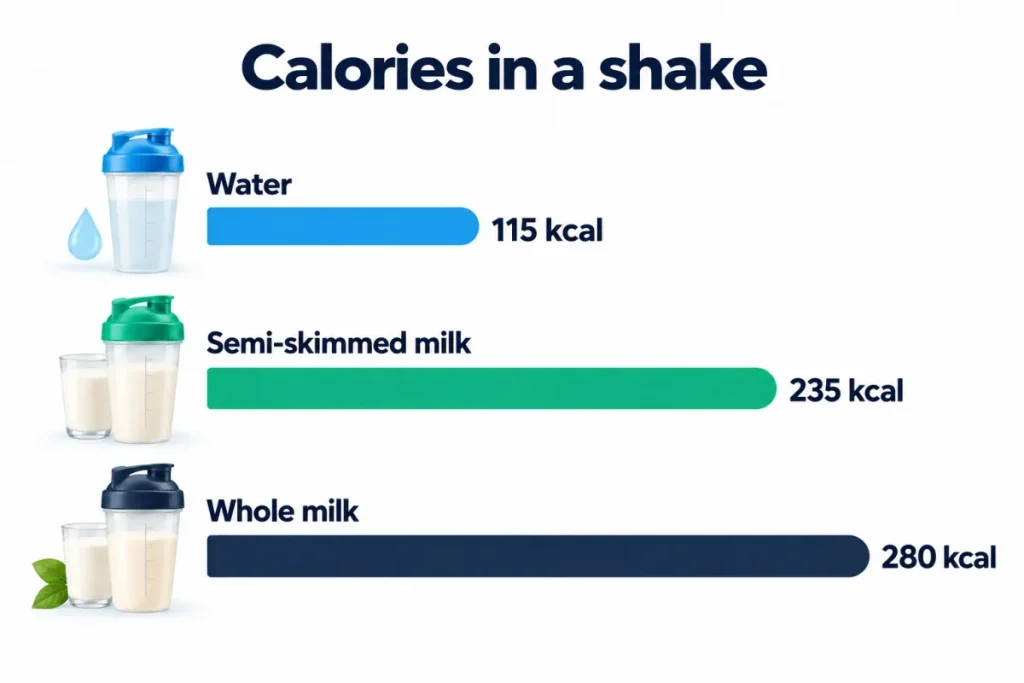
A 30 g serving of whey protein brings about 115 kcal, whether it is an isolate or a concentrate. What pushes the bill up is the liquid: with 250 ml of semi-skimmed milk, the shake climbs to around 235 kcal.
- Per 100 g of powder: 370 to 385 kcal across the wheys we checked.
- Isolate: not fewer calories per serving, but more protein for the same calories.
- With water, whey remains one of the least calorific ways to swallow 20 to 26 g of protein.
You may think whey protein contains almost no calories, or on the contrary that it blows up your daily total. Both ideas are wrong: one serving weighs in at about 115 kcal, neither nothing nor a lot, and it is mostly what you put around it that changes everything.
Here we stick to the numbers: calories per serving, by type of whey and by liquid, taken from manufacturers’ labels and from the ANSES Ciqual table. If your real question is whether whey makes you put on weight, read our article on does whey protein make you fat? instead.
🔬 Our method
We measured nothing in a laboratory: we compared the published nutrition values on the product sheets of several wheys (checked in October 2026) and the values for milks and plant drinks in the ANSES Ciqual table. The calculations for 250 ml assume that one millilitre of milk weighs about one gram, which gives you orders of magnitude, not values accurate to the gram.
📊 How many calories in 100 g of whey protein?
Count on 370 to 385 kcal per 100 g of powder across the wheys on the market that we follow. Protein supplies 4 kcal per gram, and a whey is mostly protein: the total therefore varies little from one brand to another.
| Whey (product sheet, checked October 2026) | Type | Kcal / 100 g | Protein / 100 g | Kcal per 30 g serving |
|---|---|---|---|---|
| Nutripure Whey Isolate Native (unflavoured) | Isolate | 382 kcal | 86.8 g | about 115 kcal (26 g of protein) |
| Nutrimuscle Whey Native Isolate (plain) | Isolate | 373 kcal | 85.5 g | about 112 kcal (26 g of protein) |
| Optimum Nutrition Gold Standard 100% | Concentrate and isolate blend | 374 kcal | 76 g | about 112 kcal (23 g of protein) |
| MyProtein Impact Whey Protein | Concentrate | about 380 kcal | about 73 g | 114 kcal (22 g of protein) |
The old “400 kcal per 100 g” figure doing the rounds is not far off, then, but it rounds upwards. The real difference between two wheys is not the calories, it is how much protein you get for those calories. The detail of the macronutrients, amino acids and additives is in our guide to whey protein composition.
🥛 How many calories in a whey shake (water or milk)?
With water, a 30 g shake stays around 115 kcal. The moment you swap the water for milk or a plant drink, you add the equivalent of a small snack: 85 to 165 kcal depending on the liquid, for 250 ml.
| Liquid (250 ml) | Kcal added (Ciqual) | Protein added | Total with 30 g of isolate |
|---|---|---|---|
| Water | 0 kcal | 0 g | about 115 kcal |
| UHT skimmed milk | about 85 kcal | about 9 g | about 200 kcal |
| Unsweetened almond drink | about 90 kcal | about 3 g | about 205 kcal |
| Plain soya drink | about 95 kcal | about 8 g | about 210 kcal |
| UHT semi-skimmed milk | about 120 kcal | about 8 g | about 235 kcal |
| UHT whole milk | about 165 kcal | about 8 g | about 280 kcal |
Milk is not the enemy: it also adds 8 to 9 g of protein, some calcium and a creamier texture. It only becomes a problem if you are counting your calories closely and taking several shakes a day. To pick the right liquid for your goal, see what to mix your whey with, and for the right amount of water per serving, our guide to the whey to water ratio.
⚖️ Whey isolate or concentrate: which has fewer calories?
Gram for gram, an isolate does not have fewer calories than a concentrate: 30 g comes to about 112 to 115 kcal either way. What the isolate does have is more protein and less lactose, carbohydrate and fat. The result: to get 25 g of protein you need slightly less powder, and therefore slightly fewer calories.
In practice, the gap is around 15 to 20 kcal per shake for the same amount of protein. That is real but modest: when dieting, your choice of liquid and your number of shakes weigh far more. Isolate still has its place if you digest lactose poorly or if you want a very pure product. Our detailed pick is in the comparison of the best whey protein for weight loss.
Among the isolates, the Nutripure Whey Isolate Native shows 86.8 g of protein for 382 kcal per 100 g, with no sweetener in its unflavoured version. It is the one we recommend when you are watching your calories, taken with water. Nutripure is a French brand and ships from France.
🎯 How to fit whey calories into your goal
Whey has no “special” calories: its 115 kcal count exactly like those of any other food. It replaces or tops up a meal, it is not added for free. How many servings are useful depends on your total protein needs, which we set out in how much whey protein per day.
- When cutting: whey with water, counted in your total, ideally in place of a sugary snack. More detail in whey protein and weight loss.
- When maintaining: water or milk as you prefer, the gap of about 120 kcal is easy to claw back elsewhere.
- When bulking: whole milk, porridge oats, a banana or peanut butter turn the shake into a proper liquid meal.
🍌 Need easy calories? The homemade mass gainer
If you struggle to eat enough to put on weight, a homemade shake with 30 g of whey, 250 ml of whole milk, 50 g of porridge oats and a banana brings about 550 kcal (calculated from Ciqual). We prefer this version to a shop-bought gainer: you keep control of the ingredients and the amount. The choice between the two is explained in whey or mass gainer, and a full recipe is in our mass gain shake without whey.
💡 Our verdict
For us, whey is a “cheap” food in calorie terms: about 115 kcal for 22 to 26 g of protein, and few foods do better. If you are watching your waistline, take it with water and count it into your day, isolate or concentrate depending on your digestion. It is not for you, though, if you are after a product that would make you lose weight on its own, or if you add it to meals that are already generous: there, those really are extra calories. To work out your needs, you can use this calorie calculator (in French).
❓ Frequently asked questions
How many calories in 30 g of whey protein?
About 112 to 115 kcal for 30 g of powder, according to the product sheets we checked. That works out at 22 g of protein for a whey concentrate and about 26 g for an isolate.
How many calories in a whey shake with milk?
About 235 kcal with 250 ml of semi-skimmed milk, and about 280 kcal with whole milk. Skimmed milk brings the total back towards 200 kcal. These values are calculated from the ANSES Ciqual table.
Is whey isolate lower in calories?
Not gram for gram, but it brings more protein for the same calories. To get 25 g of protein, the saving is in the order of 15 to 20 kcal per shake compared with a concentrate.
Does whey protein make you fat?
No, no more than any other food: it is a calorie excess over the day that makes you gain fat. A whey added to meals that are already sufficient can feed a surplus; a whey that replaces a sugary snack does not. We go into this in does whey protein make you fat?