Contents 7 sections
- What changes with a whey isolate (and what does not)
- Timing matters less than the total amount
- When to take your whey isolate to build muscle
- When to take your whey isolate when cutting or losing weight
- Morning, evening and rest days
- Our verdict: when isolate really earns its price
- Frequently asked questions
What is your main goal?
How do you digest dairy?
What matters most to you?
Summarise this article with:
💡 The essentials
Take your whey isolate whenever it helps you hit your protein for the day: most often after your session, or as a snack. What sets it apart from whey concentrate is not the time of day, it is its composition.
- Around your training: before or after, both work.
- Its real strength: very little lactose and fat, so it sits lighter just before a session, when cutting, or if milk bothers you.
- At bedtime: possible, but casein is the best studied protein for the night.
You have bought an isolate, often pricier than a concentrate, and you want to get the most out of it. Good news: the timing rules are the same as for any whey, and they are simple. Your total protein over the day matters far more than the clock.
This article focuses on what is specific to isolate: the situations where its composition makes a genuine difference. For the general rule that applies to every whey, see our guide on when to take whey protein.
🔬 Our method
We ran no trials ourselves. We cross-checked the official definition of isolate (American Dairy Products Institute), the International Society of Sports Nutrition (ISSN) position stands on protein and on nutrient timing, a meta-analysis on protein timing and a review on pre-sleep protein. The nutrition figures come from the official product sheets.
🥛 What changes with a whey isolate (and what does not)
According to the American Dairy Products Institute standard, a whey isolate contains at least 90% protein on a dry matter basis, typically with 0.5 to 1% lactose and 0.5 to 1% fat. It is that heavier filtration that makes it lighter than a concentrate. For the detail of the process, see what whey isolate is.
On the other hand, isolate is still a whey protein, digested quickly like every other whey. It has no “window” of its own. What changes is digestive comfort and calories per serving, two criteria that matter depending on the moment you choose. Our comparison of whey isolate vs whey concentrate covers the other differences.
| Moment | Whey isolate | Whey concentrate |
|---|---|---|
| Just before the session (light stomach) | ★★★★★ | ★★★☆☆ |
| After the session | ★★★★★ | ★★★★★ |
| Snack while cutting (calories per serving) | ★★★★★ | ★★★★☆ |
| Lactose sensitivity | ★★★★☆ | ★★☆☆☆ |
| Just before sleep | ★★☆☆☆ | ★★☆☆☆ |
How to read the table: isolate only wins where lactose and fat play a part. After a session, the two are equal. Before sleep, neither is the best choice, because both are fast proteins.
🕒 Timing matters less than the total amount
A 2013 meta-analysis on protein timing concludes that once the other factors are accounted for, taking your protein right around your session has no significant effect on strength or hypertrophy. The best predictor is still your total intake for the day.
So the ISSN recommends hitting your daily requirement first, with servings of 20 to 40 g of protein spread out every 3 to 4 hours. Your isolate is there to fill in the meal or snack that falls short. To work out your requirement from your body weight, see how much whey protein per day.
💪 When to take your whey isolate to build muscle
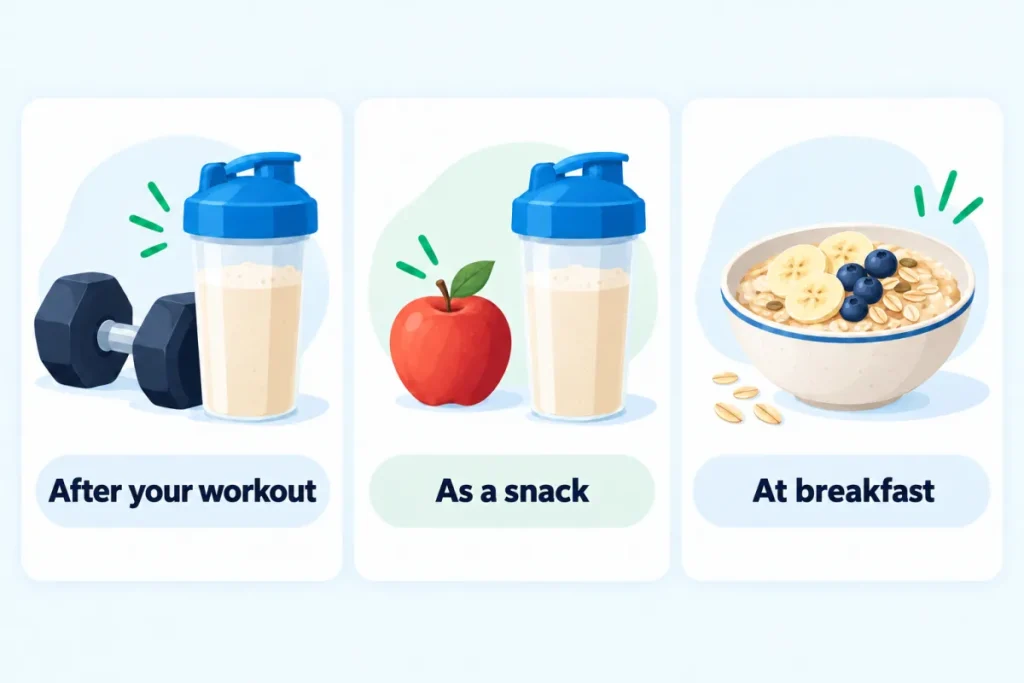
The simplest approach is to take your isolate after your session, especially if your next meal is a long way off. The ISSN position stand on nutrient timing (2017) states that a quality protein taken anywhere between immediately and 2 hours after training strongly stimulates muscle protein synthesis.
If you prefer taking it before, that works too: in a trial run on 21 trained lifters, 25 g of protein taken just before or just after the session gave the same results over 10 weeks (Schoenfeld et al., 2017). That is exactly where isolate is interesting: less lactose and less fat, so less risk of feeling heavy during your effort. It is all detailed in taking whey protein before training.
🔥 When to take your whey isolate when cutting or losing weight
When cutting, keep one shake around your training to protect your muscle, and put any second one in as a snack, in place of a sugary nibble. The ISSN notes that intakes of 2.3 to 3.1 g/kg/day can help trained lifters hold on to their lean mass in a calorie deficit.
On calories, isolate has a slight edge: a 30 g serving of the Nutripure whey isolate brings about 115 kcal for 26 g of protein (product sheet: 382 kcal and 86.8 g of protein per 100 g). Careful though, whey does not make you lose weight on its own: it helps if it replaces a more calorific snack, not if it is added on top. Our guides to whey isolate and weight loss and whey protein calories go further.
🌅 Morning, evening and rest days
In the morning, isolate is useful if your breakfast is low in protein (toast, cereal). One serving in a bowl of porridge oats or some fromage blanc is enough to lift that meal.
Just before sleep, isolate is not the best tool: it is a fast protein. The ISSN points instead to 30 to 40 g of casein before bed to support overnight muscle protein synthesis. See whey protein before bed and our comparison of casein or whey.
On days without training, isolate keeps its place if your diet does not cover your requirement. Put it at your least protein-rich meal, as explained in whey protein on rest days.
✅ Our verdict: when isolate really earns its price
For us, isolate is mainly justified if you take your shake just before training, if lactose bothers you or if every calorie counts while you are cutting. In those cases its composition genuinely changes your comfort. For a post-session shake in someone who digests milk well, a quality concentrate does the same job.
Isolate is not for you if you are allergic to milk proteins: the filtration removes the lactose, not the proteins responsible for the allergy. And if you have kidney or liver disease, if you are pregnant or under 18, ask a doctor for advice before raising your intake. The precautions specific to this type of whey are in whey isolate: what are the dangers, and our pick is in the best whey isolate.
❓ Frequently asked questions
What is the best time to take whey isolate?
After your session or as a snack, whichever helps you reach your protein total. The studies show that the daily amount counts for more than the exact hour; before or after training give comparable results.
What are the drawbacks of whey isolate?
It often costs more than a concentrate and it is not suitable for anyone allergic to milk proteins. It contains little lactose, but not necessarily zero. The other points to watch are in our article on the dangers of whey isolate.
Is it good to take whey isolate before sleeping?
It is possible, but it is not the best studied choice. The research on pre-sleep protein mostly uses 20 to 40 g of casein, a slow protein. An isolate in the evening is still useful if it tops up a dinner that is light on protein.
Is it good to take whey isolate every day?
Yes, for a healthy adult whose diet does not cover their protein requirement. It tops up your meals, it does not replace them. If you have kidney or liver disease, ask your doctor for advice first.
How many times a day should you take whey isolate?
Once or twice a day is enough for most people. Aim for servings of 20 to 40 g of protein spaced 3 to 4 hours apart, and let food supply most of the rest.
📚 Sources
- American Dairy Products Institute, definition and composition of whey protein isolate
- ISSN position stand on protein and exercise, 2017
- ISSN position stand on nutrient timing, 2017
- Schoenfeld, Aragon and Krieger, meta-analysis on protein timing, 2013
- Schoenfeld et al., protein before or after the session, PeerJ 2017