Contents 5 sections
What is your main goal?
How do you digest dairy?
What matters most to you?
Summarise this article with:
💡 The essentials
Yes, you can take whey protein without working out, but it will not build you any muscle. It is only useful if your diet is short on protein.
- Useful: an older adult with a small appetite, a low-calorie diet, meals that are often low in protein.
- Pointless: if you already eat enough protein, it mainly adds calories.
- Dose: one 20 to 30 g serving is plenty, counted within your meals.
Whey is a powdered milk protein, used mostly by athletes to reach their protein needs. But it is neither a medicine nor a gym-only product: it is a food, and you can eat it without training. The real question is whether it brings you anything.
In this article we look at what whey does (and does not do) without physical activity, the cases where it is worth it and how to use it without putting on weight. If you do train and want to know what to do on days off, that is another subject, covered in whey protein on rest days.
💪 Can you build muscle with whey protein and no exercise?
No: without training, whey on its own does not make muscles grow. Muscle is built when an effort (above all resistance training) stimulates it and protein supplies the material to rebuild. Without that stimulus, the extra protein is used for other functions or burned as energy.
The studies confirm this in older adults, the group where an effect is most hoped for. In the meta-analysis by Kirwan et al. (2022, 28 trials), raising protein brought nothing at all on lean mass or strength without resistance exercise, whereas a benefit did appear when participants trained. In younger people, the meta-analysis by Morton et al. (2018) only covers people who lift weights: it is the training plus protein pairing that works.
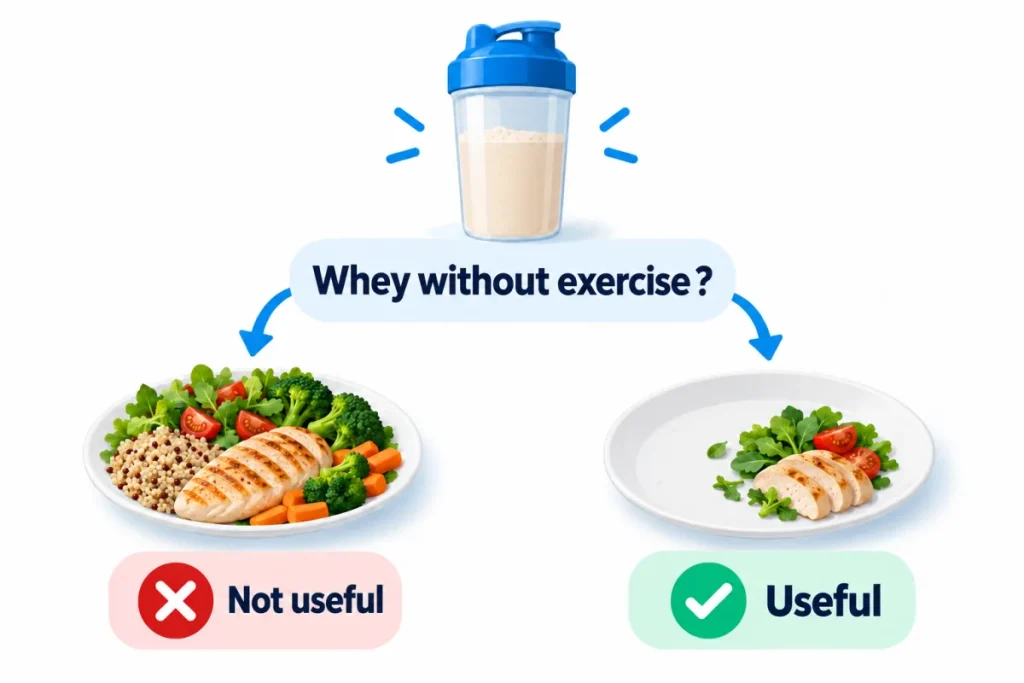
🎯 When whey protein without exercise is worth it
A sedentary adult needs roughly 0.83 g of protein per kilo per day according to the EFSA and ANSES, which is about 58 g for 70 kg. Yet, according to the INCA1 survey quoted by ANSES, French adults eat an average of 1.4 g per kilo: almost all of them already cover their needs from their meals. So whey is only worth it in situations where the plate does not keep up.
After 65, or with a small appetite
The experts of the PROT-AGE group recommend at least 1.0 to 1.2 g of protein per kilo per day after 65, which is 70 to 84 g for 70 kg, and that is hard when you eat little meat or fish. A serving of whey in a dairy product or a soup helps close the gap. A 2023 meta-analysis (Nasimi et al.) found a benefit of whey on lean mass in frail or sarcopenic older people, but not in healthy older adults. Suitable physical activity is still recommended alongside it, and medical advice is essential if you have kidney disease.
While dieting
When you eat less, keeping enough protein helps limit muscle loss and cope with hunger. A meta-analysis in people living with excess weight (Wirunsawanya et al., 2018) links whey to slightly more fat loss and better preservation of lean mass, with modest effects. The instructions are in our article on whey protein and weight loss.
When meals are often low in protein
A sugary breakfast, a sandwich on the go, quick ready meals: some days fall below your needs very quickly. A serving of whey stirred into porridge or fromage blanc rebalances the meal without any cooking. If you prefer real food, our list of what can replace whey protein does the job just as well.
⚠️ Watch out
ANSES advises against sports supplements without medical advice for people with kidney or liver disease, for children and teenagers, and for women who are pregnant or breastfeeding. If you are allergic to milk proteins, whey is off the table. Talk to your doctor if any of this applies to you.
⚖️ The real risk without exercise: surplus calories
A 30 g serving brings about 115 kcal with water, and more than 230 kcal with semi-skimmed milk. If you add it to meals that are already complete, with no extra energy spent, those are extra calories every single day. Whey does not make you fat in itself, but a daily surplus does: we explain the mechanism in does whey protein make you fat? and the numbers in whey protein and calories.
The simple rule: without exercise, whey replaces something (a snack, part of a meal), it does not get added on top. And it does not make up for not moving: regular physical activity, even modest, will always do more for your muscles than a shaker.
🔬 Our method
We did not test anything ourselves: we cross-checked the official references and the meta-analyses (EFSA and ANSES for requirements, the PROT-AGE group for older adults, Kirwan 2022 and Nasimi 2023 for whey without exercise, Wirunsawanya 2018 for dieting), together with manufacturers’ labels for the calories.
🥄 How to take whey protein when you are not an athlete
- One 20 to 30 g serving a day is enough in the vast majority of cases, rarely more. The calculation for your body weight is in how much whey protein per day.
- At your lowest-protein meal, often breakfast: in porridge, fromage blanc or yoghurt.
- With water if you are watching your weight, with milk if your appetite is lacking.
- In a recipe: pancakes, crepes or a smoothie, see our whey protein recipes.
Choose a simple whey, with few additives and a flavour that works with your recipes: an unflavoured version slips into anything, a vanilla one makes a dairy dessert more pleasant. An isolate suits you better if you digest lactose poorly.
Our preference goes to the Whey Isolate Native from Nutripure, whose unflavoured version contains neither sweetener nor flavouring: it disappears into fromage blanc or a soup. Nutripure is a French brand and ships from France.
💡 Our verdict
For us, whey without exercise is a stopgap, not a habit to pick up by default. It does a service for an older person who eats little, for someone on a diet or stringing together low-protein meals. It is not for you if you already eat meat, fish, eggs or dairy at every meal, or if you are hoping to “tone up” without moving: in those cases, keep your money, or put it into some physical activity. If you still want to try, search for “whey” on the Nutripure site, which ships from France.
❓ Frequently asked questions
Is it possible to build muscle without exercise?
No, not to any noticeable degree: without muscular effort, extra protein does not build muscle. The meta-analyses in older adults find no lean mass gain from more protein without resistance exercise. Two strengthening sessions a week make the difference.
Is it good to take whey protein every day?
For a healthy adult, one serving a day counted within your diet is not a problem. The EFSA considers a protein intake of up to twice the 0.83 g per kilo reference to be safe. If you have kidney disease, ask your doctor for advice.
What does whey protein do to your body without exercise?
It supplies good quality protein, and nothing more. It can help an older adult cover their needs or help you stick to a diet, but it does not burn fat and it does not tone anything. Taken on top of full meals, it adds calories.
What are the risks of whey protein?
In a healthy adult, the main discomfort is digestive, often linked to lactose. People with kidney disease or a milk protein allergy, pregnant women and under-18s should seek medical advice. The full picture is in whey protein: what are the dangers?
📚 Sources
- Kirwan et al. (2022), meta-analysis: protein, exercise and lean mass in older adults
- PROT-AGE group (2013), protein intake recommendations after 65
- Nasimi et al. (2023), meta-analysis of whey protein and sarcopenia
- EFSA (2012), dietary reference values for protein
- ANSES (2007), protein intake: consumption, requirements and recommendations (in French)
- ANSES (2016), opinion on food supplements for athletes