Contents 8 sections
Summarise this article with:
💡 The essentials
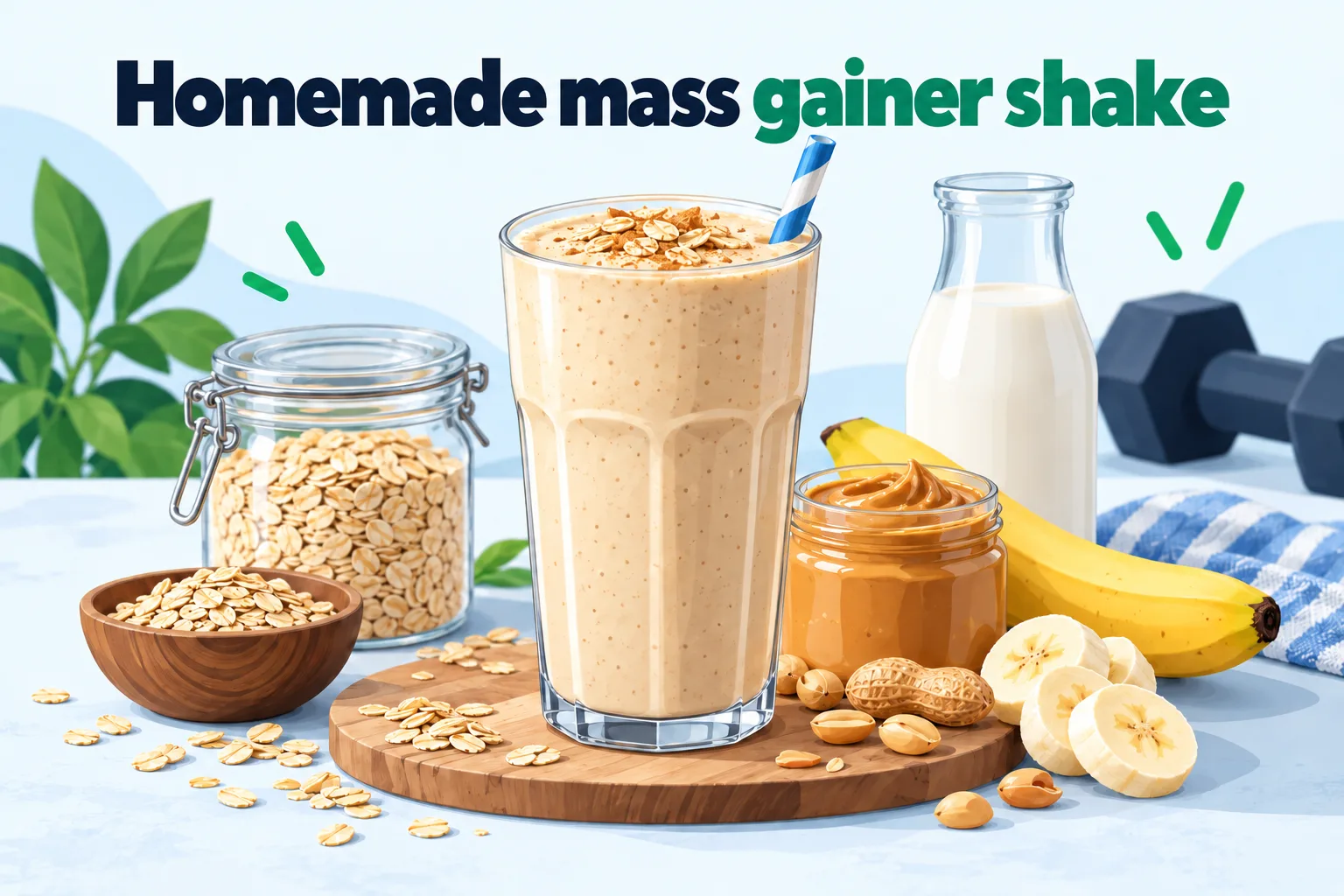
Our homemade mass gainer shake blends milk, fromage blanc, rolled oats, banana and peanut butter: around 830 kcal and 37 g of protein, with no powder at all.
- Lactose-free version: soya drink and silken tofu, around 780 kcal and 32 g of protein.
- Worth remembering: this is the equivalent of a meal, so drink it between meals to build a calorie surplus.
If you are looking for a mass gainer shake recipe without whey, you are in the right place. When you are trying to build muscle but struggle to eat enough, a high-calorie homemade shake is usually easier to get down than yet another plate of food.
We have rebuilt our old recipe from scratch. Recalculated ingredient by ingredient, the almond milk version only came to about 450 kcal and 12 g of protein, far too little for a bulk. The new recipe swaps the almond drink for milk and fromage blanc, and adds rolled oats.
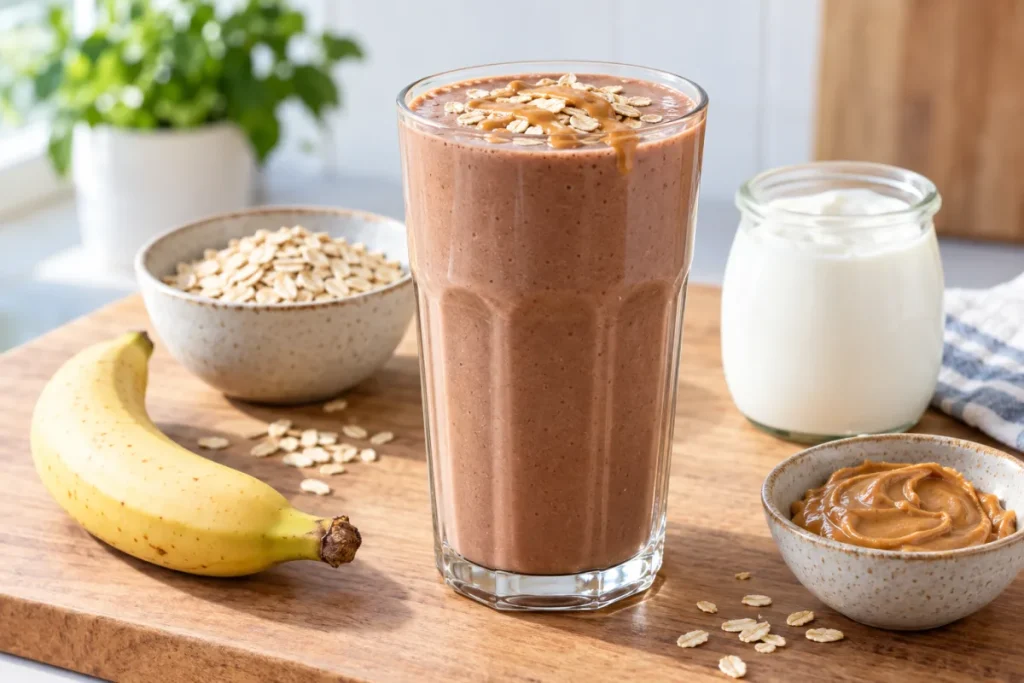
🍳 The homemade mass gainer shake recipe
Ingredients and kit (1 large shake, about 650 ml)
- 300 ml of semi-skimmed milk
- 150 g of plain fromage blanc at 3% fat (quark or fromage frais works too)
- 60 g of rolled oats
- 1 ripe banana (about 120 g peeled)
- 30 g of peanut butter
- 5 g of unsweetened cocoa powder
- 10 g of honey
- 1 pinch of cinnamon, optional
- Kit: a blender (essential for breaking down the oats)
How to make it, step by step
- Blitz the rolled oats dry first, for a few seconds, until you have a fine flour: that is what makes the shake smooth instead of gritty.
- Add the milk, the fromage blanc and the banana, cut into chunks.
- Add the peanut butter, the cocoa, the honey and the cinnamon.
- Blend for 45 seconds to 1 minute, until the texture turns creamy. Too thick? Add a splash more milk.
- Pour it into a tall glass or a bottle and drink it slowly, over 10 to 15 minutes if the volume feels like a lot.
📊 Nutrition facts for the mass gainer shake
One shake delivers around 830 kcal, 37 g of protein and 93 g of carbs, which is the profile of a proper meal. The old version of this article claimed 400 kcal and 18 g of protein; with 300 ml of almond milk, the maths actually came out at about 450 kcal and 12 g of protein.
| Per shake | Milk and fromage blanc version | Soya and silken tofu version |
|---|---|---|
| Energy | around 828 kcal | around 781 kcal |
| Protein | around 36.8 g | around 31.9 g |
| Carbs (of which sugars) | around 93 g (51 g) | around 80 g (34 g) |
| Fat (of which saturates) | around 30.6 g (10.5 g) | around 31.8 g (6 g) |
| Fibre | around 13 g | around 16 g |
| Salt | around 0.7 g | around 0.5 g |
The sugars in the dairy version come mostly from the banana and from the lactose in the milk, not from a big scoop of added sugar: the honey only accounts for 10 g. For a lighter shake, drop half the peanut butter (about 100 kcal less).
🔬 Our method
Every figure is calculated from the Ciqual 2025 table published by ANSES, the French food safety agency (in French), ingredient by ingredient: semi-skimmed milk, plain fromage blanc at 2 to 3% fat, rolled oats, raw banana, peanut butter, unsweetened cocoa, honey; and for the plant-based version, plain soya drink and silken tofu.
These are calculations, not laboratory analyses. We applied the same method to the old recipe in this article to check its numbers, and that is what led us to replace it.
🌱 The dairy-free, lactose-free version
Swap the milk for 300 ml of plain soya drink and the fromage blanc for 150 g of silken tofu, and change nothing else. You end up with around 780 kcal and 32 g of protein, and fewer sugars since there is no lactose left.
Avoid almond drink for this shake: according to Ciqual it contains around 1 g of protein per 100 g, against around 3.2 g for soya drink. That is exactly what made the old recipe so low in protein.
⚖️ Homemade shake, whey shake or mass gainer?
For bulking, what counts is your total calorie intake, and the homemade shake delivers it with everyday food. A standard whey shake (30 g of whey, 250 ml of milk and a banana) comes to around 335 kcal and 34 g of protein by our calculation: the same protein, but 2.5 times fewer calories. For shop-bought mass gainers, see our comparison of whey vs mass gainer.
| Criterion | Homemade, milk and fromage blanc | Homemade, soya and tofu | Whey and milk shake |
|---|---|---|---|
| Calories for bulking | ★★★★★ | ★★★★★ | ★★☆☆☆ |
| Protein | ★★★★☆ | ★★★★☆ | ★★★★☆ |
| Lactose-free | ★☆☆☆☆ | ★★★★★ | ★★☆☆☆ |
| Speed | ★★★☆☆ | ★★★☆☆ | ★★★★★ |
| Supermarket ingredients | ★★★★★ | ★★★★★ | ★★☆☆☆ |
🕒 When should you drink your shake to gain mass?
Drink it between meals or after training, on top of your usual meals: it is that surplus that puts weight on. The ISSN position stand on diets and body composition is a reminder that lean mass gains rest on a sustained calorie surplus, paired with resistance training.
On the protein side, aim for 1.4 to 2.0 g per kg of bodyweight per day, in servings of 20 to 40 g every 3 to 4 hours, according to the ISSN position stand on protein. Our guide to whey protein for mass gain sets out how to organise your day.
Drink it straight away if you can; otherwise keep it in the fridge and finish it within 24 hours. The oats thicken the mix while it waits, so shake it up or loosen it with a little milk before you drink it.
🥛 Our alternative for shakes with whey in them
If whey agrees with you, adding 30 g of whey isolate to this shake buys you another twenty-odd grams of protein. With a whey isolate at 81 g of protein per 100 g (the label on Nutrimuscle’s Whey Native Isolate), 30 g brings around 24 g of protein. Nutripure sells a whey isolate too:
To take a look, click the button below:
 Read nextBest whey protein for bulking
🎯 Our verdict
This is the recipe we recommend to the “hardgainers” who cannot manage to eat enough: 830 kcal in one glass, from supermarket ingredients, with no powder to buy. The fromage blanc does most of the work on protein, while the oats and the peanut butter do it on calories.
This shake is not for you if you are trying to lose weight or lean down: go for our protein shake without whey instead, which is far lighter. In its dairy form it is also unsuitable for anyone allergic to milk protein, and some people will find the volume hard to drink in one go: if that is you, split it into two servings.
⚠️ Watch out
This shake contains milk (or soya), peanuts and oats. If you have a food allergy, kidney disease, diabetes or you are pregnant, ask your doctor before adding an intake this high in calories and protein to your diet. On lactose intolerance, the French national health service (in French) advises matching your dairy portions to your own tolerance.
❓ Frequently asked questions
How do you gain mass without whey?
By eating more calories than you burn, consistently, with enough protein and a weights programme behind it. Whey is only a convenient way of hitting your protein target; milk, fromage blanc, eggs, soya or tofu do exactly the same job.
What should go in a homemade mass gainer shake?
A protein base (milk, fromage blanc, soya), a carb source (rolled oats, banana) and a fat source (peanut butter, nuts). It is that combination that gets you past 800 kcal without spending more than 5 minutes on it.
How many calories should a mass gainer shake have?
There is no universal number: it all depends on the surplus you are aiming for across the day. Our recipe comes to around 830 kcal; drop half the peanut butter or half the oats to bring it down to about 720 kcal.
Can this shake replace a meal?
Now and then, yes, but when you are bulking it works better alongside your meals. Using it in place of a meal cancels out part of the calorie surplus you are chasing.