Contents 5 sections
What is your main goal?
How do you digest dairy?
What matters most to you?
Summarise this article with:
💡 The essentials
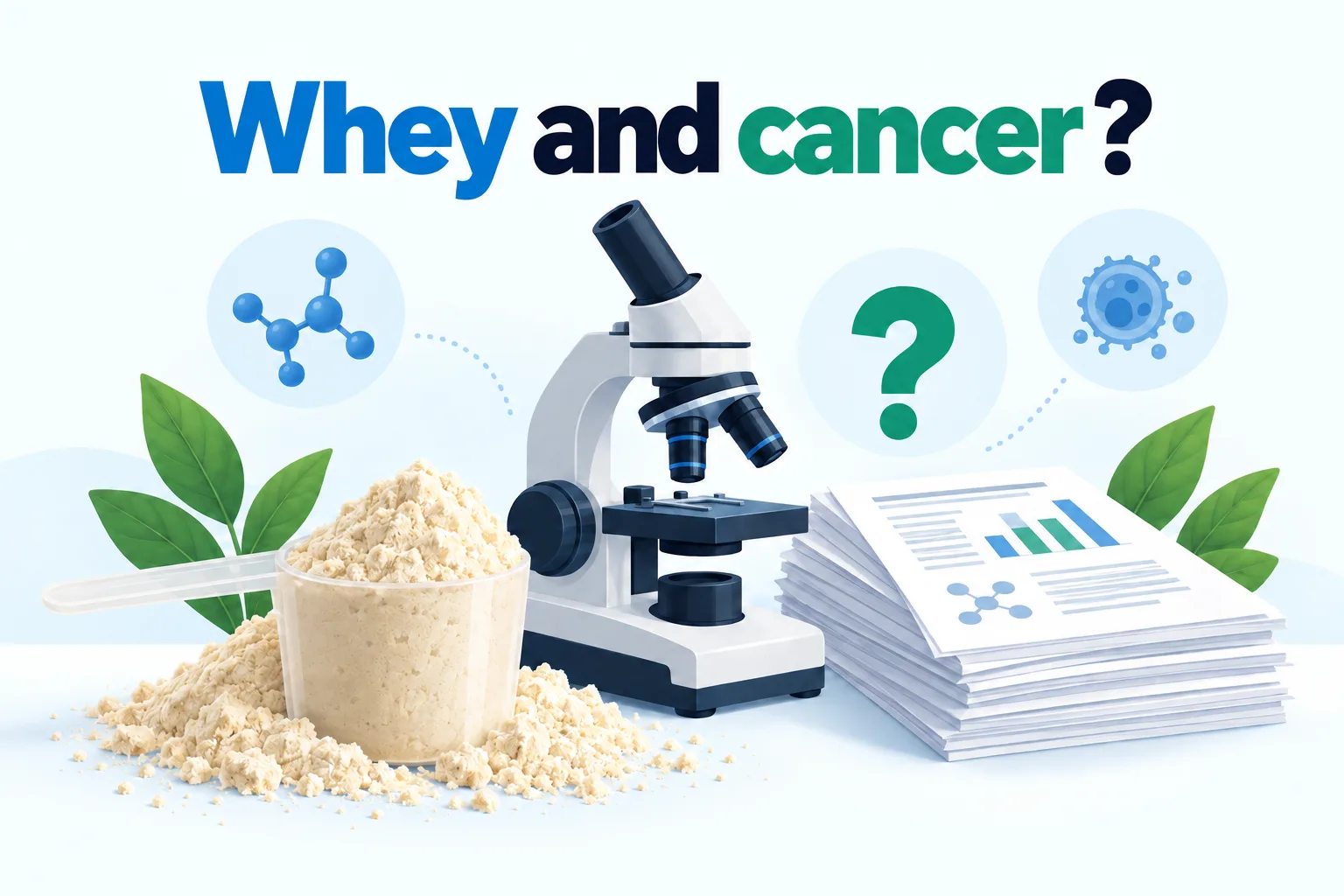
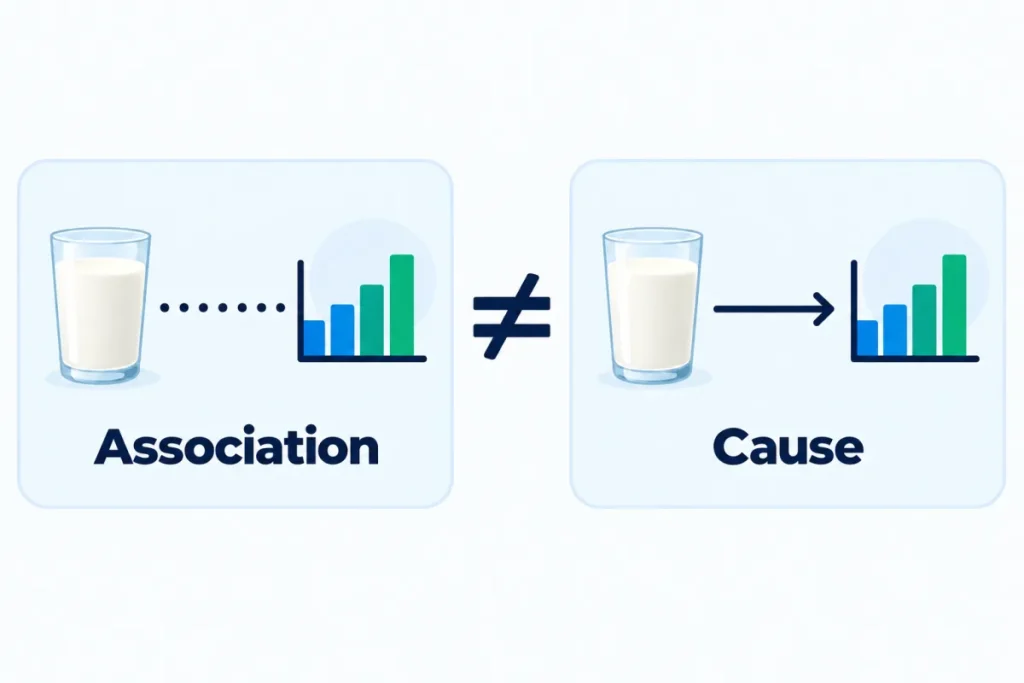
We found no study in humans showing that whey powder causes cancer. The data we do have is about dairy products in general, and it consists of statistical associations, not proof of cause.
- Dairy products: strong evidence of a lower risk of colorectal cancer, limited evidence of a slightly higher risk of prostate cancer.
- The “anti-cancer” effect of whey: mostly laboratory and animal studies, nothing that makes it a treatment.
- If you have cancer: no supplement at all without the advice of your care team.
“Animal proteins feed tumours”, “whey raises IGF-1”, or the other way round, “whey protects you from cancer”: both narratives are out there, usually with no source attached. This subject deserves better than a reassuring or an alarmist answer: you have to look at what kind of evidence exists, and at exactly what it covers.
This article does that sorting, study by study. It is no substitute for a doctor’s advice, especially if you have cancer or have had it. For the other risks of whey (kidneys, digestion, acne, contaminants), see our article on the dangers of whey protein and, for isolate, whey isolate: what are the dangers.
🔬 Our method
We are not doctors and we have run no study of our own. We read the World Cancer Research Fund (WCRF) summary on dairy products, a meta-analysis of 33 cohorts on prostate cancer, the most widely cited observational study on protein and cancer mortality, a hypothesis review on milk proteins, a systematic review on the “anti-cancer” effect of whey, two reviews on whey in patients and the guidelines of the European Society for Clinical Nutrition and Metabolism (ESPEN). For every result, we say what type of study it comes from.
📊 Dairy products and cancer: what the studies say
Because whey is a milk protein, the only large-scale data concerns dairy products. According to the World Cancer Research Fund, there is strong evidence that dairy products lower the risk of colorectal cancer, which the organisation puts down to calcium. It also reports limited evidence of a lower risk of breast cancer in women who eat them.
In the other direction, the WCRF notes limited evidence of an association between dairy products and a higher risk of prostate cancer, which is why it does not recommend them for prevention. A meta-analysis of 33 cohort studies published in 2023 puts a number on that association: around +2% risk per 400 g of dairy products a day, while pointing out that many studies are skewed by PSA screening.
None of these sources is specifically about whey powder: what they measure is milk, cheese, butter and yoghurt. The WCRF page does not cover whey supplements at all. Carrying those results over to a shaker, in either direction, means extrapolating.
🧬 Where the rumour comes from: IGF-1, mTOR and animal protein
The fear rests first of all on a mechanism. A review published in 2012 proposes that milk proteins, by way of leucine, insulin and IGF-1, switch on a cell growth pathway (mTORC1) involved in prostate cancer. That is a hypothesis built out of biological mechanisms, not a demonstration in humans taking whey.
The second source is a 2014 observational study, often boiled down to “too much protein quadruples your cancer risk”. Among those aged 50 to 65, a high protein intake was associated with a four-fold risk of death from cancer over 18 years, but the association disappeared or faded when the protein was plant-based, and it reversed after 65, with a lower cancer risk among the heaviest consumers. Intakes were self-reported by the participants, whey as such was not studied, and one of the authors declared a financial interest in a medical nutrition company.
| Claim | Type of evidence | What you can conclude from it |
|---|---|---|
| Dairy products reduce the risk of colorectal cancer | WCRF summary, evidence judged strong | True for dairy products, not demonstrated for whey powder |
| Dairy products increase the risk of prostate cancer | Cohorts, limited evidence, screening bias | Weak association, no causal link established |
| Milk proteins switch on mTOR and IGF-1 | Hypothesis review, mechanisms | A line of research, not clinical proof |
| Too much protein increases cancer mortality | One observational study | Association among those aged 50 to 65, reversed after 65 |
| Whey fights cancer | Mostly laboratory and animal work | Not demonstrated in humans |
💊 Can whey protein prevent or treat cancer?
No, nothing allows you to say so. A systematic review published in 2025 brought together 24 studies on the “anti-cancer” effect of whey proteins: 15 in the laboratory on cells, 7 in animals and only 2 trials in humans. The authors themselves acknowledge that most of the knowledge comes from preclinical studies and that good-quality trials are still needed.
In patients, on the other hand, whey has been tested as nutritional support, which is a very different thing from a treatment. A meta-analysis of 10 trials (643 patients operated on for cancer) observed fewer complications after surgery with a whey supplement (22% versus 32%), with a level of evidence judged moderate to low. In elderly patients on chemotherapy, a 2024 systematic review notes that some nutritional supplements, whey among them, improved nutritional status and reduced certain side effects such as mucositis, with no clear evidence on survival.
These results belong in a medical setting. The ESPEN guidelines on nutrition in cancer care point out that undernutrition and loss of muscle mass are common in patients and make their outcomes worse: they call for regular screening and a stepped approach to care, from dietary advice through to artificial nutrition where necessary, always alongside physical activity.
⚠️ Watch out
If you have cancer, are in treatment or are in remission, do not start or stop any supplement, whey included, without talking to your oncologist or to the dietitian on your care team. Your protein requirements, the possible interactions with your treatments and your kidney function all have to be assessed case by case. The same advice applies if you have kidney disease or liver disease.
✅ Our verdict: neither poison nor cure
For a healthy adult, the current state of knowledge does not justify giving up whey for fear of cancer, nor taking it to protect yourself from cancer. The signals that do exist concern dairy products as a whole, remain weak and do not prove a cause. The well-documented risks of whey lie elsewhere: excess, milk allergy, digestion and product quality.
This reasoning does not apply to people who are ill: where there is cancer, whey may have nutritional value, but it is for the care team to decide. If you have a personal or family history of cancer and the question worries you, talk to your doctor rather than relying on an article. To understand what this product really is, see what is whey protein and what does whey protein do; and if you would rather do without it, our guide to whey protein alternatives lists the options.
❓ Frequently asked questions
Does whey protein cause cancer?
No study in humans has shown that. The available data is about dairy products in general: a weak association with prostate cancer, a protective association with colorectal cancer, and no causal link established for whey.
Which protein should you favour when you have cancer?
There is no universally “right” protein: it is your care team that assesses your needs. The ESPEN guidelines stress screening for undernutrition and a stepped approach to nutritional care, tailored to each patient.
Can you take whey protein during chemotherapy?
Only with your oncologist’s agreement. Nutritional supplements, whey among them, have been studied in elderly patients on chemotherapy with encouraging results on nutritional status, but always within a medical setting.
What are the real risks of taking whey protein?
Above all prolonged excess, allergy to milk proteins, digestive trouble linked to lactose and the quality of the product. We go into them in detail in our article on the dangers of whey protein.
Is resistance training worthwhile when you have cancer?
The ESPEN guidelines always pair nutritional care with physical activity and advise people who have recovered to be active regularly. The type and intensity of exercise are decided with your medical team.
📚 Sources
- World Cancer Research Fund, dairy products and cancer
- Zhao et al., dairy products and prostate cancer, meta-analysis of 33 cohorts, Br J Nutr 2023
- Srinivasaraghavan et al., whey protein and complications in patients operated on for cancer, meta-analysis, 2022
- Elmas et al., anti-cancer potential of whey proteins, systematic review, 2025
- ESPEN, guidelines on nutrition in cancer patients, Clin Nutr 2017