Contents 7 sections
What is your main goal?
How do you digest dairy?
What matters most to you?
Summarise this article with:
💡 The essentials
Whey isolate and whey protein (concentrate) are the same milk whey protein: the isolate is simply filtered for longer. Here is what that does to the label, within one manufacturer’s range:
- Protein: 82 g per 100 g for the isolate against 72 g for the concentrate.
- Fat: 0.9 g against 5.9 g; carbs: 6.1 g against 8.9 g.
- Muscle: at an equal protein intake, no demonstrated difference. The isolate earns its place on lactose, not on performance.
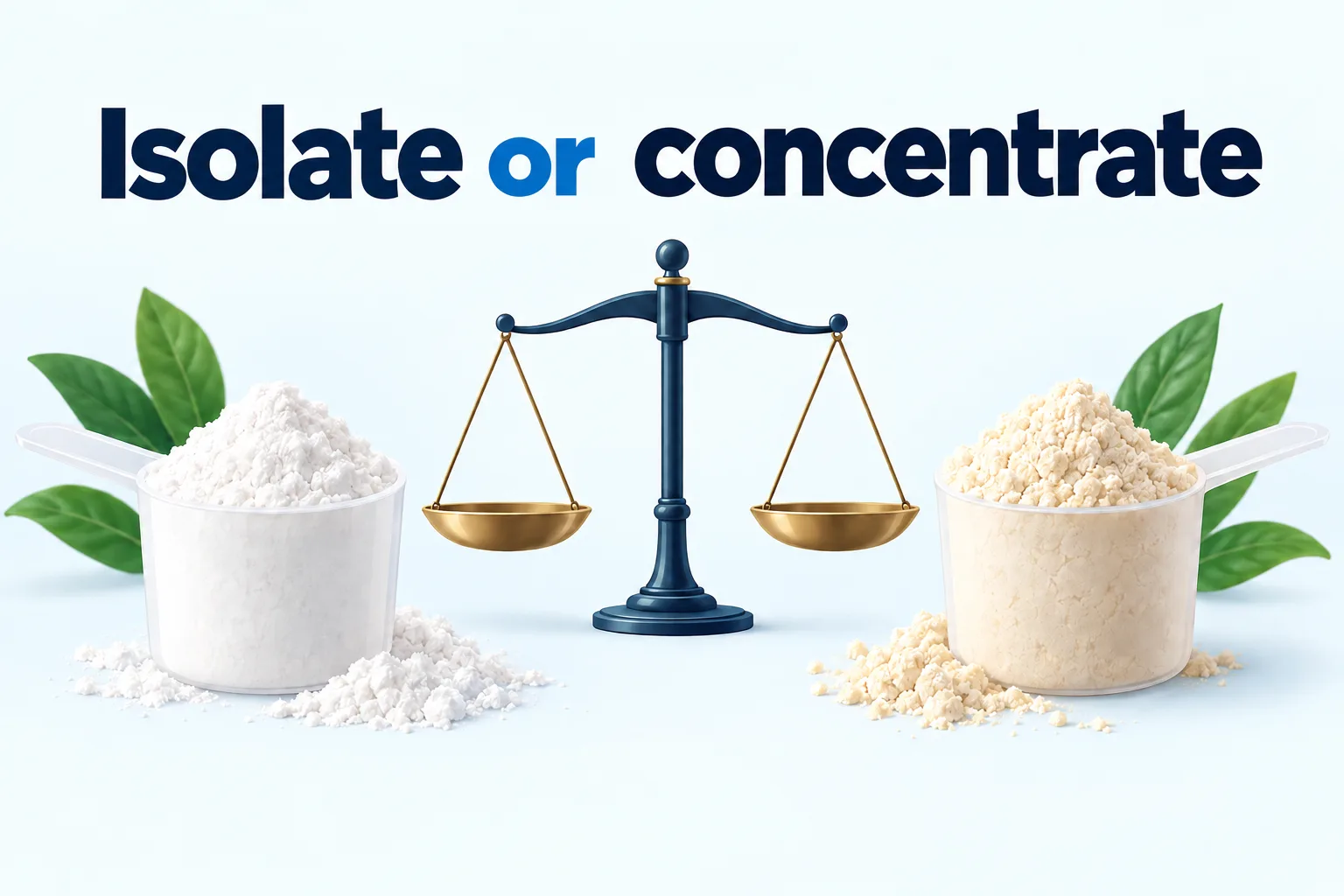
“Whey protein” and “whey isolate” are often sold as two different products. Here we look at what really separates them: the manufacturing process and the figures per 100 g. If you would rather have a quick answer based on your own profile (cutting, budget, intolerance), read our guide to whey or isolate: which one to pick for your goals.
🥛 Whey protein, whey isolate: what are we talking about?
What the shops call “whey protein” is almost always a whey concentrate (WPC). The American Dairy Products Institute (ADPI) defines it as a whey from which part of the non-protein content has been removed, with at least 25% protein. Sports powders use the most concentrated version, WPC 80.
Whey isolate (WPI), for its part, has to reach at least 90% protein on a dry basis, according to the same standard. For the full definition and where the isolate comes from, see our article on what whey isolate is.
⚙️ The real difference: the filtration process
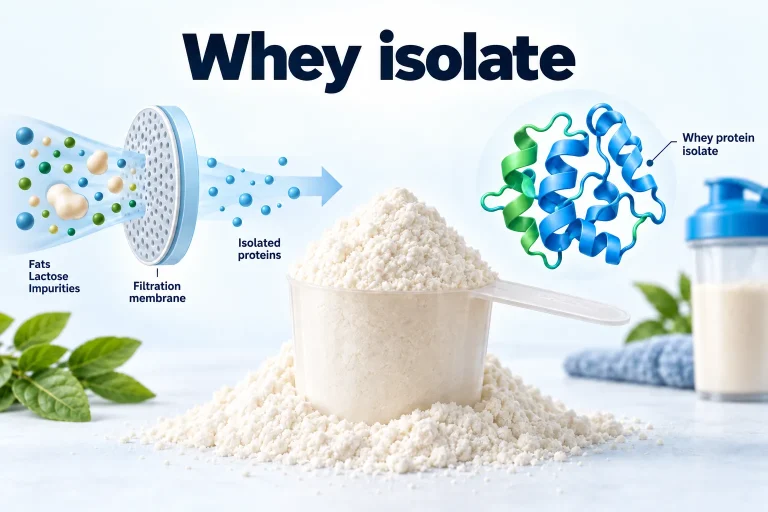
Both start from the same whey; the isolate simply goes through heavier filtration (membrane filtration and/or ion exchange, according to the ADPI). BioTechUSA sums it up on its own label: the isolate is “filtered for much longer”, hence more protein and less fat, and both are fast-absorbing.
| Typical composition (raw ingredient, ADPI) | WPC 80 (concentrate) | WPI (isolate) |
|---|---|---|
| Protein (dry basis) | 80 to 82% | 90 to 92% |
| Lactose | 4 to 10% | 0.5 to 1% |
| Fat | 4 to 8% | 0.5 to 1% |
Lactose is by far the most dramatic gap: 0.5 to 1% in the isolate against 4 to 10% in the concentrate. That is what built its reputation among lactose intolerant lifters. The fat drops in the same proportions, which trims the calorie count a little.
📊 Whey isolate vs whey protein: the figures per 100 g
To compare like with like, we took two powders from the same range, Myprotein’s Impact Whey Protein (concentrate) and Impact Whey Isolate, using the values shown on their product pages in October 2026. Same brand, same flavouring process: only the filtration changes.
| Per 100 g | Impact Whey Protein (concentrate) | Impact Whey Isolate |
|---|---|---|
| Protein | 72 g | 82 g |
| Carbs (of which sugars) | 8.9 g (5.1 g) | 6.1 g (1.9 g) |
| Fat (of which saturates) | 5.9 g (3.6 g) | 0.9 g (0.4 g) |
| Energy | 379 kcal | 361 kcal |
| Per 30 g serving | 22 g of protein, 114 kcal | 25 g of protein, 108 kcal |
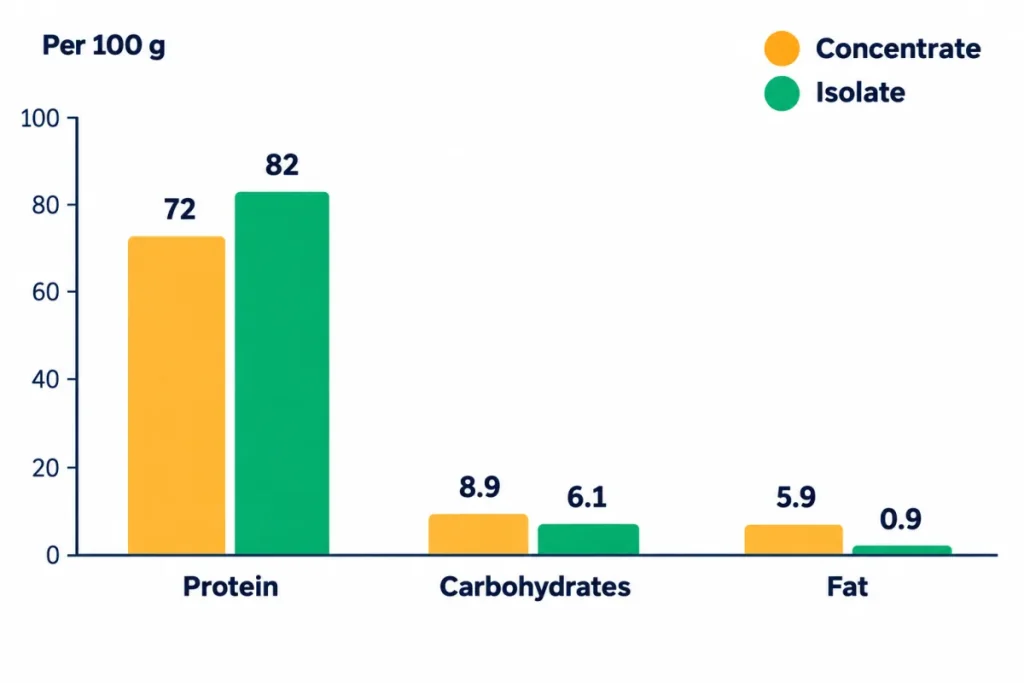
Per 30 g serving, the isolate gives you 3 g more protein and 6 kcal fewer. That is real, but modest: to get 25 g of protein you need roughly 30 g of isolate against 35 g of concentrate. The gap mainly counts if you drink several shakers a day during a cutting phase.
Watch the labels: flavouring pulls the protein percentage down. A flavoured isolate often sits around 80 to 85 g per 100 g (85 g for BioTechUSA’s Iso Whey Zero, for example), while an unflavoured isolate such as Nutripure’s claims 94%. Always compare two powders of the same flavour.
⚖️ Our isolate vs concentrate scorecard
🔬 Our method
We do not run lab tests: the scores come from product labels and official standards. We compared the ADPI standards for concentrate and isolate, the Myprotein labels (same range), the BioTechUSA and Nutripure labels as checked in October 2026, the EFSA opinion on lactose and the meta-analysis by Castro et al. (2019) on body composition.
| Criterion | Whey protein (concentrate) | Whey isolate |
|---|---|---|
| Protein per serving | ★★★★☆ | ★★★★★ |
| Low lactose content | ★★☆☆☆ | ★★★★★ |
| Little fat and sugar | ★★★☆☆ | ★★★★★ |
| Price per kilo | ★★★★★ | ★★★☆☆ |
| Effect on muscle at equal protein | ★★★★★ | ★★★★★ |
On muscle, the two are level. The meta-analysis by Castro et al. (2019), which pools eight trials, finds no significant difference between whey concentrate and whey isolate on body composition. The ISSN reminds us that what counts is total intake (1.4 to 2 g per kilo of body weight per day) and servings of 20 to 40 g of quality protein.
🎯 Our verdict: which one should you choose?
Our verdict: take an isolate if lactose is a problem for you or if every gram of fat counts, otherwise a concentrate is enough. Paying more for 3 g of protein per serving only makes sense if you get a genuine digestive or calorie benefit out of it.
- ✅ Isolate: bloating with a standard whey, cutting, a low-carb or low-fat diet. See also whey isolate for weight loss.
- ✅ Concentrate: tight budget, good milk digestion, mass gain with whey where a few extra calories do no harm.
- ❌ Neither of them if you are allergic to cow’s milk protein: the isolate cuts the lactose, not the milk proteins. Ask your doctor, and do the same if you have kidney disease.
Our favourite isolate is still Nutripure’s native Whey Isolate, made from fresh French milk: in the unflavoured version, 94% protein and less than 0.2% lactose according to its label (from €44.90, checked in October 2026; the shop ships from France). The alternatives are in our ranking of the best whey isolates.
🔬 Is there a purer protein than whey isolate?
No: hydrolysed whey is not purer than isolate, it is pre-digested. Hydrolysis cuts the proteins into shorter peptides, it does not raise the protein content. A hydrolysate therefore keeps roughly the composition of the whey it was made from, most often an isolate.
It costs more and it is not necessary for most lifters. If the subject interests you, our guide to hydrolysed whey sets out what it is really worth. For our overall take on isolate as a product, read our whey isolate review.
❓ Frequently asked questions
Is whey isolate more effective than whey protein?
No: at an equal protein intake, the studies show no difference in muscle gain. The isolate brings slightly more protein per serving and less lactose, and that is all. How well it works depends above all on your total protein intake and your training.
Why is whey isolate more expensive?
Because its filtration goes further: more lactose and fat are stripped out so that only the protein is left. That is an extra manufacturing step, and you find it again on the price tag. The price gap per kilo varies from brand to brand, so always compare the price per gram of protein.
Can you take whey protein if you are lactose intolerant?
Sometimes yes, but an isolate is the safer bet. The EFSA estimates that most intolerant people tolerate up to 12 g of lactose in a single sitting; an isolate brings about 0.2 g per serving, a concentrate more. Tolerance varies from one person to the next, so start with small servings.
When should you take whey isolate?
Whenever suits you: for the ISSN, timing is mostly a matter of individual tolerance, since the effect of training on the muscle lasts at least 24 hours. After your session or between two meals are the most common habits. Our pointers are in when to take whey isolate.
📚 Sources
- ADPI: definition and typical composition of whey protein concentrate (WPC)
- ADPI: definition and typical composition of whey protein isolate (WPI)
- Castro et al. (2019): meta-analysis of concentrate, isolate and hydrolysed whey
- EFSA (2010): lactose thresholds in lactose intolerance
- ISSN (Jäger et al., 2017): position stand on protein and exercise