Contents 8 sections
What is your main goal?
How do you digest dairy?
What matters most to you?
Summarise this article with:
💡 The essentials
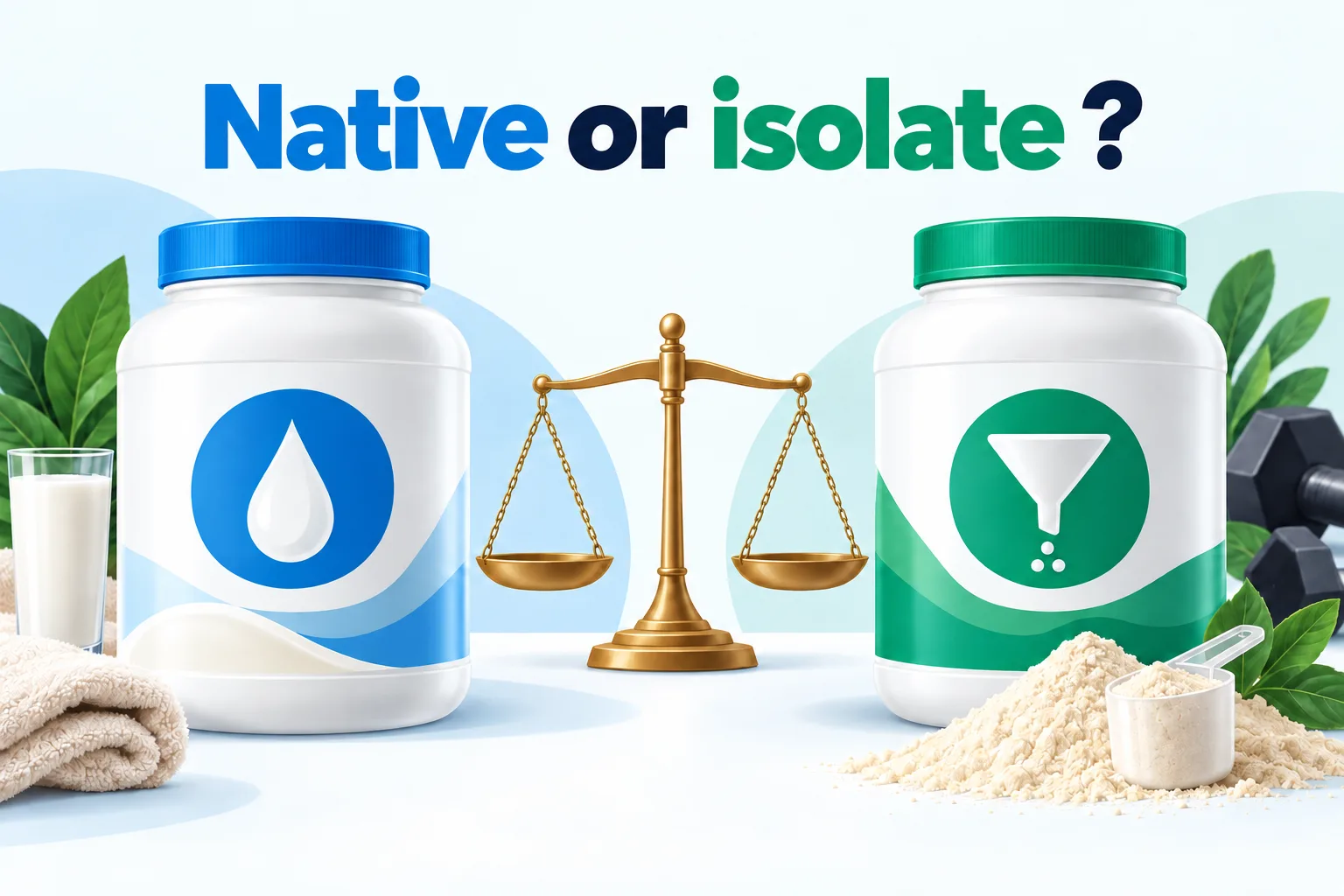
Native whey and whey isolate are not rivals: “native” describes the origin (extracted from milk, never passing through cheese), “isolate” describes the purity (90% protein or more). One and the same powder can be both.
- The best compromise: a native whey isolate, very pure and low in lactose.
- On muscle, the gap is small: the trials have not shown native whey to beat a standard whey.
- Tight budget? A native whey concentrate or a standard isolate does the job perfectly well.
“Native whey or isolate?” is one of the questions that comes up most often on bodybuilding forums. The trouble is that it compares two different criteria: one is about how the protein is extracted, the other about how much protein it contains. Once that confusion is cleared up, the choice becomes simple.
In this guide you will find the real differences, what the studies say, a scored comparison table and our pick for your goal.
🔬 Our method
We compared the official product pages (protein content, lactose, milk origin, prices checked in October 2026) from Nutripure and Nutrimuscle, and read the controlled trials that pit native whey against a standard whey. We do not run lab analyses: the figures come from the labels and the studies cited.
🥛 What is native whey?
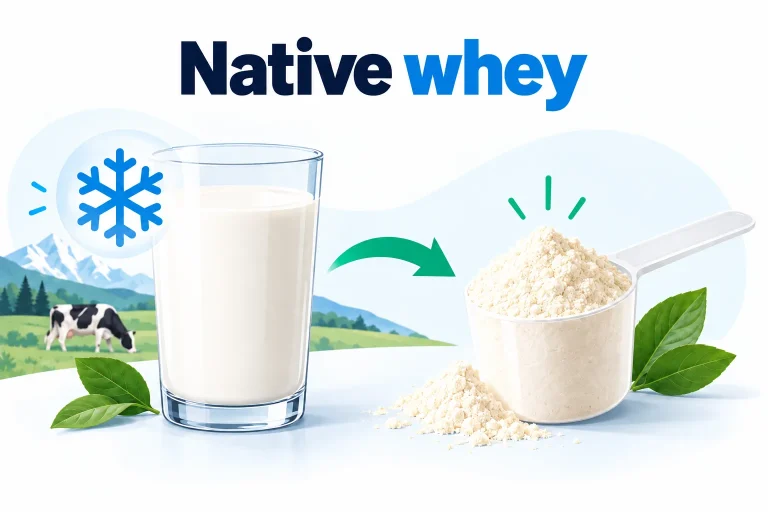
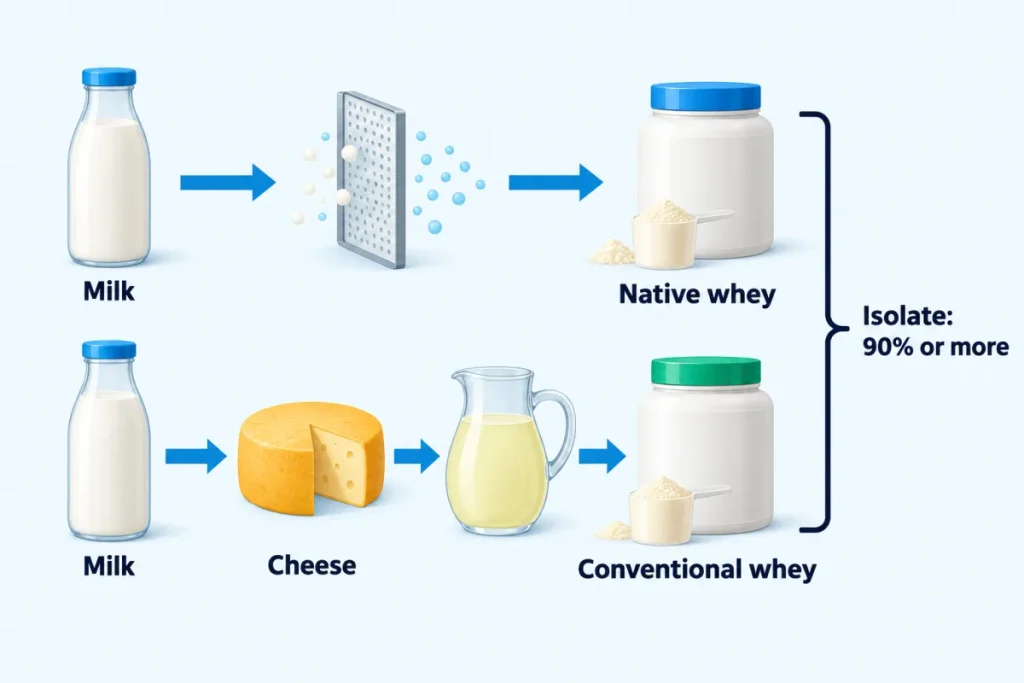
Native whey is extracted straight from milk by microfiltration, with no heat treatment, whereas standard whey comes from the whey produced during cheesemaking, with heating involved. That is the point made by a study published in 2023 in Food Science and Biotechnology. Its proteins therefore stay undenatured.
A native whey can be more or less heavily filtered. Nutrimuscle’s Whey Native, for instance, shows 82.8% protein: it is a native whey, but not an isolate. To dig deeper into this type of protein, see our full guide to native whey.
🔬 What is whey isolate?
Whey isolate is a whey filtered more finely, which generally reaches 90% protein or more, with very little lactose or fat. By way of comparison, the reference whey concentrate used in the studies, WPC-80, sits at around 80%. An isolate can come from cheese (a standard isolate) or from milk (a native isolate).
Its low lactose content often makes it better tolerated by sensitive people. It is also handy on a cutting phase, because it delivers protein with very few extra calories alongside. The process is explained step by step in our article on what whey isolate is.
⚖️ Native whey or isolate: the real differences
The difference pushed hardest in the marketing concerns leucine, the key amino acid for building muscle. A randomised trial published in 2017 in the Journal of the ISSN confirms that native whey raises blood leucine more than WPC-80 does, in 24 trained athletes.
That leucine spike did not translate into more muscle, though. In the same trial, native whey did no better than standard whey on muscle protein synthesis over the 5 hours after training. In older adults, an 11-week trial published in Nutrients in 2019 finds identical gains in mass and strength with native whey and with milk.
| Criterion | Native whey (concentrate) | Standard whey isolate | Native whey isolate |
|---|---|---|---|
| Origin | Milk | Cheesemaking whey | Milk |
| Protein content | Around 80% (82.8% at Nutrimuscle) | 90% or more | 90 to 94% (Nutrimuscle, Nutripure) |
| Lactose | Slightly more present | Low | Very low (less than 0.2% at Nutripure) |
| Blood leucine | Higher | Standard | Higher |
| Measured effect on muscle | No difference demonstrated in the trials cited | ||
📊 Scored comparison: which whey for which profile?
We scored each type of whey on five criteria, using the labels and the studies cited above. The native isolate wins on purity and digestibility, but it costs more for a muscle benefit that has not been demonstrated.
| Criterion | Native whey (concentrate) | Standard whey isolate | Native whey isolate |
|---|---|---|---|
| Protein content | ★★★☆☆ | ★★★★☆ | ★★★★★ |
| Low lactose | ★★★☆☆ | ★★★★☆ | ★★★★★ |
| Quality of the raw material | ★★★★☆ | ★★★☆☆ | ★★★★★ |
| Proven effect on muscle | ★★★★☆ | ★★★★☆ | ★★★★☆ |
| Price | ★★★★☆ | ★★★★☆ | ★★★☆☆ |
🎯 When should you choose native, and when isolate?
- You digest lactose badly: an isolate, native or not, contains very little of it.
- You are on a cutting phase: the isolate keeps carbs and fat down, see whey isolate for weight loss.
- You want a traceable, barely processed raw material: a native whey, ideally an isolate.
- You are bulking on a tight budget: a native whey concentrate is enough, and our guide to the best whey protein for bulking runs through the options.
Combining the two is not much use: a native whey isolate already brings together the milk origin and the purity. If you are still torn between isolate and standard concentrate, our whey isolate vs whey protein comparison sets out the values per 100 g.
⚠️ Watch out
Native or isolate, whey is still a milk protein: it is not suitable for anyone allergic to milk proteins. If you have an allergy, kidney disease or you are pregnant, ask your doctor before taking any.
🏆 The native whey isolates we recommend
Two French brands clearly state a native whey isolate made from French milk on their product page. Our favourite is the Nutripure, for its 94% protein content and less than 0.2% lactose in the unflavoured version, from €1.43 per shaker according to the brand’s own site (checked in October 2026; it ships from France).
- Nutripure Whey Isolate native: 94% protein, less than 0.2% lactose, milk from French cows, five flavours including unflavoured.
- Nutrimuscle Whey Native Isolate: 90% protein, French origin, enriched with lactase, €38.95 for 500 g (that is €77.90 per kilo, checked in October 2026).
For a wider ranking that includes cheaper standard isolates, have a look at our comparison of the best whey isolates.
✅ Our verdict: native whey or isolate?
If your budget allows it, take a native whey isolate: it is the purest and most digestible form, and it spares you the choice altogether. That is also why we recommend the Nutripure, which ticks both boxes on its product page.
Let us be honest about its limits. It is not essential if you digest lactose well and you are mainly after the best price per gram of protein: the trials show no more muscle with native whey than with a standard whey. In that case, a standard isolate or a native concentrate will do exactly the same job, as long as you hit your protein needs across the day.
Here is the product we recommend 👇
❓ Frequently asked questions
Is native whey better for building muscle?
Not in any demonstrated way. Native whey does raise blood leucine more, but the 2017 trial finds no more muscle protein synthesis than with a standard whey. What really counts is your total protein intake and your training.
Can a whey be both native and isolate?
Yes, and that is in fact the top-of-the-range form. “Native” means a whey extracted from milk, “isolate” a whey filtered to 90% protein or more. The Nutripure and Nutrimuscle powders mentioned above are native isolates.
Native whey or isolate if you are lactose intolerant?
Go for an isolate, preferably a native one. The heavier filtration strips out most of the lactose (less than 0.2% in the unflavoured Nutripure). A native concentrate holds more of it and can upset very sensitive people.
Should you mix native whey and whey isolate?
There is no point. A native whey isolate already combines both strengths. Mixing two tubs mostly means paying twice over for an effect the studies cannot tell apart.
📚 Sources
- Journal of the ISSN (2017): native whey and the anabolic response after exercise
- Nutrients (2019): native whey and adaptation to resistance training in older adults
- Food Science and Biotechnology (2023): commercial whey and native whey compared
- Nutrimuscle: official product page for the Whey Native Isolate (in French)