Contents 8 sections
- Isolate or concentrate: the real gap on the label
- ⭐ Our scorecard for weight loss
- The real argument for isolate: lactose
- Is the isolate premium worth it when cutting
- How to use whey isolate to lose weight
- Isolate plus a fat burner: one to avoid
- Our verdict: who isolate is worth it for
- Frequently asked questions
What is your main goal?
How do you digest dairy?
What matters most to you?
Summarise this article with:
💡 The essentials
Whey isolate does not make you lose weight faster than a whey concentrate: the gap is about 20 kcal per 25 g of protein. It earns its premium in two specific cases.
- You digest lactose poorly: an isolate holds very little of it (less than 0.2 to 0.8 g per 100 g on the labels we recorded).
- You count every calorie and want as much protein as possible per kcal.
- Otherwise, a good concentrate is enough: it is the calorie deficit that makes you lose weight, not the type of whey.
Plenty of websites present whey isolate as “the” whey for losing weight. It does have real strengths when you are cutting, but they are smaller than you are told, and they do not apply to everyone. Rather than repeating the slogans, we compared the labels.
This article answers one question only: should you pay for an isolate rather than a concentrate when you want to lose weight? For the general mechanism (deficit, daily dose, the role of protein), start with our guide on whey protein and weight loss. For the definition of the product, see what whey isolate is.
🔬 Our method
We carried out no laboratory tests and no tastings. On 3 October 2026 we recorded the nutrition tables published on the official pages of four powders (one concentrate and three isolates), taking protein as defined by European labelling rules. The prices are the ones displayed that day, promotions included. The health benchmarks come from EFSA, the ISSN and published meta-analyses.
📊 Isolate or concentrate: the real gap on the label
The most telling comparison puts two powders from the same brand side by side, at the same 30 g serving. At MyProtein, Impact Whey Isolate supplies 25 g of protein for 108 kcal, against 22 g for 114 kcal for the Impact Whey Protein concentrate. That is 3 g more protein and 6 kcal less per serving.
| Product (official label) | Type | Protein /100 g | Per serving | Lactose stated |
|---|---|---|---|---|
| MyProtein Impact Whey Protein | Concentrate | 72 g | 22 g, 114 kcal (30 g) | Not quantified |
| MyProtein Impact Whey Isolate | Isolate | 82 g | 25 g, 108 kcal (30 g) | “Reduced”, not quantified |
| BioTechUSA Iso Whey Zero (pineapple and mango) | Isolate | 85 g | 21 g, 91 kcal (25 g) | 0.79 g /100 g |
| Nutripure native Whey Isolate (unflavoured) | Native isolate | 86.8 g | 26 g, 115 kcal (30 g) | Less than 0.2 g /100 g |
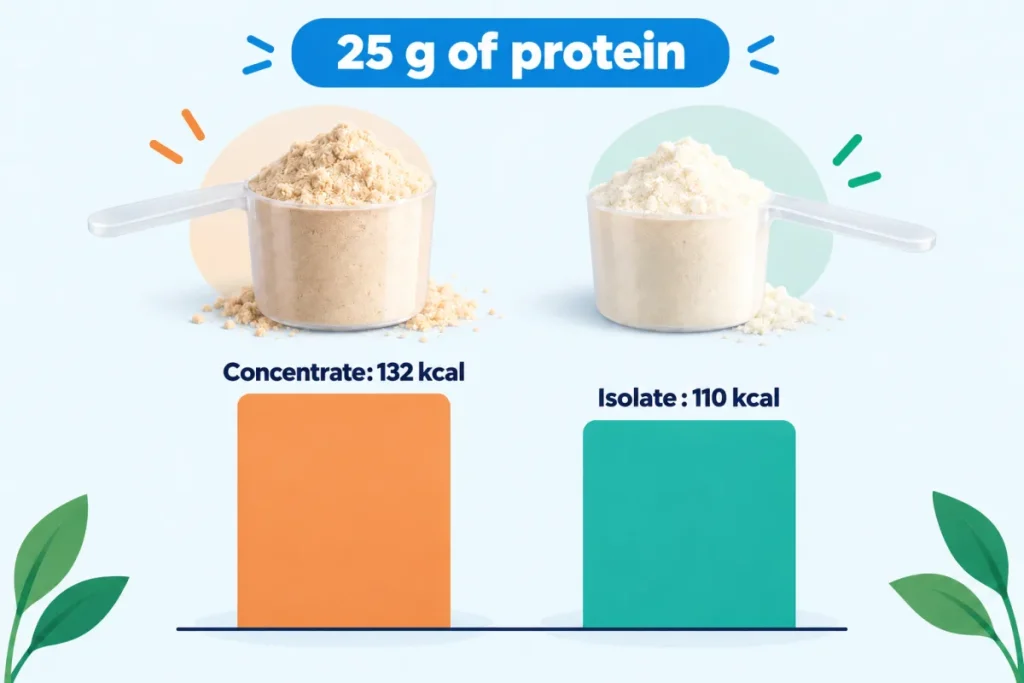
Brought back to the same amount of protein, the gap stays slim. To get 25 g of protein you need about 132 kcal of MyProtein concentrate against 110 kcal of isolate, so around twenty calories. Against a daily deficit of several hundred kcal, that is a detail, even with two shakes a day.
Watch out for marketing figures: Nutripure advertises 94% protein, but on a dry-matter basis; its label shows 86.8 g per 100 g under the European regulatory method. Always compare the “per 100 g” values in the nutrition table, not the percentage on the landing page. For the technical detail of the two processes, see whey isolate vs whey protein.
⭐ Our scorecard for weight loss
We scored each powder purely on its label data. The partner link (Nutripure) buys no extra stars: on the protein per calorie ratio, it is the Iso Whey Zero that comes out in front.
| Product | Protein per 100 g | Protein per kcal | Lactose (transparency and content) |
|---|---|---|---|
| MyProtein Impact Whey Protein | ★★★☆☆ | ★★★☆☆ | ★★☆☆☆ |
| MyProtein Impact Whey Isolate | ★★★★☆ | ★★★★☆ | ★★★☆☆ |
| BioTechUSA Iso Whey Zero | ★★★★☆ | ★★★★★ | ★★★★☆ |
| Nutripure native Whey Isolate | ★★★★★ | ★★★★☆ | ★★★★★ |
The gaps between the three isolates are small: any of them does the job for weight loss, and the choice then comes down to taste, price and how well you digest it. For a full product ranking, see our pick of the best whey isolate and our comparison of the best whey protein for weight loss.
🥛 The real argument for isolate: lactose
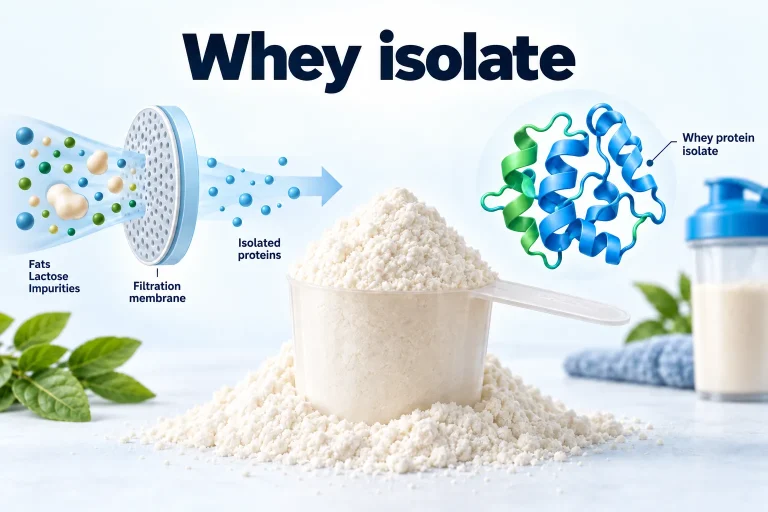
The heavier filtration of an isolate strips out most of the lactose. One serving of Iso Whey Zero contains 0.2 g of lactose according to its label, and the Nutripure less than 0.2 g per 100 g. For someone who gets bloated by milk, that is often the difference between a shake that goes down and a shake abandoned after a week.
As a benchmark, EFSA concluded that the vast majority of people who digest lactose poorly tolerate up to 12 g in one sitting, with few or no symptoms, but that sensitivity varies a great deal from person to person (2010 EFSA opinion on lactose thresholds). So if a concentrate causes you no trouble at all, isolate brings nothing decisive on this front.
💶 Is the isolate premium worth it when cutting?
On 3 October 2026, MyProtein listed the 900 g size at €38.99 for Impact Whey Protein and €54.99 for Impact Whey Isolate, promotions included. For 25 g of protein, that works out at roughly €1.50 with the concentrate and €1.86 with the isolate. Prices move often, but the order of magnitude stays the same: you pay more for about twenty fewer calories.
Among French isolates, Nutripure’s native Whey Isolate started at €44.90 on its product page the same day, in 750 g, 2 kg and 4 kg sizes. It stands out for French-origin milk and a short ingredients list (whey isolate and sunflower lecithin for the unflavoured version). If origin and cold filtration matter to you, also compare native whey vs isolate.
🎯 How to use whey isolate to lose weight
The rules are the same as for any whey. Aim for 1.2 to 1.6 g of protein per kilo per day, with 25 to 30 g per meal, as recommended by a review in the American Journal of Clinical Nutrition (2015). For an 80 kg person that comes to 96 to 128 g a day, of which one or two shakes at most.
- Replace, do not add: the shake takes the place of a snack, it is not an extra one.
- Mix it with water if you are counting tightly: milk adds calories of its own.
- Do resistance training: according to the ISSN position stand (2017), lifters may need 2.3 to 3.1 g per kilo in a deficit to hold on to lean mass.
Timing matters little: it is the day’s total intake that makes the difference. If you still want to place your shakes, see our guide on when to take whey isolate.
⚠️ Isolate plus a fat burner: one to avoid
Pairing an isolate with a fat burner speeds nothing up reliably. ANSES advises the entire population against supplements containing Garcinia cambogia, sold as slimming aids (hepatitis, pancreatitis, cardiac and muscular damage). Between 2016 and February 2024 it also logged 154 cases of adverse effects linked to sports supplements aimed at building muscle or losing fat, most of them cardiovascular.
Ask a doctor before taking a fat burner or sharply raising your protein intake if you have kidney or liver disease, a history of heart problems, a milk protein allergy, if you are pregnant or if you are on medication. A low-lactose isolate is still a milk protein: it is not suitable if you are allergic.
✅ Our verdict: who isolate is worth it for
We recommend isolate for weight loss if lactose bothers you, or if you are on a tight cut where every gram of carbohydrate and fat counts. In those cases, a few extra euros a month buy genuine digestive comfort and a slightly better protein per calorie ratio.
It is not for you if you digest milk well and your budget is tight: a quality concentrate will give you the same result on the scales, as the calorie gap is negligible. Nor will it replace a calorie deficit or regular training, however pure it is.
❓ Frequently asked questions
Does whey isolate make you lose weight?
No, no whey makes you lose weight on its own. Isolate helps you hit a high protein intake for few calories, which makes fat loss easier in a deficit while limiting muscle loss.
Whey isolate or concentrate for a cut?
Both work; what isolate mainly brings is less lactose. On the labels we compared, it offers about 3 g more protein and 6 kcal less per 30 g serving. Choose isolate if milk bloats you, concentrate if you want the best price.
How much whey isolate per day to lose weight?
Generally one or two shakes of 25 to 30 g. Work out your total need (1.2 to 1.6 g of protein per kilo), subtract what you already eat, and fill only the gap with powder.
Is whey isolate suitable for lactose intolerant people?
Most of the time yes, because it contains very little of it. The labels we recorded state from less than 0.2 g to 0.79 g of lactose per 100 g. Try a small serving first if you are very sensitive; if you are allergic to milk protein, it is still one to avoid.
📚 Sources
- Leidy et al., The role of protein in weight loss and maintenance, American Journal of Clinical Nutrition, 2015
- ISSN position stand on protein and exercise, 2017
- Official MyProtein Impact Whey Isolate page, nutrition table (in French)
- Official BioTechUSA Iso Whey Zero page, nutrition values and lactose (in French)
- ANSES, risks of food supplements for athletes, 2024