Contents 7 sections
What is your main goal?
How do you digest dairy?
What matters most to you?
Summarise this article with:
💡 The essentials
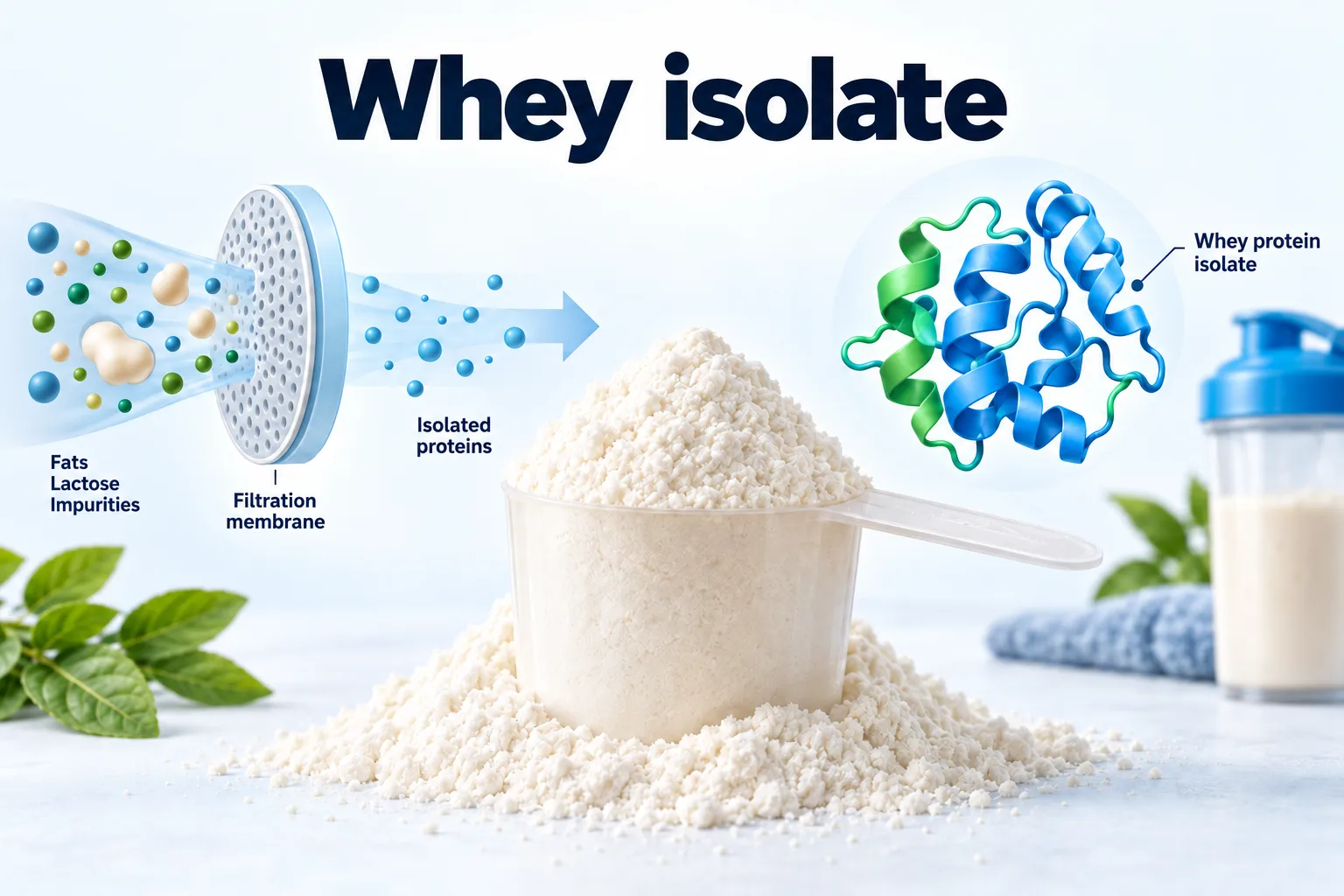
Whey isolate is a whey protein (the protein in “milk serum”) filtered until it holds at least 90% protein on a dry matter basis, with very little lactose and very little fat.
- On the label: roughly 80 to 94 g of protein per 100 g, depending on the brand and the flavour.
- Lactose: often under 0.3 g per serving, well below the threshold most lactose-intolerant people tolerate.
- Avoid it if you are allergic to cow’s milk protein: the filtration takes out the lactose, not those proteins.
The word “isolate” is everywhere on protein tubs, and usually alongside a higher price. This article answers one question only: what is whey isolate, in concrete terms? Where it comes from, how it is made, what it contains and who it is actually for.
If you are already torn between two powders, we also have a whey isolate vs whey concentrate comparison per 100 g and a practical guide to the differences between whey and isolate for your own profile.
🥛 First of all, what is whey?
Whey is the protein in milk serum, the liquid that separates from the curd when cheese is made. Cow’s milk contains two families of protein: casein (around 80%) and the whey proteins (around 20%), according to Nutripure’s product page.
Raw whey is mostly water, lactose and minerals. Every whey powder is therefore a whey concentrated by filtration: what changes from one form to the next is how far that filtration is pushed. For the basics, see our guide to what whey protein is.
🔬 Whey isolate: the precise definition
The American Dairy Products Institute (ADPI), which publishes the reference standards for dairy ingredients, defines an isolate like this: a whey from which enough non-protein constituents have been removed for the dry powder to contain at least 90% protein on a dry matter basis. Its typical values: 0.5 to 1% lactose and 0.5 to 1% fat.
By way of comparison, a whey concentrate (WPC 80) sits at around 80% protein with 4 to 10% lactose and 4 to 8% fat, again according to the ADPI. So an isolate is not a different protein: it is the same one, with much less of everything else.
ℹ️ Good to know
That “90%” applies to the raw ingredient, not necessarily to the tub you buy. Once the flavouring, the sweetener or the cocoa has gone in, a flavoured isolate shows more like 80 to 85 g of protein per 100 g. Only the unflavoured versions stay above 90%.
⚙️ How is whey isolate made?
An isolate is produced by membrane filtration and/or by ion exchange, according to the ADPI standard. In practice, the consumer brands put cold filtration front and centre.
- Separation: the whey is collected, either after cheesemaking or straight from fresh milk (in which case it is called a “native” whey).
- Heavy filtration: microfiltration and ultrafiltration hold back the proteins and let the water, the lactose and part of the minerals through. BioTechUSA, for example, describes a cross-flow microfiltration (CFM) that cuts the lactose “without enzymes or chemicals”.
- Drying: the liquid concentrate is then dried to become the powder you mix in your shaker.
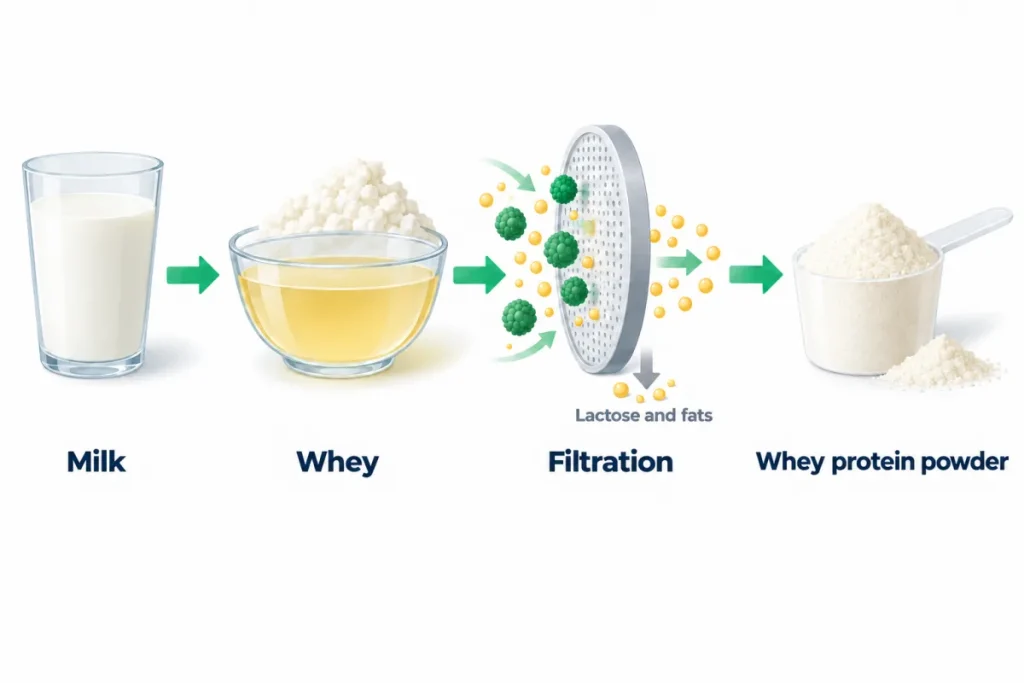
A “native isolate” is an isolate drawn straight from fresh milk, without going through cheese. Nutripure, for instance, states a cold membrane filtration from the milk of French cows. The difference with a standard isolate is spelled out in our article on native whey vs whey isolate.
📊 What is in a serving of whey isolate?
To keep this concrete, we noted the values published on two product pages in October 2026. A 25 g serving of isolate brings around 21 g of protein for barely 0.2 g of lactose.
| Product page | Protein / 100 g | Lactose | Energy / 100 g |
|---|---|---|---|
| Iso Whey Zero, BioTechUSA (pineapple-mango) | 85 g | 0.79 g / 100 g (0.20 g per 25 g serving) | 366 kcal |
| Whey Isolate native, Nutripure (unflavoured) | 94% | under 0.2% | not recorded |
Those figures explain why an isolate is often well tolerated by people who are lactose intolerant. EFSA judges that the vast majority of people who digest lactose poorly can handle up to 12 g in a single sitting with few or no symptoms. Tolerance stays individual, though: some people react at under 6 g.
🧭 Isolate, concentrate, native, hydrolysed: where does the isolate sit?
The isolate is the most heavily filtered form, but not the most processed: a hydrolysed whey goes further by cutting the proteins into peptides. Here is how we read the four forms, scored from the ADPI standards and the labels.
| Form | Protein content | Low in lactose | Gentle on the wallet |
|---|---|---|---|
| Concentrate | ★★★☆☆ | ★★☆☆☆ | ★★★★★ |
| Isolate | ★★★★★ | ★★★★★ | ★★★☆☆ |
| Native isolate | ★★★★★ | ★★★★★ | ★★☆☆☆ |
| Hydrolysed | ★★★★☆ | ★★★★☆ | ★☆☆☆☆ |
- Concentrate: the “standard” whey, less filtered, around 70 to 80% protein, and the cheapest.
- Native: extracted from fresh milk rather than from cheese-dairy whey; it can be a concentrate or an isolate. See native whey protein explained.
- Hydrolysed: pre-digested into peptides, it is no richer in protein than the isolate it is usually made from. The detail is in our guide to hydrolysed whey.
🎯 Who is whey isolate for?
🔬 Our method
We do not run laboratory analyses: we compared the official definitions and the labels. Sources used: the ADPI standards for whey isolate and whey concentrate, the EFSA opinion on lactose thresholds, the Ameli page on intolerance, the ISSN position stand on protein, and the BioTechUSA and Nutripure product pages as recorded in October 2026.
Our view: an isolate is the right whey when lactose, fat or calories are a problem for you, not a “more effective” protein. The ISSN recommends 1.4 to 2 g of protein per kilo per day for an athlete, in servings of 20 to 40 g, and a concentrate fills that role just as well. To work out your dose, see how much whey protein per day.
- ✅ For you if standard whey leaves you bloated, if you track your calories closely (cutting, weight loss with whey isolate) or if you want the most protein possible per serving.
- ❌ Not for you if your budget is tight and you digest lactose well: a concentrate will do the same job for less.
- ❌ Avoid it if you are allergic to cow’s milk protein: Ameli, the French public health insurance service, points out that this allergy involves the immune system, unlike lactose intolerance. Ask your doctor for advice, just as you should with kidney disease or during pregnancy.
If you want to try one, Nutripure’s native Whey Isolate is the one we recommend: 94% protein in the unflavoured version, under 0.2% lactose, from €44.90 (recorded in October 2026). The full ranking is in our comparison of the best whey isolates, and our verdict on the category in our whey isolate review.
❓ Frequently asked questions
What is the difference between whey and whey isolate?
An isolate is a whey that has been filtered for longer, so it is richer in protein and lower in lactose and fat. “Standard” whey (concentrate) tends to hold 70 to 80% protein. The figures are laid out in our isolate vs whey protein comparison.
Does whey isolate contain lactose?
Yes, but very little: of the order of 0.2 g per 25 g serving on the product pages we recorded. That is far below the 12 g in one sitting that most intolerant people tolerate according to EFSA. An isolate is not “lactose-free” in the strict sense.
Is whey isolate better for building muscle?
No: at an equal protein dose, there is nothing to show it beats a concentrate. A 2019 meta-analysis (Castro et al., Nutrients) finds no clear difference between the two forms on body composition. What counts is your total protein intake and your training.
Is whey isolate dangerous?
For a healthy adult who sticks to the stated doses, there is no particular known danger. The real limits are allergy to milk protein and certain illnesses, kidney disease in particular: in those cases, ask your doctor for advice. We go through all of it in whey isolate: danger or myth.
📚 Sources
- ADPI: definition and typical composition of whey protein isolate (WPI)
- EFSA (2010): lactose thresholds in lactose intolerance
- Ameli: lactose intolerance and milk protein allergy (in French)
- ISSN (Jäger et al., 2017): position stand on protein and exercise
- Castro et al. (2019): meta-analysis of concentrated, isolated and hydrolysed whey