Contents 8 sections
What is your main goal?
How do you digest dairy?
What matters most to you?
Summarise this article with:
💡 The essentials
Our verdict: whey isolate is an excellent product, but it only earns its price if lactose or calories are a problem for you.
- Strengths: very little lactose, more protein per serving, almost no fat.
- Weaknesses: nearly twice the price per kilo of a standard whey from the same brand, with no proven edge on muscle.
Whey isolate has a reputation as “the best whey”. Here, we give our verdict on isolate as a product category: what it does well, what it does no better than a standard whey, and who it is really for. To choose a specific tub, head to our ranking of the best whey isolates.
🔬 A reminder: what whey isolate is
In its “isolate” form, whey has gone through more filtration than in its “concentrate” form. The ADPI standard requires at least 90% protein on a dry basis for the raw ingredient; once flavoured, the powder tends to show 80 to 85 g of protein per 100 g. The full definition is in what whey isolate is.
👍 What whey isolate genuinely does well
It is easy to digest
Its very low lactose content is its best argument. EFSA reckons that the vast majority of lactose intolerant people tolerate up to 12 g of lactose in one sitting, with few or no symptoms. A 25 g serving of Iso Whey Zero (BioTechUSA) contains 0.20 g of it according to its label; Nutripure states less than 0.2% for its native isolate. Tolerance does vary from person to person, though.
It packs in a lot of protein
Per 100 g of isolate you generally get 80 to 85 g of protein depending on the flavour (84 to 85 g for BioTechUSA’s Iso Whey Zero, 80 to 81 g for the flavoured versions of Nutrimuscle’s Whey Native Isolate, 94% for Nutripure’s unflavoured isolate), against 72 g for a concentrate such as Myprotein’s Impact Whey Protein. So you get through slightly less powder for the same amount of protein.
It is light on fat and sugar
Around 1 to 2 g of fat per 100 g on the isolates we recorded (0.9 g for Myprotein’s Impact Whey Isolate), against 5.9 g for the concentrate in the same range. That helps if you track your calories closely, for instance during weight loss with whey isolate.
👎 What it does no better than a standard whey
- Price: at Nutrimuscle, €70.95 per kilo for the Whey Native Isolate against €37.95 for the standard Whey Native (recorded in October 2026). That is its main flaw.
- Muscle gain: the meta-analysis by Castro et al. (2019) finds no significant difference between whey concentrate and isolate on body composition.
- Absorption speed: it is often sold as “faster”, but BioTechUSA itself writes on its own label that isolate and concentrate are both fast absorbing.
- Milk allergy: isolate removes the lactose, not the milk proteins. If you are allergic to cow’s milk protein it is still one to avoid: ask your doctor.
For all the differences in figures, see our whey isolate vs whey protein comparison per 100 g. And on the question of risk, our article on whey isolate: danger or myth sorts the facts from the noise.
💬 What customer reviews say
Buyers rate the big brands’ isolates very highly, above all for digestion. BioTechUSA’s Iso Whey Zero shows 4.9/5 from nearly 39,000 reviews on the brand’s website, and Nutripure’s native isolate 4.7/5 from 1,345 reviews (recorded in October 2026). These are ratings published by the brands themselves, so read them with a pinch of salt.
Going by the review summary published on the BioTechUSA page, the points that keep coming up are the taste, how easily it mixes and the absence of bloating, while a few customers find some flavours very sweet. That is consistent with what the label promises: little lactose, but flavoured and sweetened versions.
⚖️ Our verdict in stars
🔬 Our method
Our verdict rests on labels and scientific sources, not on laboratory tests. We compared the BioTechUSA, Nutripure, Nutrimuscle and Myprotein product pages as recorded in October 2026, the ADPI standard for isolate, the EFSA opinion on lactose, the ISSN position stand on protein and the meta-analysis by Castro et al. (2019).
| Criterion | Whey isolate | Standard whey (concentrate) |
|---|---|---|
| Digestion, lactose | ★★★★★ | ★★★☆☆ |
| Protein per serving | ★★★★★ | ★★★★☆ |
| Calories, fat | ★★★★★ | ★★★☆☆ |
| Effect on muscle | ★★★★☆ | ★★★★☆ |
| Value for money | ★★★☆☆ | ★★★★★ |
| Overall score | ★★★★☆ | ★★★★☆ |
Same overall score, different profiles: isolate wins on comfort and purity, concentrate on price. On the muscle side, the ISSN points out that what matters is hitting 1.4 to 2 g of protein per kilo per day, in servings of 20 to 40 g; both forms let you do that.
🎯 Is whey isolate right for you?
- ✅ Yes if a standard whey bloats you, if you are lactose intolerant, or if you are cutting and counting every calorie.
- ✅ Yes if you want a very concentrated powder and budget is not a barrier.
- ❌ No if you digest milk well and want the best value: a concentrate will do the same job. Our guide on whey or isolate for your profile helps you decide.
- ❌ No if you are allergic to cow’s milk protein; and if you have kidney disease or are pregnant, ask your doctor first.
🛒 What to look at before buying your iso
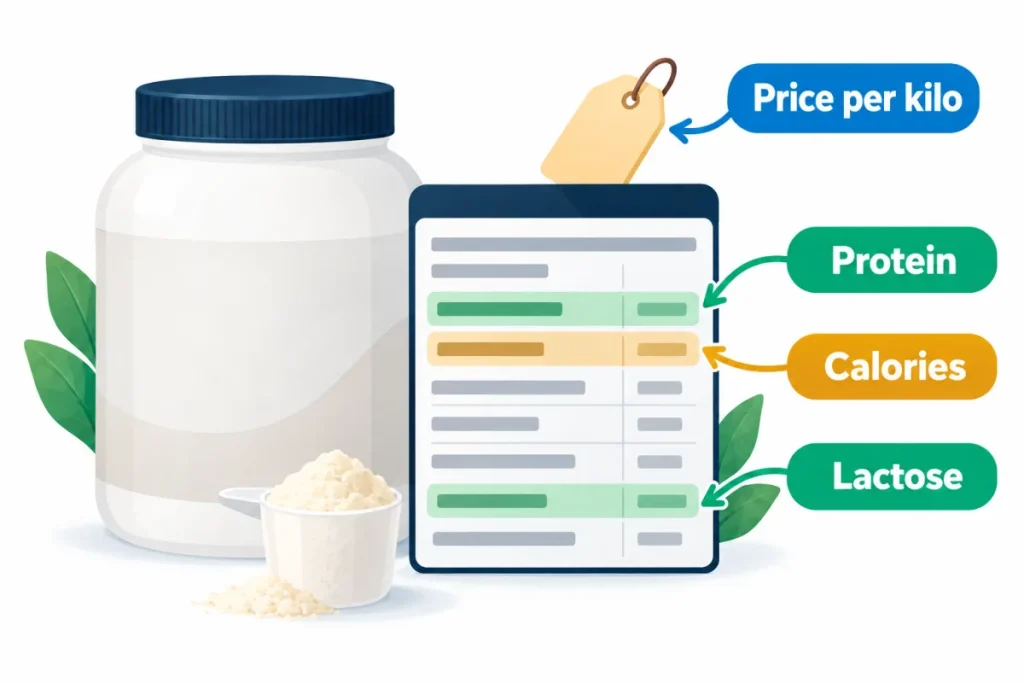
1. The price per kilo, and even the price per protein serving
Always compare the price per kilo, which websites do not always put front and centre. The 1,816 g tub of Iso Whey Zero, for instance, is listed at €104.90, which works out at €57.76 per kilo (recorded in October 2026). Better still: divide by the protein content to get the real price of your protein.
2. The protein per 100 g, flavour for flavour
The protein content is always in the nutrition table; compare identical flavours. An unflavoured version often tops 90%, a chocolate version drops towards 80%. That is not a quality flaw, it is the effect of the flavouring and the cocoa.
3. The kcal and the lactose per serving
If you are picking an isolate for how light it is, check the calories and the lactose per serving: they vary from brand to brand. Look at the ingredients list too if you want to avoid sweeteners: Nutrimuscle’s flavoured Whey Native Isolate contains sucralose, for instance, while its plain version does not.
❓ Frequently asked questions
Is whey isolate worth the price?
Yes if you digest lactose poorly or are cutting, no otherwise. At equal protein, it builds no more muscle than a concentrate, while costing considerably more per kilo.
Does whey isolate make you lose weight?
No, no whey makes you lose weight on its own: it is your calorie deficit that counts. Isolate simply helps you hit your protein with slightly fewer calories. Our benchmarks are in whey isolate and weight loss.
What is the best whey isolate?
Our favourite is Nutripure’s native isolate, for its 94% content in the unflavoured version and its lactose below 0.2%. Other brands do better on price or on flavours: it is all compared in our ranking of the best whey isolates.
How much whey isolate should you take per day?
One or two servings of 20 to 40 g of protein are usually enough, alongside your diet and within the 1.4 to 2 g of protein per kilo per day the ISSN recommends for an athlete. See how much whey protein per day.
📚 Sources
- EFSA (2010): lactose thresholds in lactose intolerance
- Castro et al. (2019): meta-analysis of whey concentrate, isolate and hydrolysate
- ISSN (Jäger et al., 2017): position stand on protein and exercise
- ADPI: definition and typical composition of whey protein isolate
- BioTechUSA: Iso Whey Zero nutrition label (in French)