Contents 6 sections
What is your main goal?
How do you digest dairy?
What matters most to you?
Summarise this article with:
💡 The essentials
Whey concentrate and whey isolate do exactly the same job on your muscles; what separates them is lactose, fat and price.
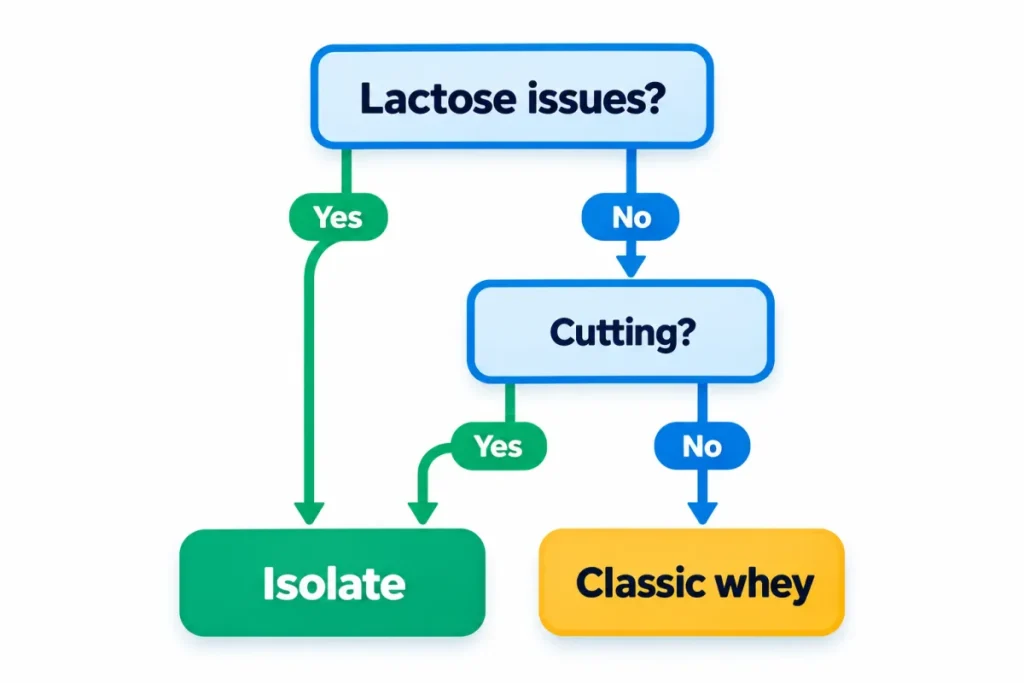
- Go for an isolate if milk leaves you bloated, or if you are on a cutting phase.
- Go for a whey concentrate if you digest milk well and want to pay less: at Nutrimuscle, the isolate costs almost twice as much per kilo.
- Neither of them if you are allergic to cow’s milk protein.
If you are reading this, you are wondering what really separates a standard whey concentrate from an isolate, and above all which one to buy. Given the price gap between the two, it is a fair question to ask.
This guide starts from your own situation and gives you an answer. For the technical detail (filtration, nutritional values per 100 g), see our whey isolate vs whey concentrate comparison; for the definition on its own, read our article on what whey isolate is.
📋 Whey and isolate: the 4 differences that matter
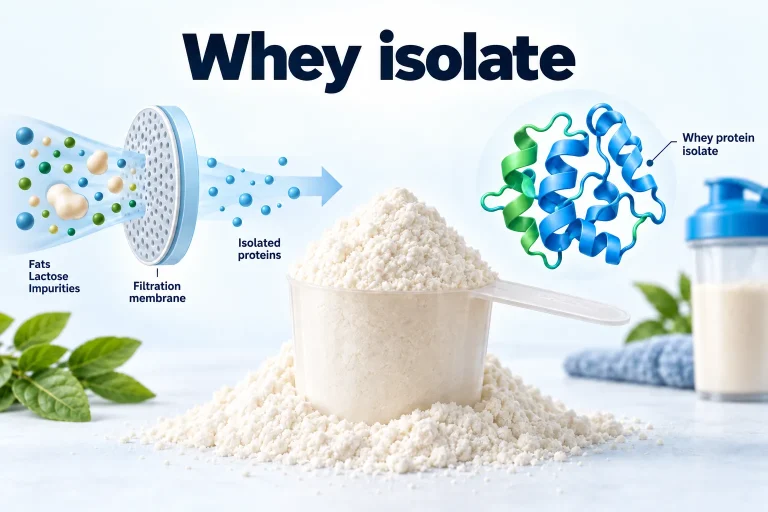
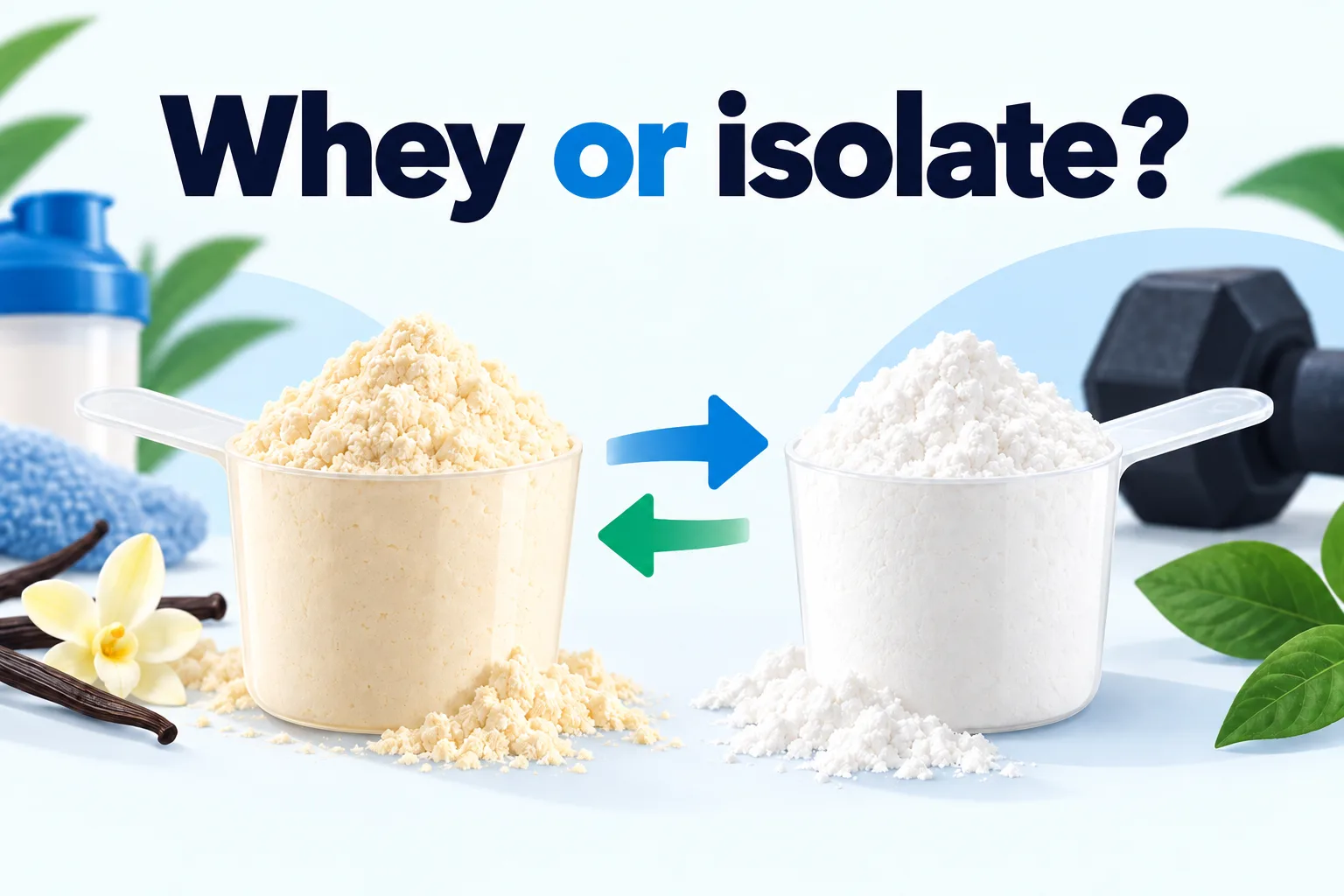
Both are whey proteins, made from the “little milk” left over by the dairy and cheese industry; the isolate is simply filtered for longer. In practice, four things change:
- Lactose: 0.5 to 1% in an isolate against 4 to 10% in a WPC 80 concentrate, according to the ADPI standards.
- Protein per serving: within the same Myprotein range, 25 g of protein per 30 g serving for the isolate against 22 g for the standard whey.
- Fat and calories: 0.9 g of fat per 100 g against 5.9 g on those same two products, for 361 kcal against 379 kcal.
- Price: €70.95 per kilo for Nutrimuscle’s Whey Native Isolate against €37.95 for its standard Whey Native (checked in October 2026).
On muscle, on the other hand, no difference has ever been demonstrated. A 2019 meta-analysis (Castro et al.) finds no significant gap between whey concentrate and whey isolate on body composition. What drives progress is your total intake: 1.4 to 2 g of protein per kilo of body weight per day for an athlete, according to the ISSN.
🧭 Whey or isolate: which one suits your profile?
You struggle to digest milk, or you are lactose intolerant
This is the first question to ask yourself: if the answer is yes, take an isolate. A 25 g serving of Iso Whey Zero (BioTechUSA) contains 0.20 g of lactose according to its label, while the EFSA estimates that most intolerant people tolerate up to 12 g in a single sitting. Tolerance remains individual, so start with a small serving.
You are on a cutting phase or watching your calories
The isolate is the logical choice, without being essential. Less fat and fewer carbs per serving is a small advantage, but it adds up if you drink two or three shakers a day. Our full advice is in whey isolate and weight loss.
You are on a bulking phase
A whey concentrate is more than enough: the handful of extra calories will not bother you. It is not its carbs that build muscle, it is the total protein and total calories across your meals. See our guide to whey protein for mass gain.
You are on a tight budget, or you are just starting out
Start with a good-quality whey concentrate if you digest milk well. You keep almost half the price per kilo in your pocket for an equivalent result. You can always move up to an isolate if you feel any discomfort. To get off on the right foot, read how to choose your whey protein.
You are allergic to cow’s milk protein
Avoid both: an isolate removes the lactose, not the milk proteins. Ameli points out that a milk protein allergy involves the immune system, unlike lactose intolerance. Ask your doctor before taking any protein supplement, and do the same if you have kidney disease or you are pregnant.
⚖️ Our scorecard by profile
| Your profile | Whey concentrate | Whey isolate |
|---|---|---|
| Tight budget | ★★★★★ | ★★☆☆☆ |
| Beginner who digests milk well | ★★★★★ | ★★★☆☆ |
| Bulking | ★★★★★ | ★★★☆☆ |
| Cutting, calories watched | ★★★☆☆ | ★★★★★ |
| Lactose intolerance | ★★☆☆☆ | ★★★★★ |
🔬 Our method
These scores come from product labels and official sources, not from home testing. We compared the ADPI standards for concentrate and isolate, the Myprotein, BioTechUSA and Nutrimuscle labels as checked in October 2026, the EFSA opinion on lactose, the Ameli page on milk allergy and the meta-analysis by Castro et al. (2019).
Our verdict: for most lifters who digest milk well, a whey concentrate is the best value for money. The isolate earns its premium in two specific cases: digestive discomfort and cutting (we explain why in our whey isolate review). If you are in one of them, our ranking of the best whey isolates will save you time; if not, have a look at our ranking of the best whey proteins.
✅ Pros and cons at a glance
| Whey concentrate (standard whey) | Whey isolate | |
|---|---|---|
| Pros | Cheaper, just as effective on muscle | Almost lactose-free, more protein per serving, less fat |
| Cons | More lactose, slightly more fat and calories | Clearly higher price per kilo |
🧪 Bonus: what about the other forms of protein?
- Native whey: extracted straight from fresh milk by low-temperature filtration, rather than from cheese-making whey. It exists as a concentrate and as an isolate: it is not a third price category. See native whey and native whey vs whey isolate.
- Hydrolysed whey: its proteins are cut into shorter peptides (pre-digested). It is no richer in protein than the isolate it is usually made from. The details are in hydrolysed whey.
- Plant protein: rice, pea or fava bean, for vegans. It is not whey, but a good powder can be very concentrated: Nutripure’s organic plant protein claims 89% protein.
❓ Frequently asked questions
Does isolate build more muscle than whey?
No: at an equal protein intake, nothing shows that it does better. The meta-analysis by Castro et al. (2019) finds no significant difference between the two forms on body composition. What counts is your total protein intake and your training.
Which whey should you choose as a beginner?
A good-quality whey concentrate, if you digest milk well. It costs far less for the same effect. Move up to an isolate only if you feel bloated. Our guide on which whey protein to choose covers the other criteria.
Is whey isolate lactose-free?
Not quite, but it contains very little: around 0.2 g per serving on the labels we checked. That is generally well tolerated by lactose intolerant people. It is still off limits, however, if you have a milk protein allergy.
Can you take whey isolate every day?
Yes, for a healthy adult, as long as your total protein intake stays sensible. The ISSN recommends 1.4 to 2 g per kilo of body weight per day for an athlete, in servings of 20 to 40 g. If you have kidney disease, ask your doctor. See also whey isolate: the real risks.
📚 Sources
- ADPI: typical composition of whey protein concentrate (WPC 80)
- EFSA (2010): lactose thresholds in lactose intolerance
- Ameli: lactose intolerance and milk protein allergy (in French)
- Castro et al. (2019): meta-analysis of concentrate, isolate and hydrolysed whey
- ISSN (Jäger et al., 2017): position stand on protein and exercise