

Contents 8 sections
What is your main goal?
How do you digest dairy?
What matters most to you?
Summarise this article with:
💡 The essentials
- The best proven benefits of marine collagen concern the skin (hydration, elasticity) and, to a lesser degree, knee pain.
- Tendons and bones: promising signals, not solid proof yet. Muscle, weight loss, hair, cellulite: nothing proven.
- Collagen never replaces whey: it is an incomplete protein, with no tryptophan and little leucine.
Powders, capsules, bars: marine collagen is everywhere, and half the promises are marketing. Good news: research has already sorted what works from what does not. Here are the marine collagen benefits actually measured, the doses used in studies, and why it will never do your whey’s job.
🔬 Our method
This guide relies on published meta-analyses and randomised trials, and on the EU register of health claims, read on 24 October 2026. We run no clinical trials and do not test products: we summarise what studies measured, with their level of evidence.
🐟 What is marine collagen?
It is type I collagen taken from fish skin and scales, then cut into small peptides. The result is a soluble, easy-to-digest powder, nothing like gelatin that sets in the fridge. Type I is the main collagen of your skin, tendons, ligaments and bones, hence its use for beauty and joints.
But it is not a complete protein: almost no tryptophan, very little leucine. It is a targeted ingredient, not a quality protein source.
✅ The benefits actually proven
Skin: hydration and elasticity
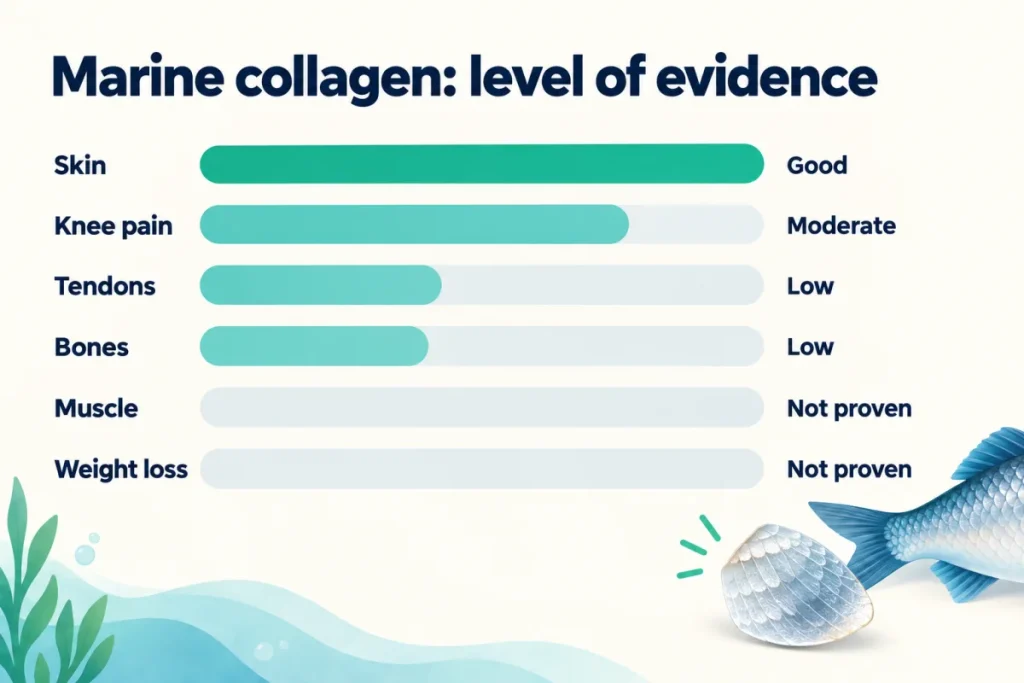
This is the best documented area. A 2023 meta-analysis of 26 randomised trials and 1,721 participants found a clear improvement in skin hydration and elasticity versus placebo, with biases noted in several trials. Expect softer, better hydrated skin, not a facelift.
Joints: knee pain
In people with knee osteoarthritis, a 2023 meta-analysis (4 trials, 507 patients) shows reduced pain. The signal is real, but the trials are few: take it as a nudge, not a treatment.
Tendons: promising, not confirmed
The most quoted protocol pairs 15 g of collagen with about 50 mg of vitamin C, one hour before a strength session. The data remain mostly mechanistic and the trials small. Progressive rehab stays at the heart of the programme, collagen at best adds to it.
Bones: a modest effect
A 12-month trial in 131 postmenopausal women, with 5 g a day, measured a small rise in bone density versus placebo. Real, but small and from a single trial: calcium, vitamin D and weight-bearing training remain the base.
❌ The unproven promises
- Muscle mass: no trial shows muscle gains from collagen, and it does not stimulate muscle protein synthesis the way whey does.
- Weight loss: no reproducible effect. A calorie deficit does the work, as we explain in our guide on whey protein and weight loss.
- Hair and cellulite: small trials, often with blends of ingredients, preliminary results.
- “Anti-ageing miracle”: no health claim specific to collagen is authorised in the EU. Only vitamin C may claim “normal collagen formation”.
| Benefit claimed | Level of evidence | What is behind it |
|---|---|---|
| Skin hydration and elasticity | Good | Meta-analysis of 26 randomised trials |
| Knee pain | Moderate | Meta-analysis of 4 trials, 507 patients |
| Tendons | Low | Small trials, mostly mechanistic data |
| Bone density | Low | One 12-month trial, 131 women |
| Hair, cellulite | Low | Small trials, ingredient blends |
| Muscle mass | Not proven | No gain measured |
| Weight loss | Not proven | No reproducible effect |
🥛 Collagen or whey for muscle?
To build muscle, it is whey, and collagen replaces it neither fully nor partly. With no tryptophan and little leucine, its protein quality score drops to zero in published tables. Swapping 30 g of whey for 30 g of collagen means losing essential amino acids and muscle building.
Sort your protein base first with our ranking of the best whey protein, then possibly add 10 to 15 g of collagen for your connective tissue. Both can be taken the same day. To choose your protein, also read our guide on how to choose whey protein.
⏱️ What dose, and for how long?
- Skin: 2.5 to 10 g a day, for at least 8 to 12 weeks.
- Joints: about 10 g a day, for 12 to 24 weeks.
- Tendons: 15 g one hour before training, with vitamin C.
- Bones: 5 g a day for 12 months.
Do not judge before 8 weeks: studies last 8 to 24 weeks, and skin effects often show after 12.
🛒 How to choose your marine collagen
- Hydrolysed peptides, stated clearly on the label, not gelatin.
- A low molecular weight, around 2 to 5 kDa when the brand states it.
- An identified raw material: names like Peptan or Naticol signal documented peptides.
- The fish origin and a heavy metals test: fish concentrate lead, cadmium and arsenic.
- The price per gram of collagen, not per tub. Avoid “complexes” that hide the real dose.
⚠️ Warning
Avoid marine collagen if you are allergic to fish, and ask your doctor if you have kidney or liver disease, are pregnant or breastfeeding, or take medication. Stomach upset is possible at high doses: start small. This article summarises studies, it does not replace a consultation.
🏁 Our verdict
Marine collagen has a real but narrow use: skin, and maybe your joints. It is worth it if that is your goal and you accept waiting two to three months. It is not for you if you want muscle: then your money goes into a good whey, not collagen.
❓ Frequently asked questions
How much marine collagen per day?
Between 2.5 and 15 g a day depending on the goal: around 5 to 10 g for skin, about 10 g for joints, 15 g before training in tendon protocols.
How long before you see results?
Count at least 8 to 12 weeks, rather 12 to 24 for joints. Under two months, you are judging blind.
Marine or bovine collagen?
Same family, similar profiles. Marine brings mostly type I, bovine types I and III; choose on tolerance, diet and budget.
Can you take collagen and whey together?
Yes. Whey covers complete protein, collagen targets connective tissue; just do not count collagen in your quality protein.
Does collagen build muscle?
No. It does not meaningfully stimulate muscle protein synthesis: for muscle, it is whey and training.