Contents 7 sections
What is your main goal?
How do you digest dairy?
What matters most to you?
Summarise this article with:
💡 The essentials
Native whey is a whey protein extracted straight from fresh milk by low-temperature filtration, without going through cheesemaking. “Native” describes the process, not a protein content.
- Its strengths: a traceable raw material, less heating, and a higher leucine peak in the blood.
- Its limit: studies have not shown more muscle than with a standard whey, for a higher price.
- Our pick: Nutripure’s native Whey Isolate, the richest in protein of the native wheys we compared.
The word “native” is appearing on more and more whey tubs, often with a higher price attached. Here is what it actually means, what the science says about it and where to buy a genuine native whey in 2026, based on the brands’ own product pages and the studies published on the subject.
🥛 What is native whey protein?
What does “whey” mean?
Whey is the liquid part of milk that separates from the curds. Milk is roughly 80% casein and 20% whey protein. For the basics, read our article on what whey protein is.
What does the “native” label mean?
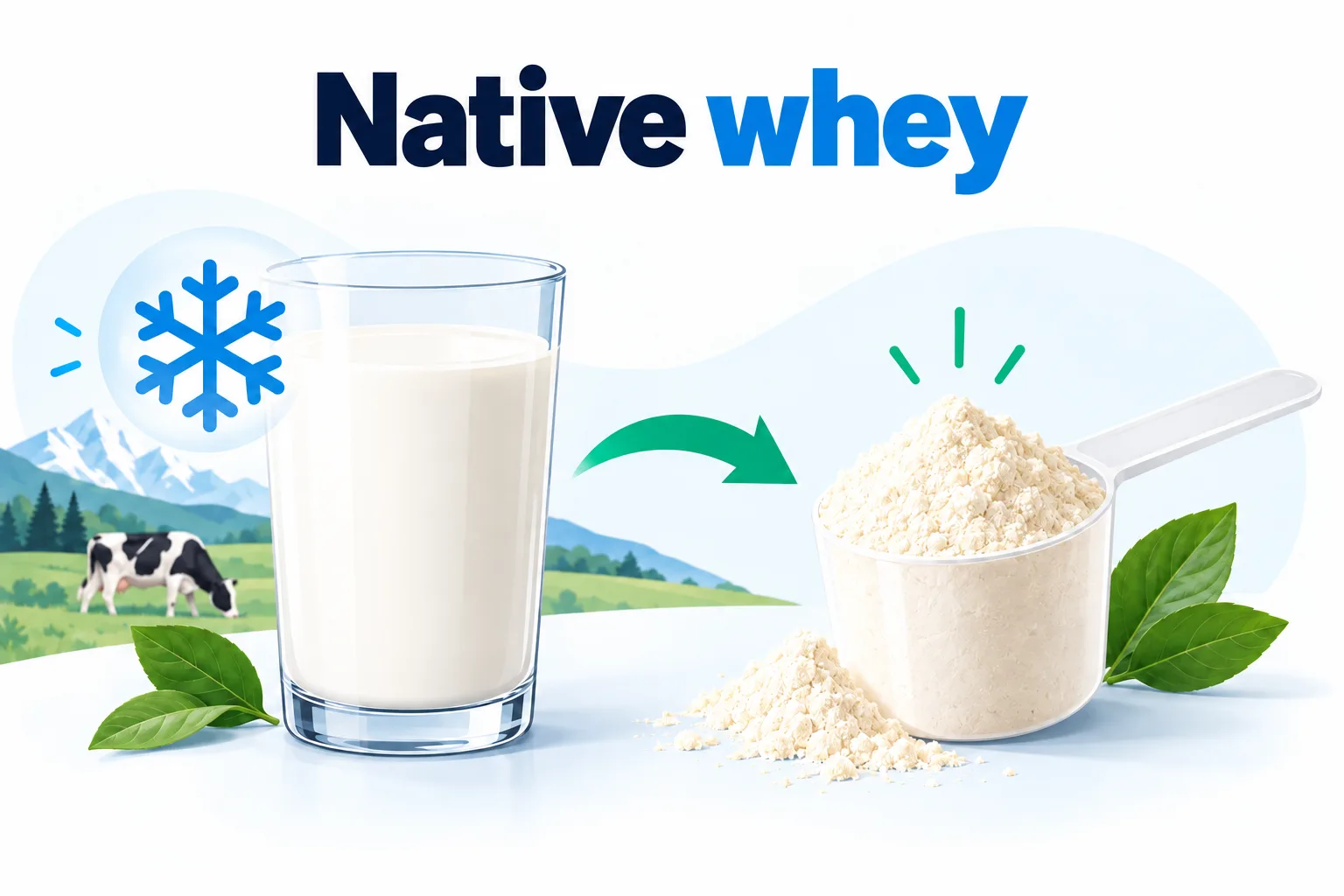
A standard whey is made from the whey left over by cheesemaking. A native whey, by contrast, is extracted from fresh milk by low-temperature microfiltration, with no cheesemaking step. Nutrimuscle, for example, describes cold microfiltration and ultrafiltration for its Whey Native Isolate, and Nutripure describes cold membrane filtration of fresh French milk.
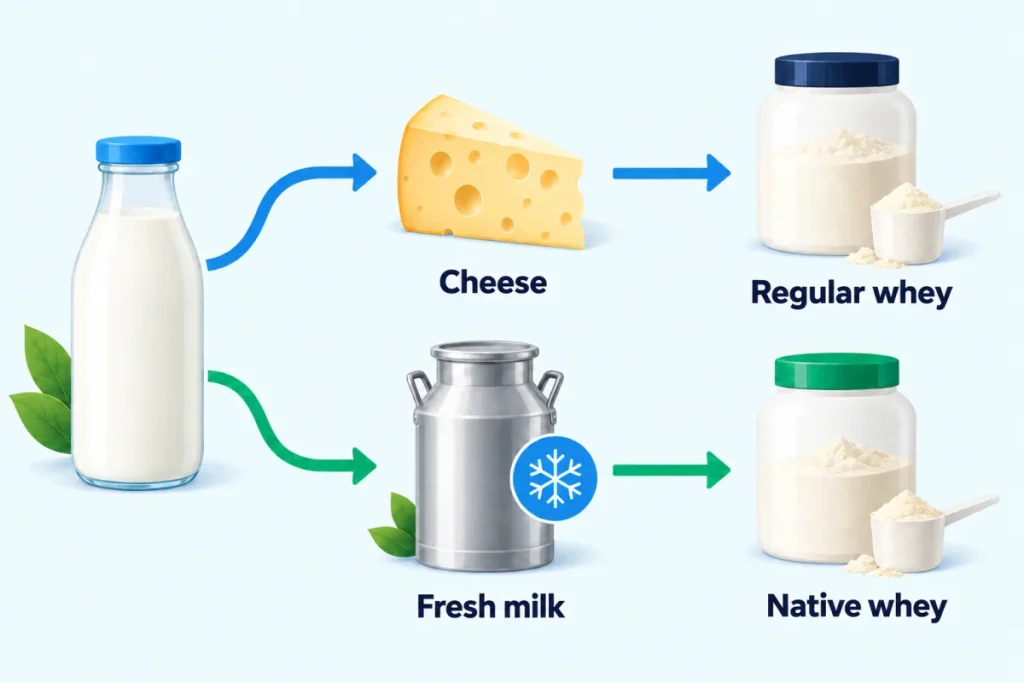
Beware of one common shortcut: a native whey is not an “unprocessed” protein. It is filtered and then dried into a powder, like every whey. The difference lies in the starting material (fresh milk rather than cheese whey) and in the lower temperatures, which limit protein denaturation.
⚖️ Native, concentrate or isolate whey: the comparison
“Native” and “isolate” are not opposites: the first word describes the origin, the second the level of filtration. A whey can therefore be native and an isolate at the same time, like those from Nutripure and Nutrimuscle. The detail is in our article on native whey vs whey isolate.
| Type of whey | Protein content | Low lactose | Price | Milk traceability |
|---|---|---|---|---|
| Whey concentrate (standard) | ★★★☆☆ | ★★☆☆☆ | ★★★★★ | ★★☆☆☆ |
| Whey isolate (standard) | ★★★★☆ | ★★★★☆ | ★★★☆☆ | ★★★☆☆ |
| Native whey (concentrate) | ★★★☆☆ | ★★★☆☆ | ★★★☆☆ | ★★★★★ |
| Native whey isolate | ★★★★★ | ★★★★★ | ★★☆☆☆ | ★★★★★ |
🔬 Our method
These scores come from product pages, not from a laboratory: in October 2026 we compared the nutrition tables, processes and prices published by Nutripure, Nutrimuscle, Prozis and BioTech USA, then the randomised trials from Hamarsland’s team (Norway) comparing native whey, standard whey and milk. We did not taste or test these products ourselves.
✅ The upsides and limits of native whey
What it gives you
Its first strength is traceability: native whey brands usually state where the milk comes from (French cooperatives at Nutripure, the French manufacturer Ingredia at Nutrimuscle). Cold filtration also limits protein denaturation by heat.
On the physiology side, native whey pushes blood leucine higher than a standard whey concentrate does. That is what a randomised trial published in 2017 in the Journal of the International Society of Sports Nutrition measured, in 24 young weight trainers.
What it does not give you (yet)
In that same trial, the leucine peak did not translate into stronger muscle protein synthesis than with standard whey. Over twelve weeks of training in 40 young adults, the same team also found no difference in muscle mass or strength between native whey and milk. These are small trials, but none of them shows a clear advantage for muscle.
Its main drawback is still the price: the native wheys we recorded cost from €47 to €78 per kilo depending on the brand and the size. For most people who train, it is your total protein intake over the day that matters most, far more than the type of whey.
🛒 Where to buy native whey protein
Not every whey sold as an “iso” is native. Check that the product page explicitly mentions fresh milk and cold filtration. Here is what we recorded on the brands’ websites in October 2026:
| Product | Native? | Protein per 100 g | Price recorded (October 2026) |
|---|---|---|---|
| Nutripure native Whey Isolate | Yes, fresh French milk | About 87 g (94% on a dry-matter basis) | €44.90 for 750 g, €189.90 for 4 kg |
| Nutrimuscle Whey Native Isolate | Yes, Ingredia isolate (France) | 80 to 81.2 g depending on the flavour | €38.95 for 500 g, €246.95 for 4 kg |
| Prozis Natural Pure Native Whey Isolate | Yes, going by its name | Not recorded | €64.79 for 900 g on promotion |
| ISO WHEY ZERO, from BioTech USA | Not claimed (low-temperature microfiltration) | 85 g | €104.90 for 1,816 g |
Worth noting: Decathlon’s Pure Whey 100% Isolate and the Myprotein wheys are not sold as native. If you are weighing up these brands, read our reviews of Decathlon whey protein, Prozis whey protein and Myprotein whey protein, or our ranking of the best whey isolate.
Click below to go to our favourite native whey:
🕒 How to take native whey protein
How much per day and per serving?
Start from your total need: the ISSN position stand puts the useful intake at between 1.4 and 2.0 g of protein per kilo per day for most people who train, food included. Whey protein only tops up what your diet does not supply. Our guide on how much whey protein per day helps you do the sums.
Per serving, the ISSN recommends 20 to 40 g of protein, or around 0.25 g per kilo of body weight. A 30 g scoop of native whey isolate supplies about 24 g of protein (up to 24.4 g per 30 g serving on the Nutrimuscle label).
When should you take it during the day?
Before or after your session, both work: according to the ISSN, the right moment mostly depends on your own tolerance, and the training effect lasts at least 24 hours. Ideally, spread your protein servings every 3 to 4 hours. More detail in our article on when to take whey protein.
Mix it with water or with milk?
With water if you are watching your calories, with milk if you are trying to add some: milk brings its own protein, around 80% of which is casein. Our guide to the whey protein to water ratio gives you the right proportions.
💬 Our verdict on native whey protein
Native whey is worth its price if the origin of the milk and purity matter to you, and a native whey isolate like Nutripure’s is our pick if you digest lactose poorly. What it is not is a shortcut to more muscle: the available studies give it no advantage over a standard whey.
It is not for you if money is tight: a well-chosen standard concentrate will do the same job for less. And if you are allergic to milk protein, have kidney disease or are pregnant, ask your doctor before taking any supplement, native or otherwise.
❓ Frequently asked questions
What is native whey protein?
It is a whey protein extracted straight from fresh milk by cold filtration, without going through cheesemaking. It is still filtered and dried into a powder, like any whey.
What is the difference between native whey and isolate?
“Native” refers to the origin (fresh milk), “isolate” to the level of filtration (more protein, less lactose). The two combine in native whey isolates. See our comparison of native whey vs whey isolate.
Is native whey protein more effective?
Not according to the available trials: it raises blood leucine further, but it did not produce more muscle protein synthesis than a standard whey, nor more muscle than milk over 12 weeks. Its appeal lies mainly in origin and purity.
What is the best native whey protein?
Of the native wheys we compared, Nutripure’s shows the highest protein content (about 87 g per 100 g as sold), ahead of Nutrimuscle. Always compare the product as sold, and on the price per kilo.
📚 Sources
- Native whey versus standard whey after exercise (Hamarsland et al., JISSN 2017)
- Native whey versus milk over 12 weeks of resistance training (Hamarsland et al., MSSE 2019)
- ISSN position stand on protein and exercise (Jäger et al., 2017)
- Nutrimuscle Whey Native Isolate product page: process and nutrition values (in French)