Contents 7 sections
What is your main goal?
How do you digest dairy?
What matters most to you?
Summarise this article with:
💡 The essentials
Whey isolate is not dangerous for a healthy adult who sticks to a sensible dose: a meta-analysis of 28 trials finds no adverse effect of a high-protein diet on kidney function.
- Risk no. 1: chronic excess, above all in someone sedentary (the kidneys and the liver are first in line).
- Risk no. 2: contaminants such as lead, which is why a brand that publishes its test results matters.
- Medical advice is compulsory if you have kidney or liver disease, a milk allergy, or you are pregnant.
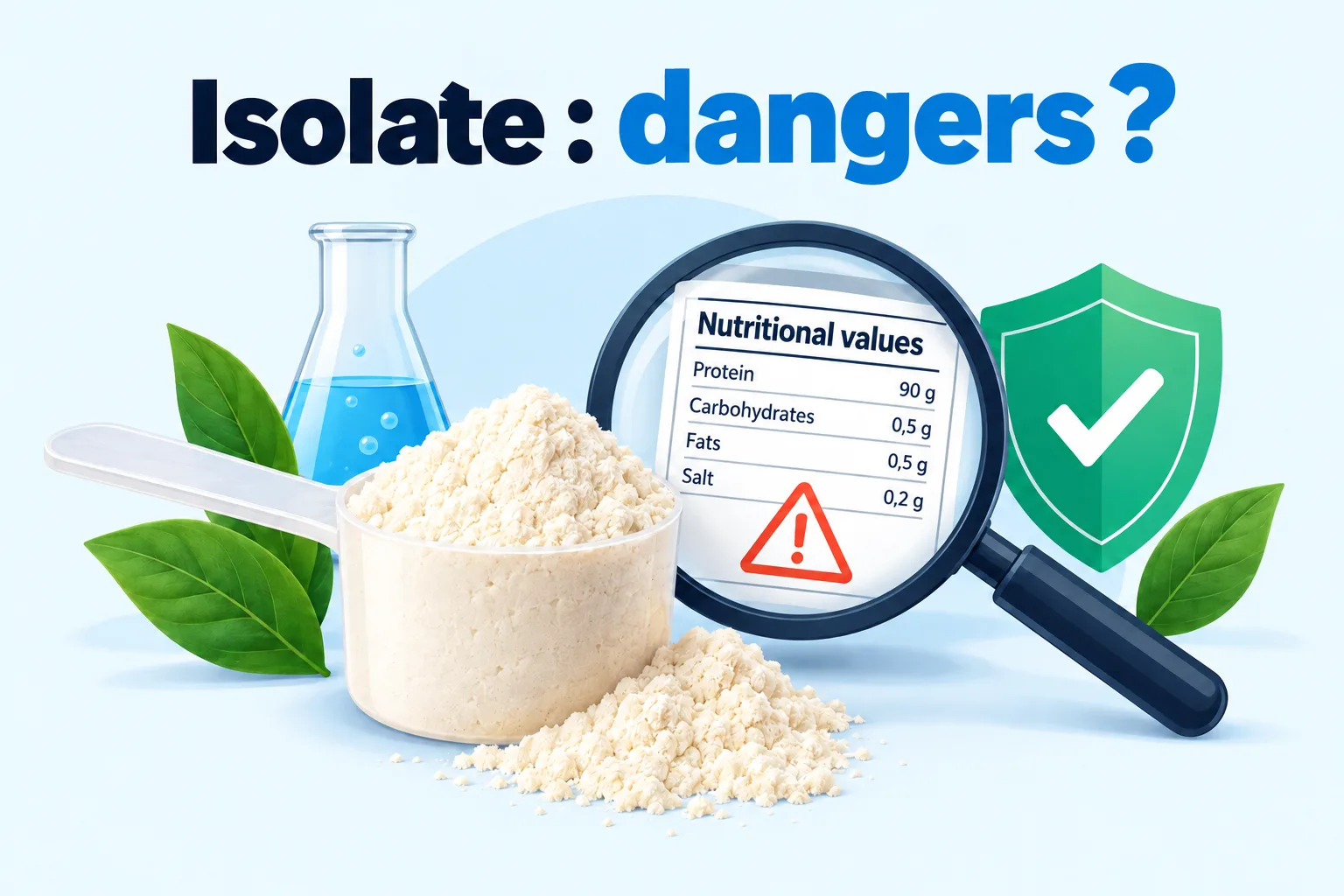
Whey isolate is often sold as a “pure”, “clean”, “easy to digest” protein. That is partly true: it is very concentrated in protein and low in lactose and fat. But pure does not automatically mean safe. The debate too often shrinks to “does whey wreck your kidneys?”, when the real risks lie elsewhere.
This guide puts the priorities back in the right order, with the sources to back them: what the studies actually say about the kidneys and the liver, what the contamination testing reveals, and who needs to be careful. For the definition and the manufacturing process, start with our guide to what whey isolate is.
🔬 Our method
We carried out no laboratory analysis of our own. We read the primary sources: the protein reference values from ANSES, the French food safety agency, its 2024 warning on supplements for athletes, one meta-analysis and one systematic review published in peer-reviewed journals, plus the test reports from the Clean Label Project and Consumer Reports. Every figure in this article comes from one of those pages.
🧪 Why “pure” does not mean “harmless”
Whey isolate is whey put through a heavy filtration that strips out most of the lactose and the fat. That filtration improves the nutritional profile, but it does not fix a mediocre raw material, weak quality control, or additives mixed in afterwards. It also makes the product extremely convenient, and therefore easy to overdo.
| Feature | The real benefit | The associated risk |
|---|---|---|
| Heavy filtration | Less lactose and less fat | Guarantees nothing about the contaminants it started with |
| High protein content | A dense, convenient product | Easy to overconsume, the reflex shake |
| Fast digestion | Useful around training | Little point for someone sedentary |
So purity on its own is not what should reassure you, but the combination of traceability, contaminant testing and a dose that fits you.
🫘 Kidneys and liver: what the studies really say
In a healthy adult, the fear about the kidneys is not borne out. A meta-analysis of 28 trials published in 2018 in the Journal of Nutrition (1,358 participants) concludes that a high-protein diet does not impair kidney filtration, at intakes of at least 1.5 g/kg/day or 100 g of protein per day.
The picture changes with abuse. A 2021 systematic review links most of the reported adverse effects to chronic, excessive and unsupervised use of whey, with the kidneys and the liver as the main organs affected. It notes that those effects are made worse by a sedentary lifestyle, and other work it includes points to acne and changes in the gut microbiota.
The ANSES reference values give you the order of magnitude. The recommended intake is 0.83 g/kg/day for an adult, around 1.2 to 1.5 g/kg/day for a trained athlete, and intakes of up to 2.2 g/kg/day are judged satisfactory in an adult with normal kidney function. To build muscle mass, the agency advises not going beyond 2.5 g/kg/day, for six months at most. Those figures cover your whole diet, not just the powder: to work out the share your shake should take, see how much whey protein to take per day.
The signals that should make you revisit your dose are rarely dramatic: persistent bloating, a heavy feeling after each serving, recurring discomfort despite a “premium” isolate. They do not necessarily come from the lactose: the dose, the flavourings, the sweeteners or the thickeners can all be to blame.
☣️ The hidden danger: lead, heavy metals and BPA

The market’s real blind spot is industrial contamination. The Clean Label Project report published in January 2025 covered 160 products from 70 brands: 47% exceeded at least one regulatory threshold, and 21% exceeded double the Californian threshold (Proposition 65) for lead. BPA, for its part, was detected in only 3 products out of 160, against 55% in the 2018 round of testing.
Two caveats make those figures more useful. First, the whey-based proteins were the least contaminated: 28% went over the thresholds, against 77% of plant proteins and 79% of organic powders. Second, the Californian threshold is a very cautious one: 0.5 µg of lead per day, 25 times lower than the FDA reference level for adults (12.5 µg per day), a gap the industry disputed sharply, also criticising the report for not being peer-reviewed.
In October 2025, Consumer Reports tested 23 protein powders and drinks: more than two thirds went over that same 0.5 µg per day benchmark, and the plant proteins contained on average nine times more lead than the dairy proteins. No product reached a level capable of causing an immediate effect: the issue is repeated exposure over months. And lead can harm the reproductive system in both men and women, which is one more reason to limit any avoidable exposure.
These results come from the United States and do not single out any specific French brand. What they mainly show is that an “ultra pure isolate” label proves nothing without contaminant testing. For the full set of risks tied to protein powders, see also our article on the dangers of whey protein.
⚠️ Who needs to be careful with whey isolate?
| Profile | Level of caution | Why |
|---|---|---|
| Kidney or liver disease, borderline blood work | Very high | A repeated protein load becomes an avoidable stress |
| Allergy to milk protein | Very high | Filtration removes the lactose, not the milk proteins that cause the allergy |
| Pregnancy, breastfeeding | High | No self-medication: both the point of the product and its contaminants are open questions |
| Severe lactose intolerance | Medium | An isolate contains little, but not necessarily zero |
| Sedentary person, daily shakes | Medium | Little benefit, higher risk of excess |
⚠️ Watch out
If you have kidney or liver disease, a milk allergy, or you are pregnant or breastfeeding, ask your doctor before taking whey isolate regularly at all. ANSES in fact advises every athlete to consult a healthcare professional (a doctor, a sports dietitian) before taking any supplement.
✅ How to choose a safe whey isolate

In July 2024, ANSES renewed its warning about supplements for athletes. It advises choosing products that comply with the European standard EN 17444:2021, avoiding stacking several supplements at once, and treating online purchases with suspicion. Third-party certification adds a guarantee, provided you know what it covers: NSF Certified for Sport tests for heavy metals among other things, whereas Informed Choice focuses on banned substances (doping).
- Published contaminant tests (heavy metals, batch by batch if possible): this is criterion no. 1.
- The right third-party certification: NSF for contaminants, Informed Choice or EN 17444 for doping.
- A short ingredient list, without a pile of flavourings, sweeteners and thickeners.
- The origin of the milk stated: with no traceability, a quality promise stays just a promise.
- A dose that makes sense for your weight, your activity and what you already eat.
To see these criteria applied to specific products, we used them in our ranking of the best whey isolates, and you will find broader guidance in our guide to choosing your whey protein well.
🎯 Our verdict: should you be afraid of whey isolate?
No, as long as you buy it with your eyes open and dose it like a supplement, not like a meal. For a healthy athlete who struggles to hit their protein needs, a traceable, tested isolate is still a practical tool, and the kidney data is reassuring at a sensible dose.
It is not, however, made for everyone. We advise against it without medical advice for anyone with kidney or liver disease, for anyone allergic to milk and for pregnant women, and we think it is pointless for a sedentary person who already covers their needs at the table. The real danger is not its reputation: it is excess, poor quality and the absence of any verification.
❓ Frequently asked questions
Is whey isolate dangerous for your kidneys?
Not in a healthy adult who sticks to a sensible dose. The 2018 meta-analysis cited above finds no adverse effect of a high protein intake on kidney filtration. If you have a diagnosed kidney disease or borderline blood work, the situation is different: ask your doctor for advice.
Is an organic whey automatically safer?
No: in the Clean Label Project report, 79% of organic powders exceeded at least one threshold, more than the average. The organic label covers the production method, not heavy metals. Only published contaminant tests give you proof.
Is whey isolate dangerous for male fertility?
No study establishes a causal link between whey isolate itself and a drop in fertility. The risk under discussion is lead contamination, which can harm the reproductive system where exposure is repeated. That is one more reason to insist on batch testing.
Can you take whey isolate while pregnant or breastfeeding?
Not without talking to your doctor or your midwife first. ANSES advises seeking a healthcare professional’s advice before any supplement, and lead exposure during pregnancy can affect the development of the baby’s brain: a powder with no published testing has no place here.
Should you stop whey isolate altogether just to be safe?
Not necessarily: what you should stop is buying it blind. An isolate is still useful to an athlete who wants to top up their intake, provided it is justified, tested, properly dosed and suited to their state of health.
📚 Sources
- ANSES: protein intakes, consumption, quality, requirements and recommendations (in French)
- ANSES (2024): risks of food supplements and fortified foods for athletes
- Journal of Nutrition (2018): protein and kidney function, meta-analysis
- Systematic review (2021): potential adverse effects of whey
- Clean Label Project (2025): contaminants in protein powders