Contents 6 sections
What is your main goal?
How do you digest dairy?
What matters most to you?
Summarise this article with:
💡 The essentials
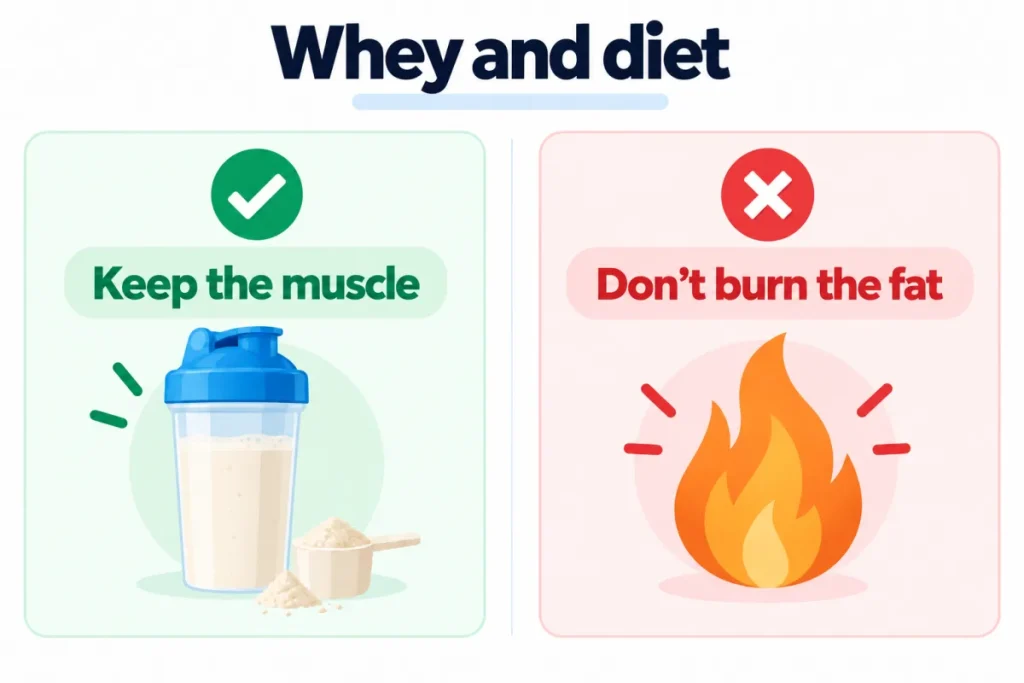
Whey does not make you lose weight on its own, but it helps you stick to a high-protein diet, which limits muscle loss and hunger. And no, it will not make you “bulk up”.
- What makes you lose weight: a calorie deficit held over time.
- What whey brings: 20 to 26 g of protein for around 115 kcal, in place of a snack.
- What to avoid: adding it on top of everything else, or taking it while pregnant without medical advice.
You want to lose weight and you are wondering whether whey can help, without ending up with a bodybuilder’s arms? Good news: whey is a simple way to eat more protein while dieting, and it will not reshape a woman’s figure overnight.
So, here is what the studies say, what whey actually changes for a woman who wants to lose fat, and our verdict with no miracle promises attached. If you would rather go straight to a product, our round-up of the best whey protein for weight loss is made for you.
🔬 What whey really does on a diet
When you eat less, your body also draws on your muscle: keeping protein high limits that loss. That is whey’s main value on a diet. A meta-analysis of 9 trials in overweight people (Wirunsawanya et al., 2018) links whey to 1.12 kg less fat mass on average and to better retention of lean mass compared with the control groups.
On hunger, protein does fill you up a little more, but whey’s own effect stays modest: a 2017 meta-analysis finds a drop in appetite over the long term, with no clear difference from carbohydrates within a single meal. The EFSA in fact refused the “satiety” and “maintenance of a normal body weight” claims for whey back in 2010. So take it that whey helps you follow a diet, it does not follow it for you.
💪 Does whey make a woman “bulk up”?
No: whey adds no muscle size without training, and even with training, muscle comes on slowly. In people who lift weights, adding protein brings an average of 0.30 kg of extra lean mass over several weeks (meta-analysis by Morton et al., 2018). On a diet, the goal is to keep the muscle you have rather than to gain much anyway.
If your scales go up after you start taking whey, look at your total calories rather than at muscle: a shake made with semi-skimmed milk comes to more than 230 kcal. The subject is covered in does whey protein make you fat? and the figures liquid by liquid in whey protein calories.
🎯 How much protein for a woman who wants to lose weight?
The EFSA reference value is 0.83 g of protein per kilo per day for any adult woman, which is about 50 g at 60 kg. According to the INCA1 survey cited by ANSES, women in France eat an average of 82 g a day: most are already above that minimum.
If you train and you are dieting, the International Society of Sports Nutrition (ISSN) puts the requirement between 1.4 and 2.0 g per kilo per day for most active people, which is 84 to 120 g at 60 kg. That is where whey becomes handy: one serving brings about a quarter of that total with no cooking involved. To adjust it to your own weight, see how much whey protein per day.
⚠️ Pregnancy and breastfeeding
If you are pregnant or breastfeeding, this is not the moment for a diet or for a supplement without medical advice. Protein needs go up (the EFSA adds 1 g, then 9 g, then 28 g a day depending on the trimester, and 19 g during the first six months of breastfeeding), and ANSES advises against sports supplements for pregnant or breastfeeding women without the advice of a health professional. Talk it over with your doctor or your midwife.
🥤 How to use whey to lose weight
- In place of a sugary snack, not on top of it: a 25 to 30 g serving with water.
- At breakfast, often the meal lowest in protein: stirred into fromage blanc or porridge.
- With some resistance training, even two sessions a week, so that the protein goes towards keeping muscle.
- An isolate if lactose bloats you: it contains far less of it than a concentrate.
For the detailed set-up (timing, amount, common mistakes), read whey protein and weight loss. If you are unsure which type of powder to buy, our article on whey isolate for weight loss compares the options, and our whey-based recipes will keep you from getting bored of the shaker.
👩 A woman’s take on whey for weight loss
Now to my own experience. Yes, I have tried whey protein for weight loss, and it is not a miracle solution, more an extra helping hand: I felt fuller after having whey, which helped me keep my urge to snack under control. That is a personal impression, not a promise: hunger varies enormously from one person to the next, and the studies cited above describe a modest effect.
🔬 Our method
The figures in this article come from published sources, not from measurements of our own: the EFSA and ANSES for protein requirements (including pregnancy and breastfeeding), the ISSN position stand for active people, the meta-analyses by Wirunsawanya (2018), Mollahosseini (2017) and Morton (2018), and manufacturers’ labels for the calories.
💡 Our verdict
Whey is worth it if you are dieting, doing a bit of resistance work and struggling to eat enough protein. It is a far better swap than a sugary snack and it protects your muscle mass. It is not for you if you are looking for a “fat burner”, if you already eat protein at every meal, if you are pregnant and have not spoken to a doctor, or if you are allergic to milk protein.
❓ Frequently asked questions
Does whey really help a woman lose weight?
It helps indirectly, by making a high-protein diet easier to run, but the effect of its own stays modest. Studies in overweight people show about 1 kg less fat mass on average compared with controls. The calorie deficit does most of the work.
When should you take whey to lose weight?
At whichever point it replaces a snack or tops up a meal that is low on protein, often breakfast or the middle of the afternoon. The exact moment matters little: it is the day’s total protein and calories that make the difference.
Which whey should a woman choose?
The same one a man would: nutritionally, there is no such thing as a whey “for women”. Look at the protein content, the additives and your own tolerance to lactose. A product marketed at women has no specific need to cover: just compare the labels, see our round-up of the best whey protein for weight loss.
Is whey dangerous for a woman?
Not for a healthy adult who sticks to the stated doses, but some situations call for medical advice. Pregnancy, breastfeeding, kidney disease or a milk protein allergy all need a professional’s opinion. The full picture is in whey protein: what are the dangers?