Contents 9 sections
- What exactly is whey
- The different types of whey
- The types of whey compared
- Which whey should you choose for your goal
- Choosing according to your training level
- What should you look at on the label before buying
- Which whey brands should you look at
- Our verdict: how to choose your whey well
- Frequently asked questions
What is your main goal?
How do you digest dairy?
What matters most to you?
Summarise this article with:
💡 The essentials
To choose your whey well, start from your goal and your digestion, then read three figures on the label: protein per 100 g, carbs, and price per kilo.
- Tight budget or beginner: a whey concentrate (around 72 to 75 g of protein per 100 g).
- Cutting or lactose sensitivity: a whey isolate (80 to 87 g of protein, fewer carbs).
- Traceable milk: a native whey, extracted from fresh milk.
When you first land in the world of supplements, you usually just want to “take some whey” to cover your protein needs. The catch is picking the right whey out of dozens of types, brands and formats. This guide gives you a simple method, with the figures to back it up.
🥛 What exactly is whey?
Whey is the protein of milk serum, the liquid part that separates from milk during cheesemaking. It supplies every essential amino acid, including leucine, which plays a part in muscle protein synthesis. To go further: what is whey protein?
🔬 The different types of whey
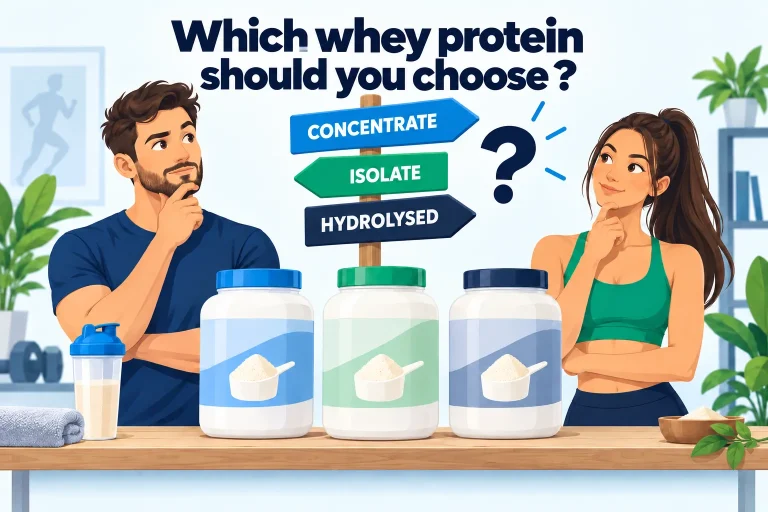
Whey concentrate
This is the most common whey, and the cheapest. The two concentrates whose labels we checked in October 2026 show 72 g (Myprotein Impact Whey Protein) and 75 g (Decathlon unflavoured) of protein per 100 g, with 9 to 12 g of carbs, part of which is lactose.
Whey isolate
An isolate is filtered more finely: it holds more protein and less lactose and fat than a concentrate. The isolates we compared show between 80 and roughly 87 g of protein per 100 g as sold. Everything you need to know is in our article on what whey isolate is.
Hydrolysed whey
Hydrolysed whey is a whey whose proteins have been partly pre-cut into peptides. Before you pay for that extra step, compare it with an isolate on protein per 100 g and on price per kilo. The detail is in our guide to hydrolysed whey.
Native whey
Native whey is extracted straight from fresh milk by cold filtration, without going through cheesemaking at all. “Native” therefore describes the process, not a protein percentage: a native whey isolate such as Nutripure’s shows 94% on a dry basis, which works out at roughly 87 g per 100 g of powder as sold (checked in October 2026). It is also one of the dearest options.
Plant proteins (so-called “vegan whey”)
“Vegan whey” is a misnomer, since whey always comes from milk. What you are actually buying is plant protein, often a blend of pea and rice, with no lactose: the option for people who do not eat dairy. Nutripure’s organic plant protein (rice and pea), for instance, shows 89% protein.
Blends
Plenty of well-known products mix concentrate, isolate or hydrolysate. There is nothing dangerous about that, but read the ingredient list so you know which types of protein you are buying, and always compare the protein per 100 g.
⚖️ The types of whey compared
| Type | Protein | Low in carbs and lactose | Price | Traceability |
|---|---|---|---|---|
| Whey concentrate | ★★★☆☆ | ★★☆☆☆ | ★★★★★ | ★★☆☆☆ |
| Whey isolate | ★★★★☆ | ★★★★☆ | ★★★☆☆ | ★★★☆☆ |
| Native whey isolate | ★★★★★ | ★★★★★ | ★★☆☆☆ | ★★★★★ |
| Plant protein | ★★★★☆ | ★★★★★ | ★★★★☆ | ★★★☆☆ |
🔬 Our method
These stars summarise labels, not lab tests: in October 2026 we recorded the nutrition tables and the prices published by Decathlon, Myprotein, Nutripure, Nutrimuscle, YAM Nutrition, Bulk and BioTech USA, and we lean on the position stand of the International Society of Sports Nutrition (ISSN) for protein needs.
🎯 Which whey should you choose for your goal?
If you are on a bulking phase
A concentrate is more than enough: a few extra grams of carbs do no harm when you are chasing a calorie surplus, and your wallet gets off lightly. See our guide to whey and mass gain.
If you are on a cutting phase
An isolate starts to earn its place: more protein and fewer carbs per serving, which helps you hold a calorie deficit while still covering your needs. More advice in our article on whey and weight loss.
If you digest lactose badly
Choose an isolate that puts a number on its lactose content, or a plant protein. If you are allergic to milk proteins (which is not the same thing as lactose intolerance), no whey is suitable at all: ask a doctor for advice.
🏋️ Choosing according to your training level
If you are a beginner, take a concentrate: cheaper, easy to find, and it brings enough protein to make progress. Our pick of the best whey protein for beginners will save you time.
Experienced lifters often move on to isolate or hydrolysate, mostly for digestive comfort. But according to the ISSN position stand, what matters most for building and keeping muscle is your total daily protein intake: 1.4 to 2.0 g per kilo of body weight per day for most athletes, spread across the day. The type of whey mainly affects digestion and price; our guide to how much whey per day helps you work out your servings.
🔎 What should you look at on the label before buying?
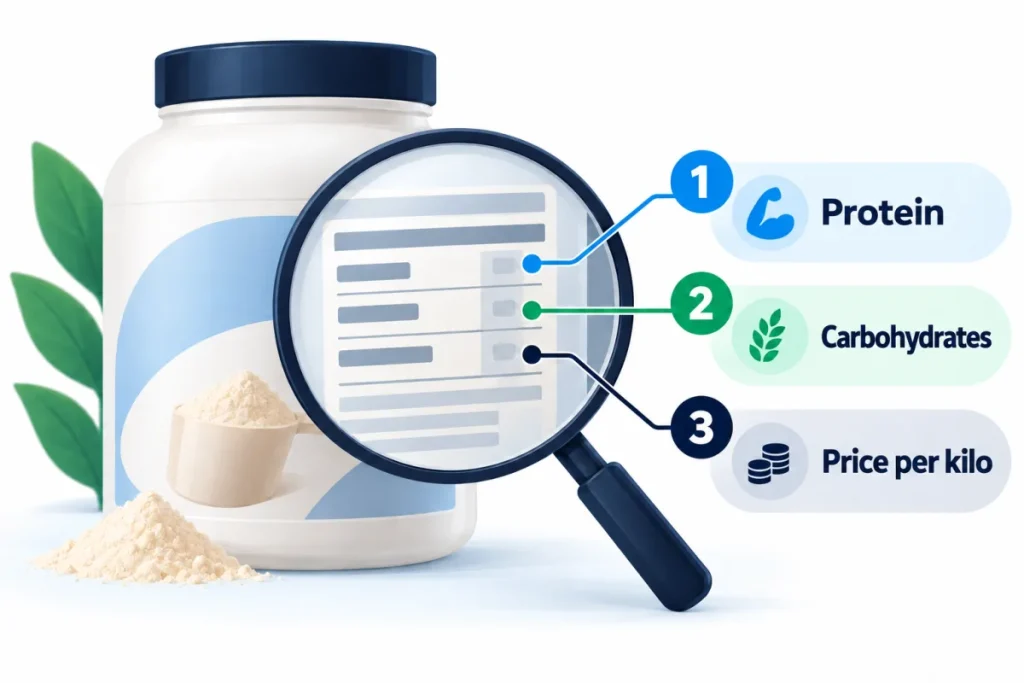
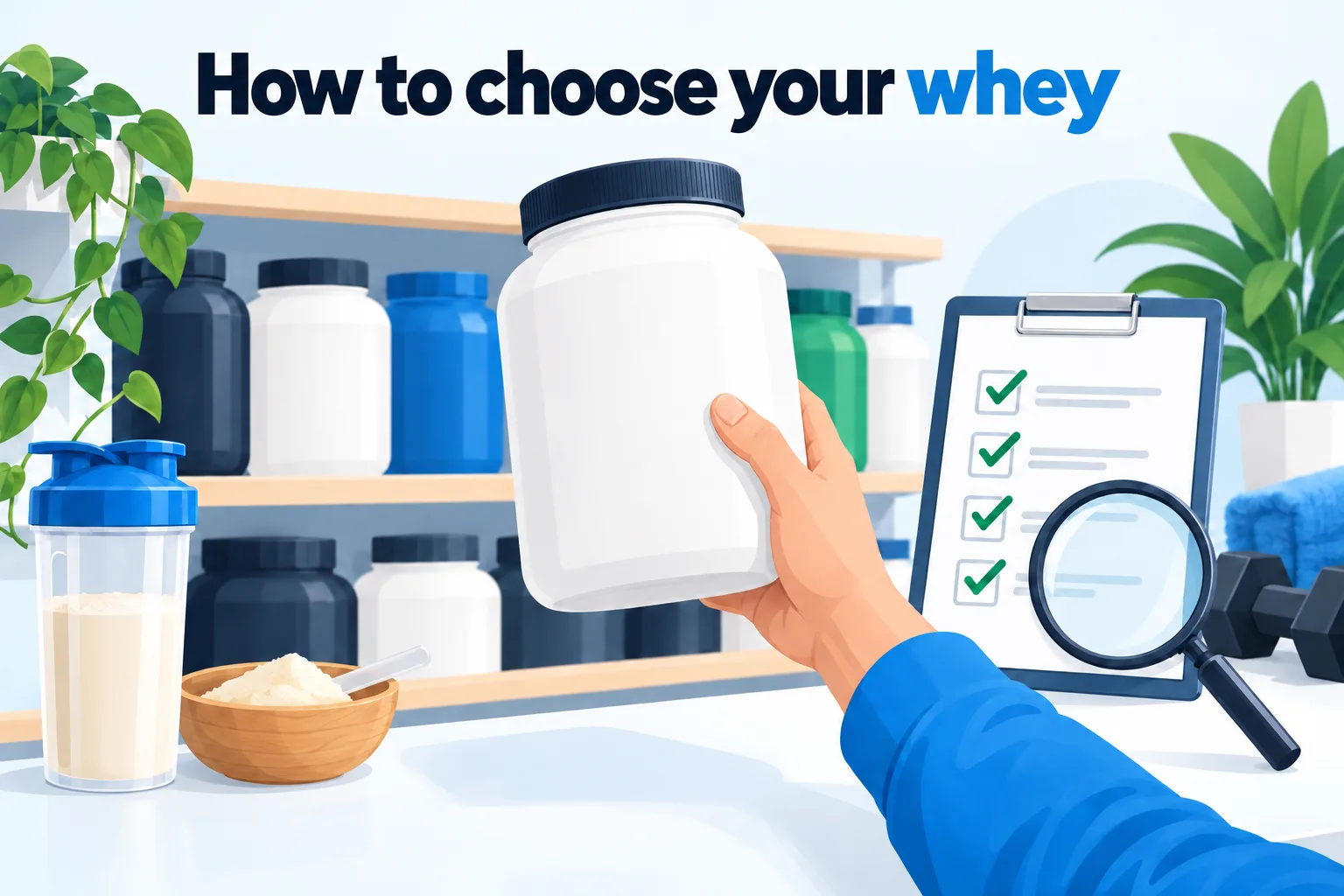
1) Protein per 100 g
This is the first figure to look at: the higher it is, the less powder you swallow for the same dose of protein. Always compare the product “as sold”: a percentage given “on a dry basis” leaves out the water in the powder and looks higher (94% on a dry basis works out at roughly 87% as sold, according to Nutripure).
2) Carbs and calories per 100 g
On a cutting phase, the fewer carbs the better: in our survey they range from under 1 g (native isolate) to 12 g per 100 g (concentrate). If, on the other hand, you struggle to put weight on, a more calorific whey or a gainer can be justified.
3) Price per kilo
You will probably be buying another tub every month, so always compare the price per kilo, not the price of the tub. In October 2026 we recorded around €43/kg for the Decathlon and Myprotein concentrates (900 g, the latter on promotion) and €44 to €78/kg for the isolates depending on the brand and the format.
4) Quality and the anti-doping standard
ANSES advises athletes to favour products that comply with the EN 17444 standard, to ask a healthcare professional for advice before supplementing and not to stack several supplements at once. A brand that publishes the origin of its milk and its lab analyses also gives you more guarantees.
🏷️ Which whey brands should you look at?
For a full ranking, see our pick of the best whey protein and our comparison of the best whey protein brands. Here are the brands whose labels we checked in October 2026, and what each does best:
| Brand | What we recorded | Who it is for |
|---|---|---|
| Nutripure | Native whey isolate, around 87 g of protein per 100 g, fresh French milk | Purity, sensitive stomachs |
| Nutrimuscle | Whey native isolate, 80 to 81.2 g of protein, isolate of French origin | Traceability |
| YAM Nutrition | Isolate at 82 to 84 g, €51/kg in the 900 g tub | Best price per kilo in isolate |
| Decathlon | Unflavoured concentrate at 75 g, isolate at 82 g, made in France | Buying in store |
| Myprotein | Impact Whey Protein at 72 g, often discounted | Deal hunters |
| BioTech USA | A Hungarian brand despite the name; Iso Whey Zero at 85 g | A wide choice of flavours |
Would you rather be guided to an answer in a few questions? Our article on which whey protein to choose points you straight to a product.
💬 Our verdict: how to choose your whey well
For most lifters, a good, well-rated concentrate is enough: it is your total protein intake that drives progress, not an “isolate” or “native” label. We only advise paying more if you are on a cutting phase, if lactose bothers you, or if the origin of the milk matters to you.
Whey is not for everyone: if your diet already covers your needs, it adds nothing. And if you have kidney disease, you are pregnant or you are allergic to milk, ask your doctor before taking any. Finally, if you are after a protein for the evening, have a look at our casein vs whey comparison.
❓ Frequently asked questions
Which whey is the most effective?
No type of whey is clearly more effective for muscle: it is your total protein intake that counts, 1.4 to 2.0 g per kilo per day according to the ISSN. Isolate and native whey stand out mainly on purity and on their low lactose content.
How can you tell whether a whey is good quality?
Look at the protein per 100 g as sold, a short ingredient list and compliance with the EN 17444 standard. A brand that states where its milk comes from and publishes its analyses is easier to check up on.
Which whey should you choose as a beginner?
A whey concentrate, at the best price per kilo. It brings enough protein to make progress; move up to an isolate only if you digest lactose badly or if you are starting a cutting phase.
Whey concentrate or isolate: which one should you pick?
Concentrate if budget comes first, isolate if you want as little carbohydrate and lactose as possible. In our survey, the isolate brings roughly 5 to 15 g more protein per 100 g, but costs more per kilo.