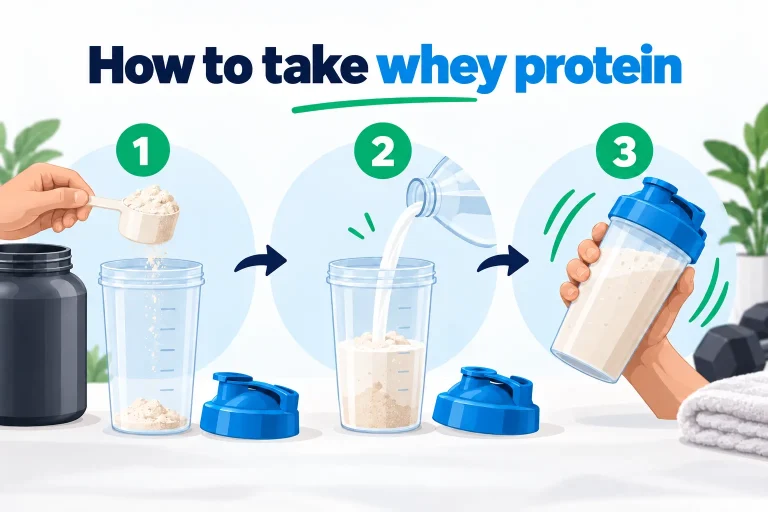
Contents 10 sections
- Step 1: how much protein a day for your profile
- Steps 2 and 3: working out your daily whey dose
- Worked examples: 60 kg, 80 kg, 100 kg
- How many whey shakes a day, at most
- How much whey per day when cutting
- Men, women, older adults: do the doses change
- How should you spread your servings across the day
- Too much whey in a day: where is the limit
- Our verdict: how much whey should you take per day
- Frequently asked questions
What is your main goal?
How do you digest dairy?
What matters most to you?
Summarise this article with:
💡 The essentials
The right amount of whey per day is whatever your diet is missing to reach your protein needs, not a fixed number. For most people who lift, that works out at 0 to 2 shakes of 30 g a day, and most often just one.
- Muscle goal: aim for around 1.6 g of protein per kg of bodyweight per day (up to 2 g/kg).
- A 30 g serving of whey brings around 22 to 26 g of protein.
- The ANSES benchmark: at least two thirds of your protein should come from food.
“How many shakes should I be having?” is probably the question that comes up most when you open your first tub of whey. The answer depends on three things: your weight, your goal and what you already eat. Someone who eats plenty of meat, eggs and dairy may well not need whey at all.
In this guide we work out your dose in 3 steps, with worked examples at 60, 80 and 100 kg, then cover the special cases: cutting, women, older adults and the limits not to go past. If you are a complete beginner, start with our practical guide to how to take whey protein.
🔬 Our method
The benchmarks in this guide come from the authorities and from scientific reviews, not from gym-floor hearsay: the protein reference values of EFSA (2012) and of ANSES, the French food safety agency (2007), the ISSN position stand on protein and exercise (2017) and the meta-analysis by Morton et al. (2018, 49 trials). The protein-per-serving figures come from product sheets checked in October 2026. We measured nothing ourselves.
🎯 Step 1: how much protein a day for your profile?
You do not start by working out a whey dose, you start by working out a total protein need. Whey is only one protein source among many: what matters for muscle is the total across the day. Here are the official and scientific benchmarks, in grams per kg of bodyweight per day.
| Profile | Protein per day | Source |
|---|---|---|
| Healthy sedentary adult | 0.83 g/kg | EFSA 2012, ANSES |
| Older adult (over 65) | 1.0 to 1.2 g/kg (1.2 g/kg or more if active) | PROT-AGE 2013 |
| Regular endurance sport | 1.2 to 1.4 g/kg | ANSES 2007 |
| Weight training (building or keeping muscle) | 1.4 to 2.0 g/kg, plateau around 1.6 g/kg | ISSN 2017, Morton 2018 |
| Cutting in a trained lifter | 2.3 to 3.1 g/kg (ISSN), 2.5 g/kg maximum according to ANSES | ISSN 2017, ANSES 2007 |
For building muscle, 1.6 g/kg is the most useful number. The meta-analysis by Morton et al. (2018) shows that beyond roughly 1.6 g/kg/day of total protein you gain no further lean mass on average (with a margin of uncertainty that reaches up to 2.2 g/kg). Aiming for 1.6 to 2 g/kg therefore covers almost everyone, without going over the top.
🧮 Steps 2 and 3: working out your daily whey dose
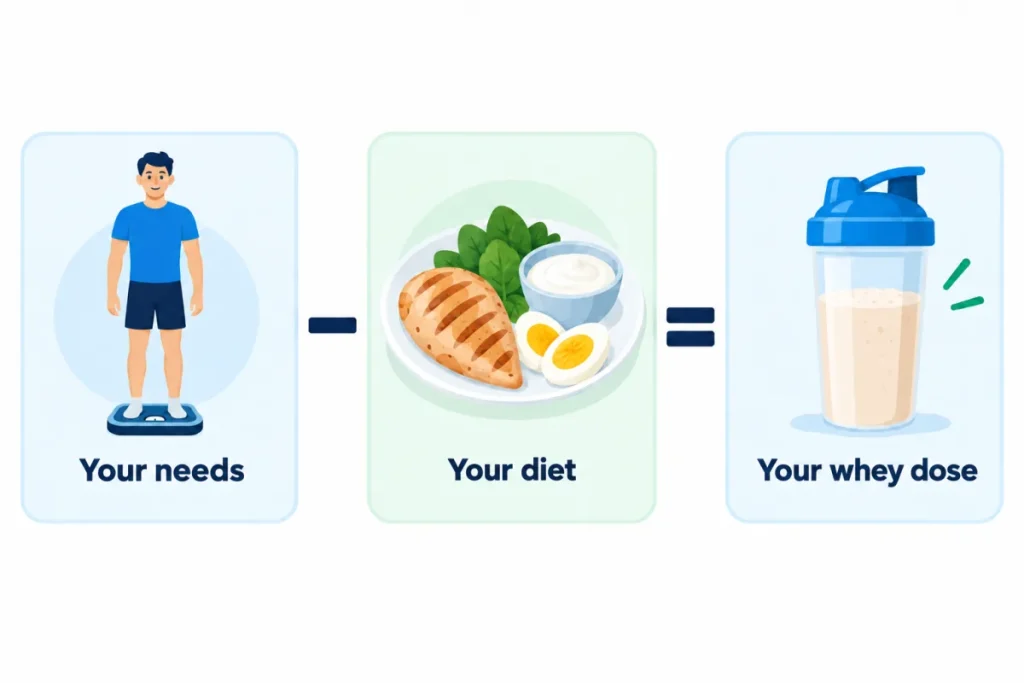
- Work out what you need: your bodyweight multiplied by your benchmark from the table (1.6 for weight training, for instance).
- Measure what you already eat: log your meals for a few days in a nutrition tracking app and average out your protein.
- Take the difference: need minus intake = the protein you are missing. Divide that gap by 22 to 26 g (one serving of whey) to get your number of shakes.
Plenty of people discover at step 2 that they already eat enough protein. According to the national INCA survey cited by ANSES, the average French adult takes in around 1.4 g/kg/day (105 g a day for men, 82 g for women). If that is you and you are aiming for 1.6 g/kg, the gap is often no more than twenty-odd grams: one shake covers it.
📊 Worked examples: 60 kg, 80 kg, 100 kg
Here are the total needs for a muscle-building goal, at the 1.6 g/kg benchmark and at the top of the useful range (2 g/kg). How many shakes you need then depends on your diet.
| Bodyweight | Need at 1.6 g/kg | Need at 2 g/kg | Maximum advised from supplements (1/3, ANSES) |
|---|---|---|---|
| 60 kg | 96 g | 120 g | 32 to 40 g, so 1 to 1.5 servings |
| 80 kg | 128 g | 160 g | 43 to 53 g, so around 2 servings |
| 100 kg | 160 g | 200 g | 53 to 67 g, so 2 to 2.5 servings |
A concrete example: a man of 80 kg who eats 105 g of protein a day and aims for 1.6 g/kg needs 128 g, so he is 23 g short, which is one whey shake. If he aims for 2 g/kg (160 g), he is 55 g short: two shakes, or better, one shake plus an extra portion of meat, fish or fromage blanc. For the foods that do the same job as the powder, see what to use instead of whey.
🥤 How many whey shakes a day, at most?
In practice, 1 shake a day is enough for most people, 2 for the heavier builds or the small eaters, and rarely more than 3. ANSES recommends that strength athletes get two thirds of their protein from food, with only the final third coming from supplements. The last column of the table above turns that rule into servings.
Per serving, 20 to 40 g of protein is enough, which is around 0.25 g per kg according to the ISSN. A standard 30 g serving of powder is therefore the right unit: no need to double up on the scoop. A study by Macnaughton et al. (2016) did find, though, that 40 g stimulated muscle protein synthesis more than 20 g after a session that worked the whole body. To get that serving mixing properly, see our guide to the whey to water ratio.
🔥 How much whey per day when cutting?
On a cut your needs go up: the ISSN cites 2.3 to 3.1 g/kg/day to preserve lean mass in trained lifters who are in a calorie deficit. ANSES is more cautious: do not go past 2.5 g/kg/day, and not for more than six months. Because you are eating less, whey often takes a bigger share, typically 2 shakes, since it delivers a lot of protein for very few calories (around 115 kcal a serving, detail in whey protein calories).
Whey does not make you lose weight on its own: it helps you hold a high protein intake inside a tight calorie budget. The full strategy is in our article on whey protein and weight loss.
👩 Men, women, older adults: do the doses change?
The per-kilo benchmark is the same for men and women, it is the total that changes. ANSES puts the needs of female athletes 15 to 20% below those of male athletes, mainly because they weigh less on average and carry less muscle mass. A woman of 60 kg aiming for 1.6 g/kg needs around 96 g of protein: one shake often closes the gap. The questions specific to women who are dieting are covered in whey protein for weight loss: a woman’s view.
After 65, needs rise again to 1.0 to 1.2 g/kg according to the PROT-AGE expert group, because of age-related muscle loss. But a review of 28 trials (Kirwan et al., 2022) shows that without strength work, adding protein improves neither lean mass nor strength: whey only makes sense alongside a bit of resistance training. If you do no sport at all, read taking whey protein without working out.
🕒 How should you spread your servings across the day?
Your daily total counts for far more than the exact hour of the shake. A meta-analysis by Schoenfeld et al. (2013) found no significant effect of timing on strength or muscle size once the total amount was taken into account. The ISSN simply advises spreading protein into servings of 20 to 40 g every 3 to 4 hours.
- 1 shake a day: after the session, or at whichever meal is lowest in protein (often breakfast).
- 2 shakes: one around training, one as an afternoon snack or at breakfast.
- Rest days: keep the same protein total, see whey protein on rest days.
The detail on each slot (on waking, before or after the session, in the evening) is in our guide to when to take whey protein, and the question of the evening shake in whey protein before bed. Pick the slots you will actually keep to every day: consistency does more than the clock.
⚠️ Too much whey in a day: where is the limit?
In healthy adults, a high protein intake does not damage the kidneys: a meta-analysis of 28 trials (Devries et al., 2018) found no adverse effect on kidney function from 1.5 g/kg/day upwards. EFSA likewise considers an intake of up to double the reference value (around 1.7 g/kg/day) to be safe. Beyond that, the benefit for muscle falls to nothing and digestive upsets become more common.
⚠️ Watch out
Ask your doctor before raising your protein intake if you have kidney or liver disease, a heart condition, if you are pregnant or breastfeeding, or if it is for a teenager: ANSES advises against sports supplements for these groups without medical advice. If you are allergic to milk protein, whey is off the table. The other risks are set out in whey protein: what are the dangers?
✅ Our verdict: how much whey should you take per day?
For us, the right starting dose is one 30 g shake a day, to be adjusted once you have counted your protein for a week. Two shakes are justified on a cut, for a heavy build, or if you eat little animal protein. Past three, you are replacing real meals with powder: that is the sign to rethink your plate, not your scoop.
Whey is not for you if your meals already cover 1.6 g/kg: it would add nothing to your results, only calories. If you do need it, we suggest a simple isolate with no sweetener: Nutripure’s Whey Isolate Native brings around 26 g of protein per 30 g serving (product sheet, checked in October 2026). To compare the other options, see our ranking of the best whey protein.
❓ Frequently asked questions
How much protein should I eat per day?
0.83 g per kg for a sedentary adult, 1.6 to 2 g per kg if you do weight training. The first figure is the EFSA and ANSES reference value, the second matches the plateau seen in muscle-building studies. An adult of 70 kg who trains is therefore aiming for about 110 to 140 g a day.
How many grams are in a scoop of whey?
The serving stated on the wheys we recorded is 30 g of powder, for 22 to 26 g of protein. How much the scoop actually holds varies with the brand and with how tightly the powder has settled: weigh it once on a kitchen scale so you know what your own scoop amounts to.
Is 30 g of protein per meal enough?
Yes for most people: the ISSN puts the right dose per serving between 20 and 40 g, or around 0.25 g per kg of bodyweight. After a session that works the whole body, one study did however see a stronger muscle response with 40 g than with 20 g.
Can you have 3 whey shakes a day?
It is possible without danger for a healthy adult, but rarely useful. Three servings bring 65 to 80 g of protein, which goes past the third of total intake that ANSES advises keeping for supplements at most body sizes. You are better off enriching your meals.
How much whey per day to lose weight?
Often 1 to 2 shakes made with water, counted inside your calorie total. In a deficit, aiming for a higher protein intake helps you keep muscle. Choosing the product is covered in our comparison of the best whey protein for weight loss.
📚 Sources
- ANSES (2007): protein intake, needs and recommendations (in French)
- EFSA (2012): dietary reference values for protein
- ISSN position stand on protein and exercise (Jäger et al., 2017)
- Morton et al. (2018): meta-analysis on protein and muscle gains
- Devries et al. (2018): high protein intakes and kidney function