Contents 10 sections
- What a bulk really demands
- Are you short of protein or short of calories
- Whey for bulking: who is it for
- Mass gainer for bulking: who is it for
- Metabolism and body type: which profile are you
- Whey or mass gainer by profile: the star comparison
- Mixing whey and mass gainer, or making your own gainer
- The thing that matters most: training
- Our verdict
- Frequently asked questions
What is your main goal?
How do you digest dairy?
What matters most to you?
Summarise this article with:
💡 The essentials
When you are bulking, take a whey if your meals are already putting weight on you, and a mass gainer only if the scales refuse to move because you cannot manage to eat more.
- Aim for a moderate surplus: roughly 10 to 20% extra calories, so you gain 0.25 to 0.5% of your body weight per week.
- Aim for 1.6 to 2.2 g of protein per kg of body weight per day.
- A full serving of mass gainer can swallow your entire surplus on its own: dose it at half a serving.
You are starting a bulk and you cannot decide between a mass gainer and a whey? The right choice depends less on the product than on what you are actually short of: protein, calories, or both. This guide helps you work that out, then choose according to your profile.
For the pure product comparison (labels, price per gram of protein, brands), read our article on whey or mass gainer: which to choose. Here we focus on bulking and on how to fit one or the other into your plan.
📈 What a bulk really demands
The review by Iraki et al. on nutrition for lifters in a bulking phase (2019) gives three benchmarks. A surplus of roughly 10 to 20% above your needs, a weight gain of 0.25 to 0.5% of body weight per week for a beginner or intermediate, and 1.6 to 2.2 g of protein per kg per day. The rest of the calories come mainly from carbohydrates, at least 3 to 5 g per kg.
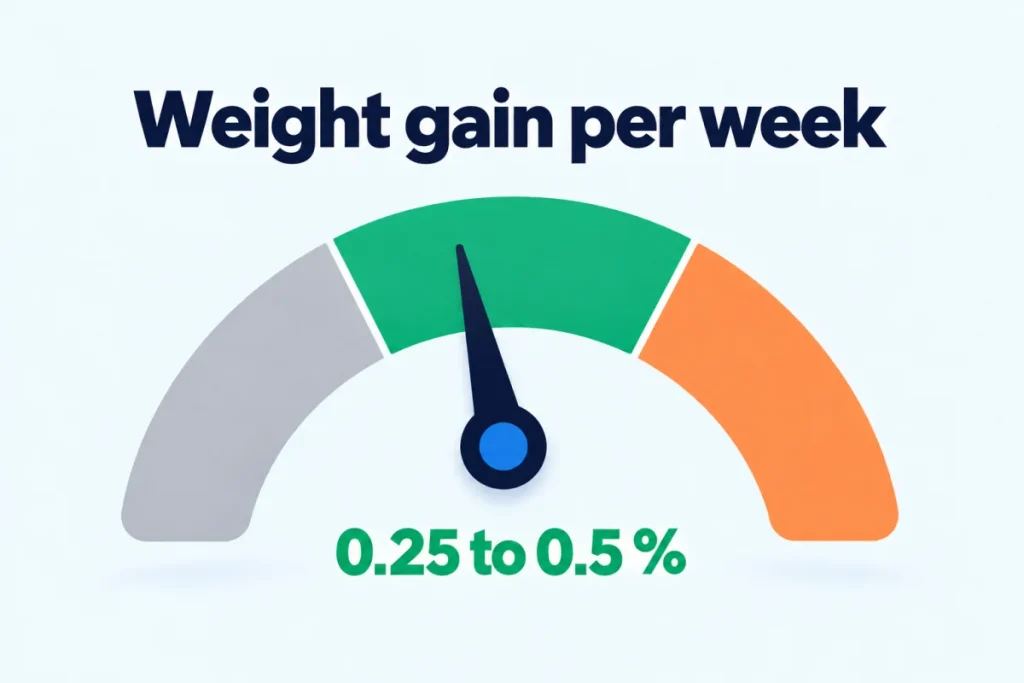
Take the example of a 70 kg person who maintains their weight on 2,500 kcal a day: a surplus of 250 to 500 kcal, a weight gain of 175 to 350 g per week and 112 to 154 g of protein per day. If the scales climb faster than that, you are mostly storing fat; if they have not budged after two or three weeks, calories are missing.
🧮 Are you short of protein or short of calories?
Write down what you eat for a few days, then compare it with the benchmarks above. A supplement is only there to close the gap: if your plate already covers your calories and your protein, you need neither whey nor mass gainer.
- Only protein is missing: whey, 20 to 40 g per shake according to the ISSN position stand on protein. The detail is in how much whey protein per day.
- Only calories are missing: add a solid snack first; a mass gainer if that is not possible.
- Both are missing: a mass gainer, or a homemade whey plus carbs shake.
🥛 Whey for bulking: who is it for?
Whey suits people who are already gaining weight from their meals but fall short on protein. It delivers roughly 24 to 25 g of protein for 115 kcal per shake according to the labels we checked, so it barely inflates your surplus: ideal for a clean bulk.
- ✅ A complete protein, quick to prepare, and usable when cutting too.
- ✅ Cheaper per gram of protein than a mass gainer.
- ❌ Filling: a modest but documented effect, awkward if your appetite is already small.
- ❌ It will not help you put on weight if energy is what you are missing.
To pick the type of whey (concentrate, isolate, native) and the dose in this context, see our guide to whey protein for mass gain. For a bulk, a whey concentrate is more than enough: paying for an isolate brings little when what you are after is calories.
🍚 Mass gainer for bulking: who is it for?
The mass gainer is aimed at slim people who cannot manage to eat enough. Optimum Nutrition’s Serious Mass, for instance, lists corn maltodextrin as its first ingredient and delivers 1,260 kcal, 250 g of carbohydrates and 50 g of protein per 335 g serving, according to the brand’s own product sheet. Drinking those calories is easier than eating them.
- ✅ Plenty of calories without killing your appetite the way a solid meal does.
- ✅ Carbohydrates that help refill glycogen after heavy sessions.
- ❌ Easy to blow past your surplus: one full serving is worth 2.5 to 5 times the surplus in our 70 kg example.
- ❌ Little protein per calorie and fast carbohydrates: a poor choice if you put on fat easily.
Our practical advice: start with half a serving (630 kcal for Serious Mass), weigh yourself every week and adjust. If you gain more than 0.5% of your body weight per week, cut the dose before you cut your meals.
🧬 Metabolism and body type: which profile are you?
Lifters are often sorted into ectomorphs, mesomorphs and endomorphs. These labels are handy shortcuts, not a diagnosis: the scales and the mirror over three or four weeks tell you far more than your silhouette does. They are still useful for steering a first choice.
Ectomorph: mass gainer, most likely
Naturally slim and struggling to put on weight? If you are not gaining despite regular meals, the mass gainer is your best ally. If you are gaining weight properly and mainly want muscle without fat, a whey is enough.
Endomorph: whey, most likely
You put weight on easily, fat included? Stick with whey, which brings protein without surplus calories, and keep your surplus near the bottom of the range. A mass gainer would mostly have you storing fat.
Mesomorph: let the scales decide
You gain and lose weight without too much trouble: start with whey and your usual meals. Move to a mass gainer (or a more calorie dense homemade shake) only if your weight stalls for several weeks despite your training.
⚖️ Whey or mass gainer by profile: the star comparison
| Profile during a bulk | Whey | Mass gainer |
|---|---|---|
| Slim, small appetite, weight stuck | ★★☆☆☆ | ★★★★★ |
| Gains weight easily, worried about fat | ★★★★★ | ★☆☆☆☆ |
| Weight climbing, protein too low | ★★★★★ | ★★☆☆☆ |
| Long heavy sessions, big carbohydrate needs | ★★★☆☆ | ★★★★☆ |
| Tight budget (price per gram of protein) | ★★★★☆ | ★★☆☆☆ |
🥤 Mixing whey and mass gainer, or making your own gainer
Mixing whey and mass gainer only makes sense if, gainer included, you are still below your protein target. The gainer already contains some, and adding a scoop of whey to your shaker mostly serves to correct a gainer that is very low in protein.
The most flexible option is still the homemade shake: a scoop of whey, some oats, milk and a banana, blended. You choose your carbohydrates and you dose your calories to the gram. Our recipes for a homemade mass gainer shake show you can even do without whey entirely.
🏋️ The thing that matters most: training
No supplement builds muscle without progressive training. Without the stimulus, the surplus a mass gainer brings ends up as fat, and the protein in your whey has nothing to repair. Priority goes to a programme that works every muscle group and adds load week after week.
If you want one more supplement, the same review lists creatine monohydrate at 3 to 5 g a day among the most useful during a bulk: see our article on whey and creatine for how to combine them.
🔬 Our method
We started from the scientific benchmarks for bulking (the Iraki et al. 2019 review, the 2017 ISSN position stand), then compared the official labels of a mass gainer (Serious Mass) and of wheys sold in France to see how each one fits into a moderate surplus. We run no laboratory tests and we do not track lifters: the ratings reflect those figures.
🏆 Our verdict
For a bulk, we recommend whey in most cases, with the calories coming from your plate: it is cheaper and easier to dose. The mass gainer keeps a genuine role for the slim lifter with a small appetite, provided you dose it at half a serving and keep an eye on the scales.
A mass gainer is not for you if you put on weight easily, if you can add a solid snack, or if you are watching your blood sugar. To compare the products suited to this phase, see our ranking of the best whey protein for bulking.
⚠️ Watch out
Whey and mass gainers are dairy products, to be avoided if you are allergic to milk proteins. If you have diabetes, kidney disease, if you are pregnant or on medication, ask your doctor before starting a bulk with a mass gainer or a high protein intake.
❓ Frequently asked questions
Mass gainer or whey to bulk up when you are slim?
If you are slim and your weight is stuck, the mass gainer is the better fit. It brings a lot of calories in liquid form, easier to get down than another meal. Start at half a serving and aim for 0.25 to 0.5% weight gain per week.
When should you take your mass gainer during a bulk?
Timing matters less than the total for the day. Optimum Nutrition suggests Serious Mass after training, as a snack between meals or before bed; pick the moment where it does not kill your appetite for the next meal.
Can you do a lean bulk with whey?
You can limit the fat gain, not avoid it completely. With a moderate surplus of 10 to 20% and a whey for the protein, fat gain stays low. With no surplus at all, gaining muscle over time becomes difficult.
Does a mass gainer replace a meal?
No, it adds to your meals, it does not replace them. It contains neither fibre nor the range of micronutrients of a full plate. If you swap a meal for a mass gainer, you lose the very surplus you were chasing.
📚 Sources