Contents 8 sections
Summarise this article with:
💡 The essentials
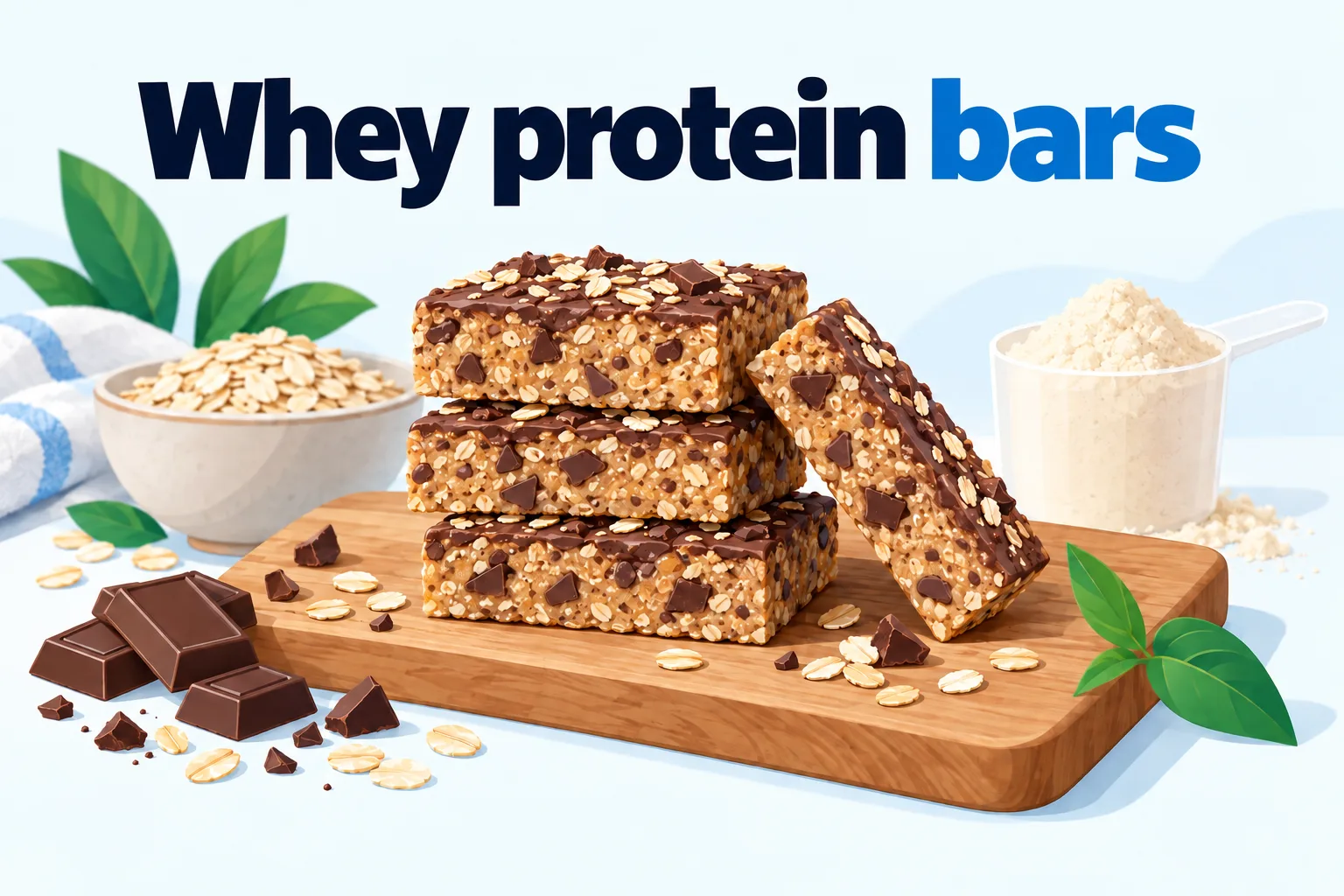
This recipe makes 8 oat, chocolate and peanut whey protein bars, with around 13 g of protein and 260 kcal per bar, worked out ingredient by ingredient.
- The secret: 60 g of whey (2 scoops) and 100 ml of milk so that the mixture holds together.
- The timing: 10 minutes of preparation, 15 minutes in the oven, and complete cooling before you cut.
- Worth knowing: this is a substantial snack, not a slimming bar. Contains milk and nuts.
Looking for a high-protein snack to take to the gym, without the endless ingredient list of the shop-bought bars? The homemade whey protein bar is the simplest way to turn your tub of whey into a solid snack: porridge oats, nuts, a little chocolate and your favourite whey.
We have reworked the original recipe in this article: the quantities are now in grams and the whey dose has been increased, because 2 tablespoons were not enough to make a genuine protein bar. The nutrition figures have been recalculated from the official ANSES table.
🍳 The whey protein bar recipe (8 bars)
Ingredients and kit
Weigh everything on a kitchen scale: that is what makes the nutrition figures below reliable, because not all spoons hold the same amount.
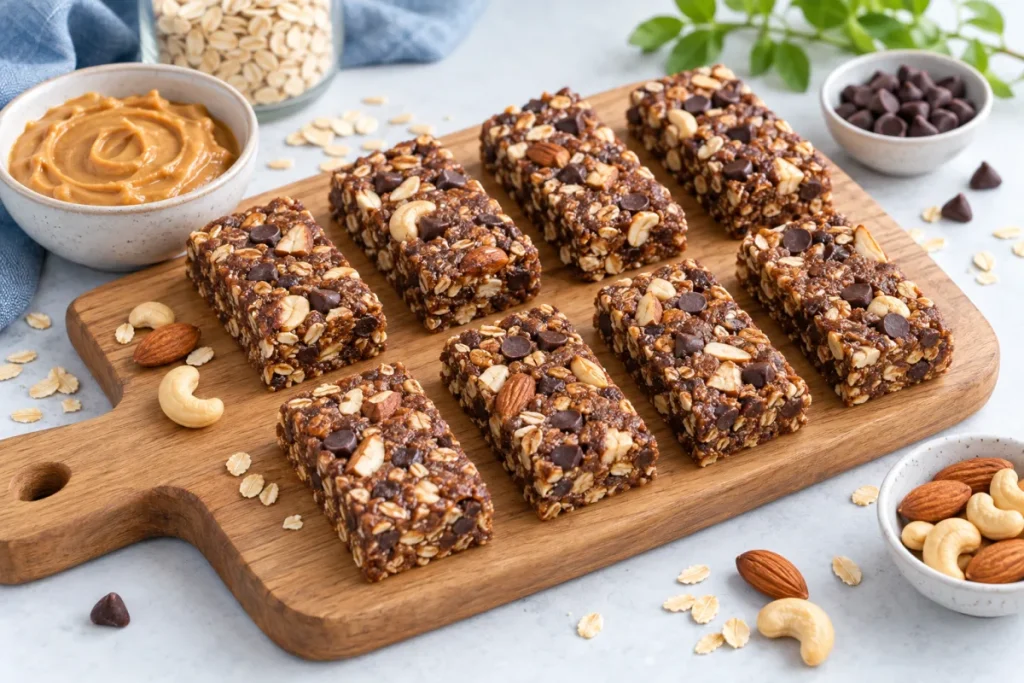
- 150 g porridge oats
- 60 g whey powder, chocolate or vanilla flavour (2 scoops of 30 g)
- 40 g unsalted cashew nuts, roughly chopped
- 40 g chopped almonds
- 60 g peanut butter
- 60 g maple syrup
- 10 g unsweetened cocoa powder
- 30 g 70% dark chocolate chips
- 100 ml semi-skimmed milk (or a plant drink)
- 1 pinch of salt
- Kit: a mixing bowl, a rectangular tin of about 20 x 20 cm, baking parchment
The method, step by step
- Heat the oven to 170 °C and line the tin with baking parchment so the slab lifts out easily.
- Mix the dry ingredients in the bowl: porridge oats, whey, cocoa, cashews, almonds and salt.
- Warm the peanut butter with the maple syrup for a few seconds to loosen it, then pour it over the dry ingredients along with the milk.
- Mix until you have a sticky mixture that holds when you press it. Too dry? Add milk a spoonful at a time. Stir the chocolate chips in last.
- Press the mixture firmly into the tin with the back of a spoon or the base of a glass: that is what stops the bars crumbling.
- Bake for about 15 minutes, until the edges are just golden. The centre should stay soft.
- Let it cool completely (ideally 1 hour in the fridge) before cutting 8 bars.
📊 Nutrition figures for one whey protein bar
One bar (one eighth of the recipe) gives you around 13 g of protein for 260 kcal. The old version of this article claimed 180 kcal: that figure did not survive the calculation, as nuts and peanut butter are very energy dense.
| Per bar (1/8) | Calculated value |
|---|---|
| Energy | around 260 kcal |
| Protein | around 12.7 g |
| Carbohydrate (of which sugars) | around 21 g (7.8 g) |
| Fat (of which saturates) | around 12.6 g (3 g) |
| Fibre | around 4.4 g |
| Salt | around 0.1 g (not counting the added pinch of salt) |
🔬 Our method
These values are calculated, not measured in a laboratory. For every ingredient we weighed, we added up the per-100 g values from the ANSES Ciqual 2025 food composition table (in French) for porridge oats, roasted unsalted cashews, almonds, peanut butter, maple syrup, unsweetened cocoa, 70% dark chocolate and semi-skimmed milk, then divided the total by 8.
For the whey, we took the label of a chocolate whey isolate on the market (Nutrimuscle Whey Native Isolate: 81.2 g of protein and 370 kcal per 100 g). With your own whey, run the numbers again from its label: a concentrate, being lower in protein, will give slightly less protein per bar.
🥛 Which whey should you use, and does baking damage it?
Take a chocolate or vanilla flavoured whey: it gives the whole bar its taste, which saves you adding sugar. A whey isolate brings more protein per gram than a concentrate; if you are torn, our comparison of the best whey isolates and our guide to choosing your whey will help.
Putting whey in the oven does not destroy its protein. A systematic review of heated milk proteins (van Lieshout et al., 2020) concludes that denaturation by heat does not affect overall digestibility. The same review does note that the reaction between proteins and sugars during cooking (glycation) can reduce the availability of certain amino acids, lysine among them: one more reason to keep the baking short and moderate, as it is here.
🕒 When should you eat these protein bars, and how many?
One bar as a snack before or after your session, or in the afternoon, is enough in most cases. The International Society of Sports Nutrition (ISSN) recommends 20 to 40 g of quality protein per serving, spread every 3 to 4 hours, and 1.4 to 2.0 g of protein per kilo of body weight per day for most active people.
So with its 13 g, one bar does not cover a full protein serving on its own. Pair it with a yoghurt, a glass of milk or a whey protein shake if it is replacing your post-workout snack. To place your needs across the day, see how much whey protein to take per day.
🧊 Storage and variations
Keep the bars in the fridge in an airtight box and eat them within the week. To have some in reserve, wrap them individually and freeze them: take one out the night before and it will be ready in your bag the next day.
- Less sweet: cut the maple syrup to 40 g and add 1 to 2 tablespoons of milk to make up for the lost binding.
- Crunchier: swap some of the almonds for pecans or pumpkin seeds.
- Fruity: add 30 g of cranberries or raisins (the figures above then change).
- Without whey: we have a dedicated no-bake recipe based on seeds and nuts (link just below).
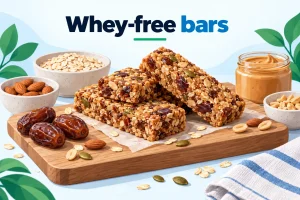 Read nextHomemade Protein Bars Without Whey (No-Bake, 8 Bars)
⚖️ Homemade bar or shop-bought protein bar?
The shop-bought bar wins on protein and convenience, the homemade one on the simplicity of its ingredients. A concrete example: the Nutrimuscle Protein Crispy Bar states 15.8 g of protein and 193 kcal for a 50 g bar on its product page, with only 2.5 g of sugars; its ingredient list includes maltitol (a polyol), glycerol and added fibre.
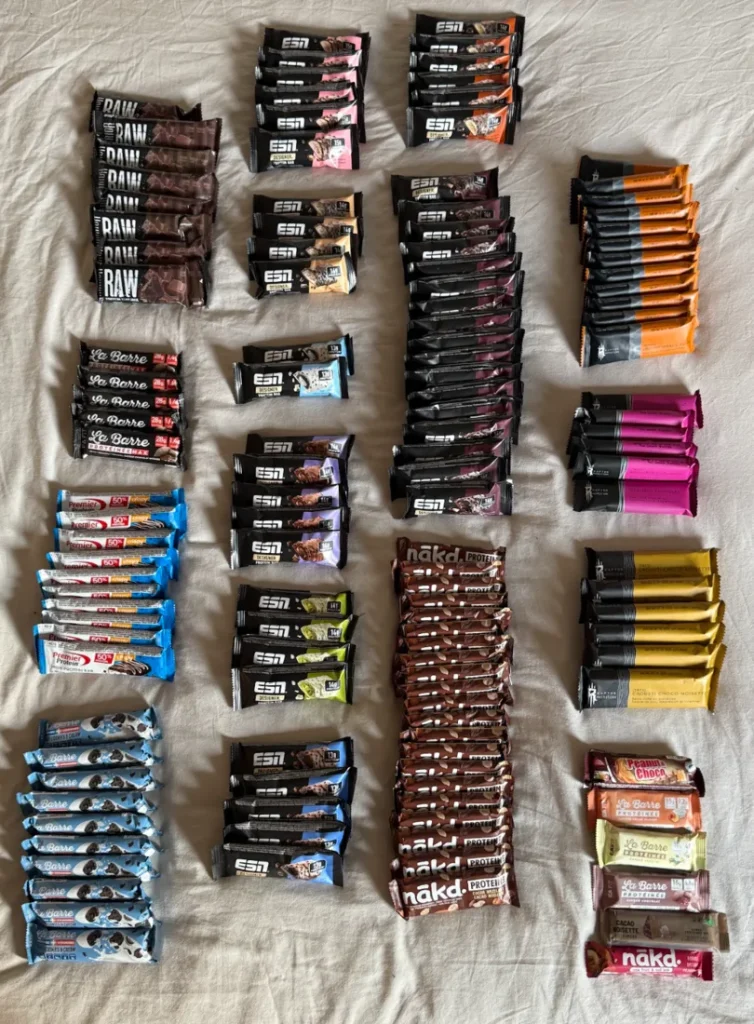
Our recipe gives slightly less protein and more calories, but it uses nothing beyond ordinary kitchen ingredients: no sweetener, no polyol, no humectant. The table sums up what we found on the labels and in our own calculations.
| Criterion | Homemade whey bar | Homemade bar without whey | Shop-bought protein bar |
|---|---|---|---|
| Protein per bar | ★★★★☆ | ★★☆☆☆ | ★★★★★ |
| Simple ingredients | ★★★★★ | ★★★★★ | ★★☆☆☆ |
| Low in sugars | ★★★☆☆ | ★★★☆☆ | ★★★★★ |
| Convenience and shelf life | ★★★☆☆ | ★★☆☆☆ | ★★★★★ |
| Control over the flavour | ★★★★★ | ★★★★★ | ★☆☆☆☆ |
🎯 Our verdict on this recipe
This is the recipe we recommend if you already own whey and you want a solid, indulgent snack with no additives. You make it in one go for the whole week, and the calculation shows a good balance of protein, carbohydrate and fibre for a snack around training.
It is not for you if you are watching your calories closely (260 kcal a bar is the price of the nuts), if you are after 20 g of protein or more per bar (a shop-bought bar or a shake will do better), or if you cannot tolerate dairy, in which case take the whey-free version. To go further, browse all our whey protein recipes.
⚠️ Watch out
This recipe contains milk, nuts and peanuts. If you have a food allergy, kidney disease or you are pregnant, ask your doctor before increasing your protein intake or using whey.
❓ Frequently asked questions
Can you bake whey in the oven?
Yes, cooking does not make the protein in whey disappear. Heat changes its structure (denaturation) without reducing its overall digestibility, according to a systematic review of milk proteins. Simply keep the baking short, because prolonged heat in the presence of sugars can reduce the availability of certain amino acids.
How much whey should you put in homemade protein bars?
Count on about 60 g of whey for 8 bars, which is 7.5 g of powder per bar. Beyond that, the mixture risks turning dry and crumbly, unless you add liquid or a binder (nut butter, banana, syrup).
How do you stop homemade protein bars falling apart?
Press the mixture down firmly and let the bars cool completely before you cut them. The peanut butter and the syrup act as the binder; if the mixture crumbles in your hand, it needs more liquid.
Will a homemade protein bar make you put on weight?
No, no more than any other food: what counts is your calorie balance across the day. At around 260 kcal, a bar replaces an afternoon snack, it is not something you add on top of a full meal. Our article on whey and weight gain goes into this in detail.