Contents 6 sections
What is your main goal?
How do you digest dairy?
What matters most to you?
Summarise this article with:
💡 The essentials
For most people who train, a good whey concentrate is enough: it is the best protein-per-pound you will find. The type barely changes your results, it is your total protein intake that counts.
- Isolate: if lactose bothers you, or if you count every calorie.
- Native: a quality bonus (less processed), not a proven muscle gain.
- Hydrolysed: rarely worth it unless you have a specific digestive need.
- Plant-based: if you are vegan or allergic to milk protein, going for a blend (pea plus rice, for instance).
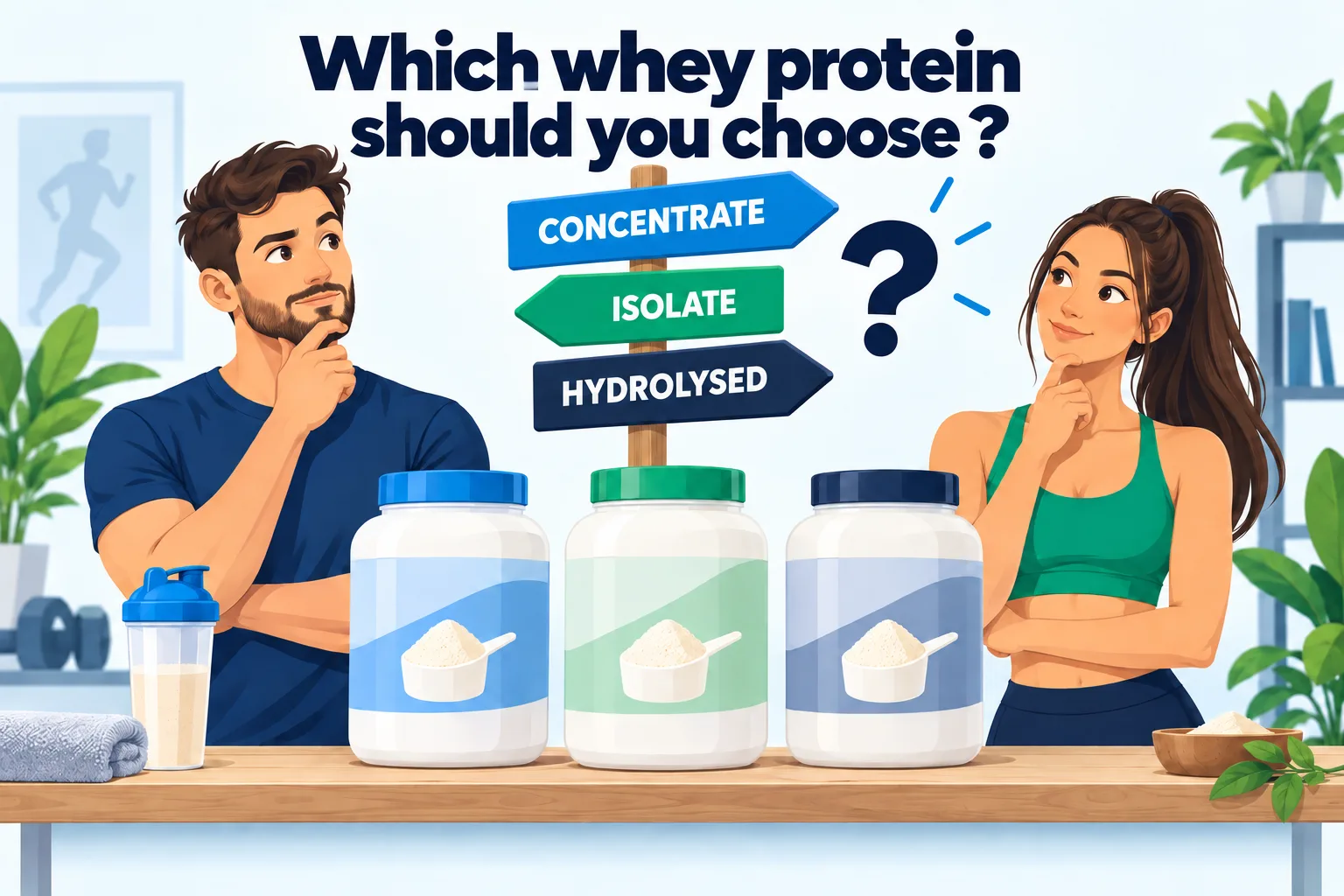
Concentrate, isolate, native, hydrolysed, plant-based: standing in front of a shelf of protein powders, the question “so which whey am I supposed to buy?” comes up again and again. This guide helps you pick the right TYPE of whey for your profile, not a specific brand: for the product ranking, see our round-up of the best whey proteins.
Want to go straight to a quality whey isolate? Nutripure is the brand we keep coming back to (affiliate link, the shop ships from France):
🥛 The 5 types of whey: what really sets them apart
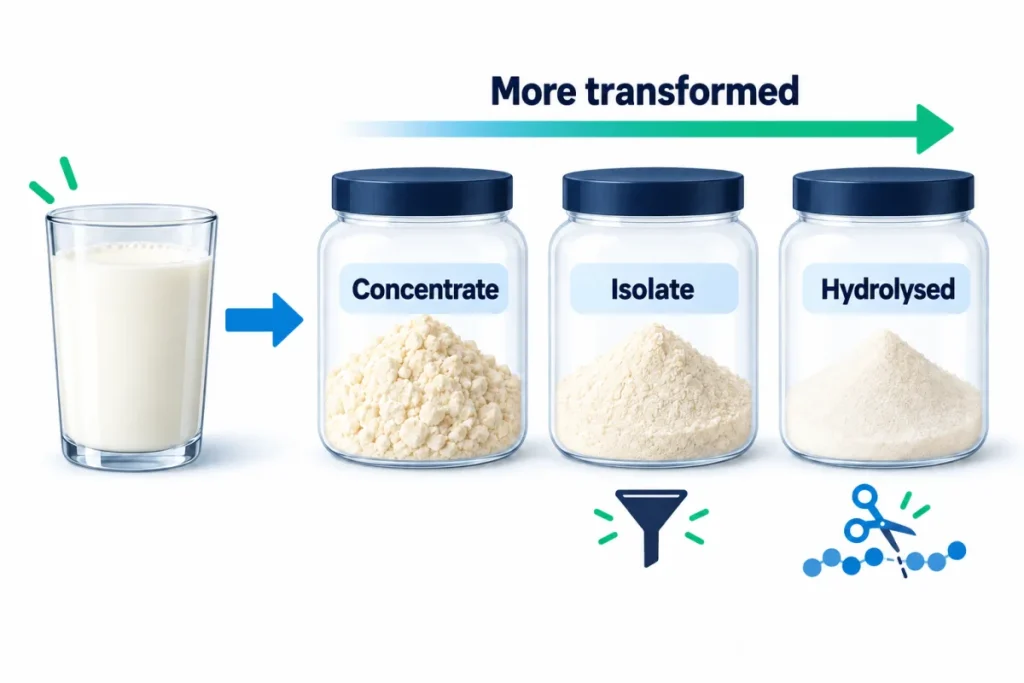
Every whey comes from the same place, the liquid left over from cheesemaking, but they differ in how far they have been filtered, and therefore in how much protein, lactose and fat they carry. For where it comes from and how it is made, read what whey protein is.
Whey concentrate
This is the most common form. According to Dairy Global Nutrition (U.S. Dairy Export Council), the benchmark ingredient, WPC80, contains 80 to 82% protein, with a little lactose and a little fat. Once it has been flavoured the label reads lower: Myprotein’s Impact Whey, a concentrate, states 72 g of protein per 100 g, which is 22 g per 30 g serving.
Whey isolate
Filtered more finely, isolate contains at least 90% protein and little to no lactose or fat (same source). In its flavoured version, Myprotein’s Impact Whey Isolate shows 82 g of protein and 1.9 g of sugars per 100 g. Everything about this format: what whey isolate is.
Native whey
Native whey is obtained by filtering raw milk, rather than as a by-product of cheesemaking, which leaves the proteins intact and gives it more leucine. It exists as both a concentrate and an isolate. In two trials by Hamarsland et al., it pushed blood leucine up faster than WPC80 did, without stimulating any more muscle protein synthesis, in trained young adults and in older adults alike. The details are in our guide to native whey protein.
Hydrolysed whey
Here, the protein chains are pre-cut into smaller peptides that are easier to digest. It is the “fastest” form, but that quicker digestion does not turn into extra muscle when the total intake is the same. Its real case is a stomach that struggles with the other forms: see hydrolysed whey.
Plant protein (“vegan whey”)
Strictly speaking this is not whey at all, but it is the direct alternative. An analysis by Gorissen et al. (2018) shows that plant isolates contain fewer essential amino acids than whey (21 to 22% for oat, lupin or wheat, against 43% for whey), and that blending several plant proteins brings their profile closer to that of animal proteins. More dairy-free routes in our guide to whey protein alternatives.
📊 The types of whey compared
This table scores each type on four concrete criteria. The more stars, the better (for price, ★★★★★ = the most affordable).
| Type | Protein / 100 g | Low lactose | Price | Amino acids | Who is it for? |
|---|---|---|---|---|---|
| Concentrate | ★★★☆☆ | ★★☆☆☆ | ★★★★★ | ★★★★★ | Most people who train |
| Isolate | ★★★★★ | ★★★★☆ | ★★★☆☆ | ★★★★★ | Lactose, cutting, decent budget |
| Native | ★★★★☆ | ★★★☆☆ | ★★★☆☆ | ★★★★★ | Anyone wanting the least processed |
| Hydrolysed | ★★★★★ | ★★★★☆ | ★★☆☆☆ | ★★★★★ | Very sensitive digestion |
| Plant-based | ★★★☆☆ | ★★★★★ | ★★★☆☆ | ★★★☆☆ | Vegans, milk allergy |
Native gets 4 stars on protein because everything depends on which version you buy (concentrate or isolate). On effectiveness, the four wheys are equivalent at an equal protein intake: which is why price and digestion weigh more than the type in your decision.
🎯 Which whey to choose for your profile?
- You are starting out: a plain concentrate with a short ingredient list. Our selection: best whey protein for beginners.
- You are bulking: a concentrate, plus a few calories around it. If you eat very little, compare it with a mass gainer: best whey protein for bulking.
- You are cutting: an isolate, for the least sugar and fat per serving. See the best whey protein for weight loss.
- Lactose bloats you: an isolate, and a hydrolysed as a last resort. Our ranking: best whey isolate.
- You are vegan or allergic to milk protein: a plant protein blend. Watch out, a milk isolate is still off the table with an allergy: it always contains milk protein.
🔎 3 things to check on the label to pick the right whey
- Protein per 100 g and per serving: compare at the same weight, not by each brand’s “scoop”, whose size varies.
- Calories and sugars: barely matter when bulking, decisive when cutting.
- The ingredient list: the shorter the better. An anti-doping testing label or the EN 17444 standard (formerly AFNOR NF V94-001), which ANSES recommends you look for, is a plus.
To read a label line by line (leucine, BCAAs, additives), follow our guide to whey protein composition. And to work out how much to take, start from your total intake: that is the subject of our article on how much whey protein per day.
🔬 Our method
We do not run lab analyses. We compared the official ingredient definitions (U.S. Dairy Export Council), the labels of a concentrate and an isolate from the same brand (Myprotein, checked in October 2026), the ANSES recommendations and the published studies on native whey and plant proteins. The stars reflect that data, not our partnerships.
🏆 Our verdict: which whey should you choose in 2026?
Our advice is simple: start with a good quality concentrate and only move up a tier if you have a concrete reason to (lactose, a strict cut, digestion). Paying for a hydrolysed “to progress faster” is, in our view, money badly spent: the meta-analysis by Morton et al. (2018) shows it is total protein intake that makes the difference, with a ceiling around 1.6 g/kg/day.
If your budget allows it and you digest lactose poorly, a native isolate is our favourite pick, for example the Nutripure Whey Isolate Native (affiliate link, ships from France). The big international brands (Myprotein, whose range we go through in our Myprotein review, Optimum Nutrition, Dymatize and so on) also sell decent concentrates and isolates: compare the labels.
Who is whey simply not for? Anyone allergic to milk protein, whichever type it is, and anyone who already covers their protein needs through food: for them, the powder buys nothing but convenience. Still unsure where to buy? See where to buy whey protein.
⚠️ Watch out
ANSES, the French food safety agency, advises against sports supplements without medical advice for children and teenagers, for women who are pregnant or breastfeeding, and for anyone with kidney, liver or heart disease. In those cases, ask your doctor before choosing a whey.
❓ Frequently asked questions
What is the difference between whey isolate and whey concentrate?
Isolate is filtered further: at least 90% protein and very little lactose, against around 80% for concentrate. Both deliver the same amino acids. Isolate costs more, and concentrate is enough if you digest lactose well.
Which whey should a beginner choose?
A plain whey concentrate, with few ingredients and a sensible price. Move up to an isolate only if you get bloated. The products we recommend are in our guide to the best whey protein for beginners.
Is native whey better?
It is less processed and richer in leucine, but the studies show no more muscle protein synthesis than a standard concentrate. It is a choice about quality and comfort, not a shortcut to building muscle.
Which whey should you choose if you are lactose intolerant?
A whey isolate, which holds little to no lactose. If it still bothers you, try a hydrolysed whey or a plant protein. With a milk protein allergy (which is not the same thing as intolerance), every whey is to be avoided.
Is a plant protein as effective as whey?
It is slightly lower in essential amino acids, but a blend of several sources (pea and rice, for instance) closes a good part of the gap. Aim for a slightly more generous serving and check the protein content per 100 g.
📚 Sources
- Dairy Global Nutrition (USDEC): definitions of whey concentrate and isolate
- Hamarsland et al. 2017 (JISSN): native whey against WPC80 in trained athletes
- Gorissen et al. 2018 (Amino Acids): composition of plant proteins
- Morton et al. 2018 (Br J Sports Med): meta-analysis of protein and resistance training
- ANSES: food supplements for athletes, risks and precautions