Contents 8 sections
- The protein shake without whey recipe (quick version)
- With no powder at all: the silken tofu protein shake
- Nutrition figures for both whey-free shakes
- Plant powder, tofu or whey: which shake should you choose
- When should you drink this shake, and with what
- Our pick if you would rather use whey
- Our verdict
- Frequently asked questions
Summarise this article with:
💡 The essentials
For a protein shake without whey, swap the whey for a plant protein powder and the water for a soya drink: around 33 g of protein for 345 kcal.
- With no powder at all: blended silken tofu gives a creamy shake at roughly 21 g of protein.
- The trap: almond milk brings 3 times less protein than a soya drink.
- Dairy-free: both versions suit anyone who is lactose intolerant.
A protein shake really is remarkably effective and convenient. The thing is, not everyone drinks whey. Lactose intolerance, a plant-based diet or simply fancying a change: you can make a shake just as protein-packed as a whey shake without an ounce of milk.
No problem, here are our two whey-free recipes: a quick version with plant protein powder, and a version with no powder at all, built on silken tofu. If you do tolerate whey, have a look at our comparison of the best whey isolates instead.
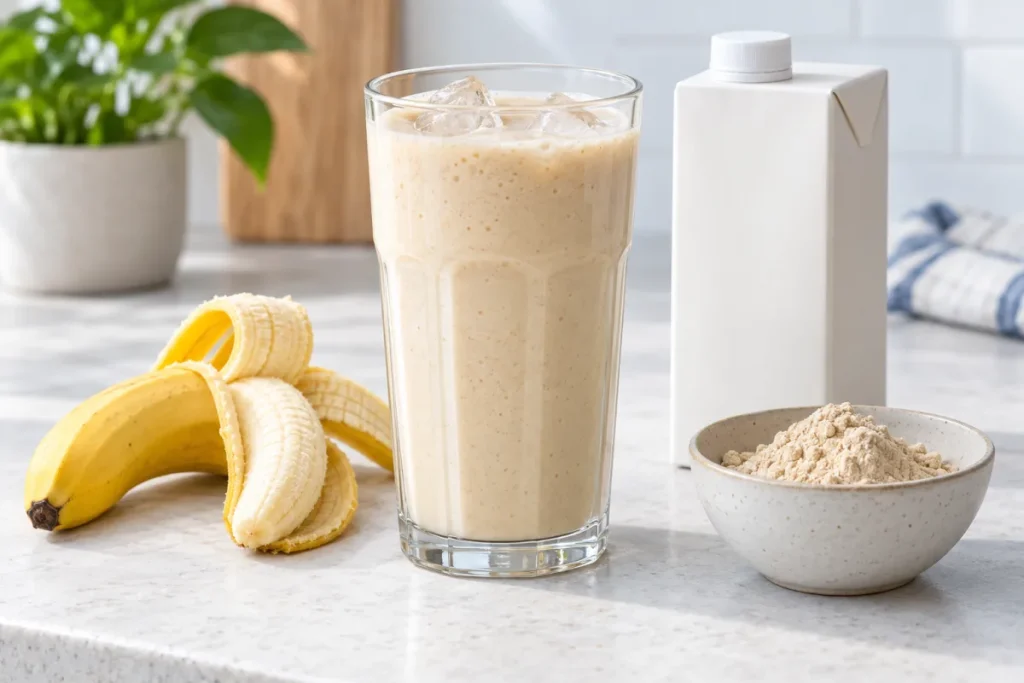
🍳 The protein shake without whey recipe (quick version)
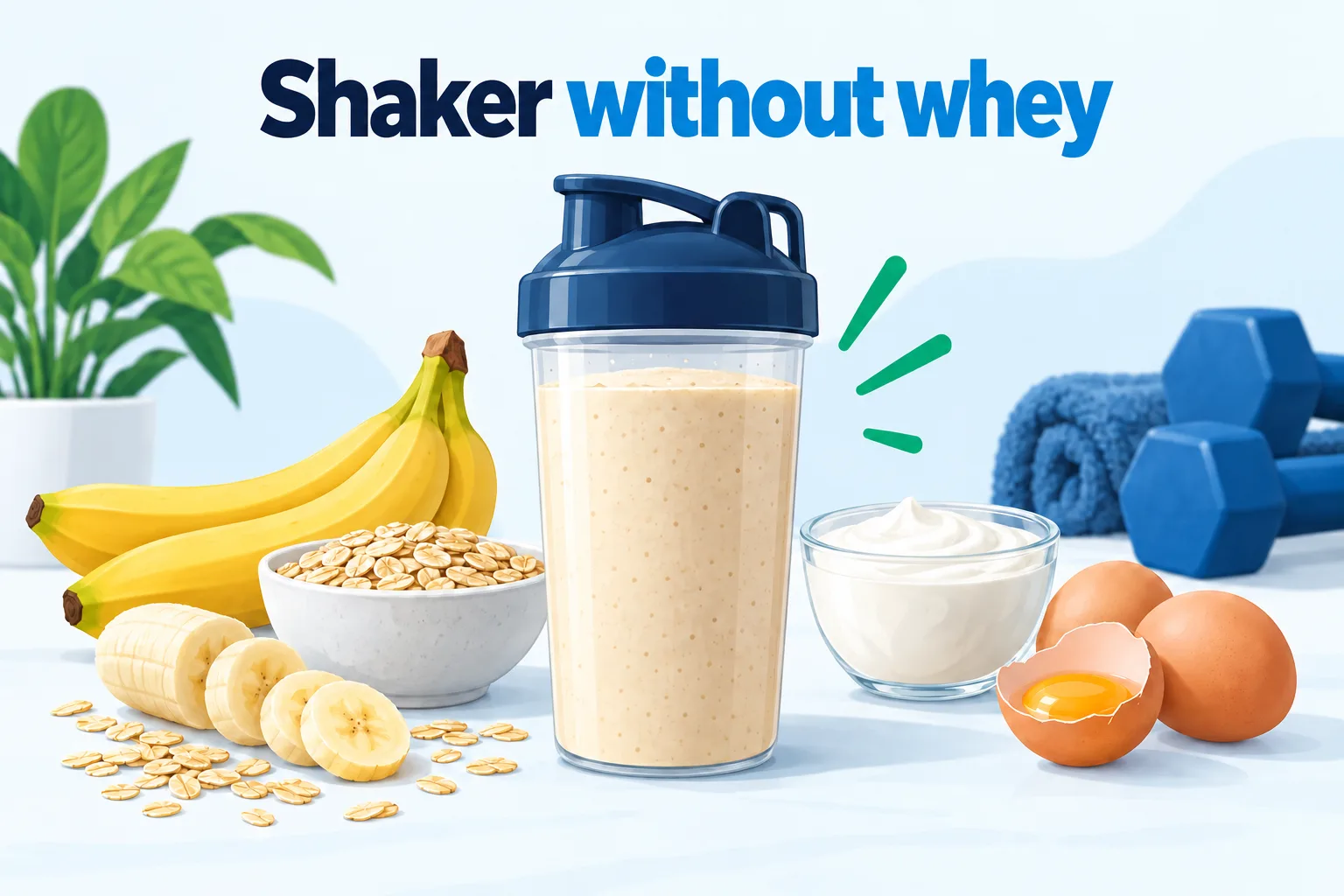
Ingredients and equipment (1 shake of about 400 ml)
- 1 ripe banana (about 120 g peeled)
- 250 ml plain soya drink
- 30 g plant protein powder (soya, pea or a pea and rice blend)
- 5 g maple syrup (about 1 tsp), optional
- 15 g almond or peanut butter, optional, for creaminess
- A few ice cubes
- Equipment: a blender (or a shaker bottle if you mash the banana first)
The method, step by step
- Peel the banana and cut it into chunks.
- Pour the soya drink in first, then the powder: it blends in better and will not stick to the bottom.
- Add the banana, the syrup and the nut butter if you are using them.
- Blend for about 30 seconds, add the ice cubes and blend for a few seconds more.
- Drink it straight away: that is when it is at its smoothest.
🌱 With no powder at all: the silken tofu protein shake
No powder whatsoever? Blended silken tofu gives you a cream-like texture and brings the protein; the banana and the cocoa bring the flavour. This is our “store cupboard” version: every ingredient is available in the supermarket.
- 200 g silken tofu
- 200 ml plain soya drink
- 1 ripe banana (about 120 g peeled)
- 5 g unsweetened cocoa powder
- 15 g peanut butter
Blend everything for 30 to 45 seconds, until the texture is perfectly smooth. The tofu has to disappear completely: a hand shaker is not enough for this version.
📊 Nutrition figures for both whey-free shakes
The plant powder version brings around 33 g of protein, the silken tofu version around 21 g. An earlier version of this article claimed 20 g of protein with almond milk and 2 scoops of powder: we have replaced those volumes with gram weights and redone the calculation.
| Per shake | Plant powder (without nut butter) | Silken tofu |
|---|---|---|
| Energy | about 345 kcal | about 414 kcal |
| Protein | about 33 g | about 21 g |
| Carbohydrates (of which sugars) | about 32 g (23 g) | about 34 g (24 g) |
| Fat (of which saturates) | about 6.3 g (0.8 g) | about 18.7 g (3.6 g) |
| Fibre | about 6.7 g | about 8.1 g |
| Salt | about 0.9 g | about 0.3 g |
With the optional 15 g of nut butter, the quick version moves to roughly 442 kcal and 37 g of protein. Almost all of the sugars come from the banana; the salt in the quick version comes mainly from the powdered soya protein, as listed by Ciqual (shop-bought powders vary, so check your own label).
🔬 Our method
We calculated these figures from the ANSES Ciqual 2025 table, ingredient by ingredient: raw banana, plain unfortified soya drink, powdered soya protein (80.5 g of protein per 100 g), silken tofu, unsweetened cocoa, peanut butter, maple syrup.
These are calculations, not laboratory analyses, and they depend on the products you use. With a pea protein, take the protein content printed on its own label; a soya drink fortified with calcium barely changes the protein.
⚖️ Plant powder, tofu or whey: which shake should you choose?
The liquid you pick matters as much as the powder. According to Ciqual, 250 ml of soya drink brings around 8 g of protein, against around 2.6 g for the same amount of almond drink. The table compares our two recipes with a classic whey and milk shake.
| Criterion | Plant powder + soya | Silken tofu, no powder | Whey + milk |
|---|---|---|---|
| Protein per shake | ★★★★★ | ★★★☆☆ | ★★★★★ |
| Lactose-free | ★★★★★ | ★★★★★ | ★☆☆☆☆ |
| Speed | ★★★★★ | ★★★☆☆ | ★★★★★ |
| Supermarket ingredients | ★★☆☆☆ | ★★★★★ | ★★☆☆☆ |
| Low in fat | ★★★★☆ | ★★☆☆☆ | ★★★★☆ |
🕒 When should you drink this shake, and with what?
After your session or as a snack, a single shake is enough for one protein serving. The International Society of Sports Nutrition (ISSN) recommends 20 to 40 g of protein per serving, spread every 3 to 4 hours: both our versions sit inside that range.
To turn it into a full meal, add a source of slow carbohydrates and good fats: a slice of wholemeal bread, a handful of almonds or a piece of fruit. And if your goal is to put weight on, our mass gainer shake without whey is far more calorific.
Drink it as soon as it is ready if you can; otherwise keep it in the fridge and have it within 24 hours, shaking it before you drink because the banana and the powder tend to separate.
🥛 Our pick if you would rather use whey
If you tolerate dairy, whey is still the simplest option for a protein shake. The quick recipe works exactly the same way if you replace the plant protein with 30 g of whey. Nutripure sells one, and our guide to making your whey shake gives you the right doses. The brand ships from France.
To take a look, click the button below:
🎯 Our verdict
If you want a genuine recovery shake without whey, go for the plant protein version: it is the only one that matches a whey shake on protein. The silken tofu version is our favourite for getting by without buying anything special, at the cost of less protein and more fat.
These shakes are not for you if you are allergic to soya (in which case go for a pea protein and an oat drink, which has less protein), nor if you are looking for a very calorific drink to put weight on. For other routes, read our guide to what to use instead of whey.
⚠️ Watch out
Both shakes are built on soya: avoid them if you are allergic to it. If you have an allergy (soya, peanut, tree nuts), kidney disease or you are pregnant, ask your doctor before increasing your protein intake. On lactose, it is worth remembering that plant drinks such as soya are listed by the French health service (Assurance Maladie) as an alternative to milk as a drink, ideally fortified with calcium.
❓ Frequently asked questions
What can you use instead of whey in a shake?
A plant protein powder (soya, pea, a pea and rice blend) at the same dose, or blended silken tofu. Pair them with a soya drink rather than water or almond drink to gain a few extra grams of protein.
Can you make a protein shake without powder?
Yes, with silken tofu and a soya drink you get to around 21 g of protein. If you eat dairy, fromage blanc blended with milk works too.
Is almond milk good for a protein shake?
For the taste yes, for the protein no. According to Ciqual, almond drink contains around 1 g of protein per 100 g, against around 3.2 g for a plain soya drink.
Is a shake without whey just as effective for weight training?
Yes, as long as it brings enough protein across the day and at each serving. The ISSN targets 1.4 to 2.0 g of protein per kilo of body weight per day for most athletes; the protein source matters less than the total you reach.