Contents 6 sections
What is your main goal?
How do you digest dairy?
What matters most to you?
Summarise this article with:
💡 The essentials
You use a hydrolysed whey exactly like a standard whey: one serving of 20 to 40 g of protein, around your session or at any other moment, on top of what your meals already bring.
- How much: aim for 1.4 to 2 g of protein per kilo per day in total, and let the powder fill only the gap.
- When: ideally within the 2 hours after training, though your daily total matters more.
- What with: water when you are cutting, milk when you are bulking.
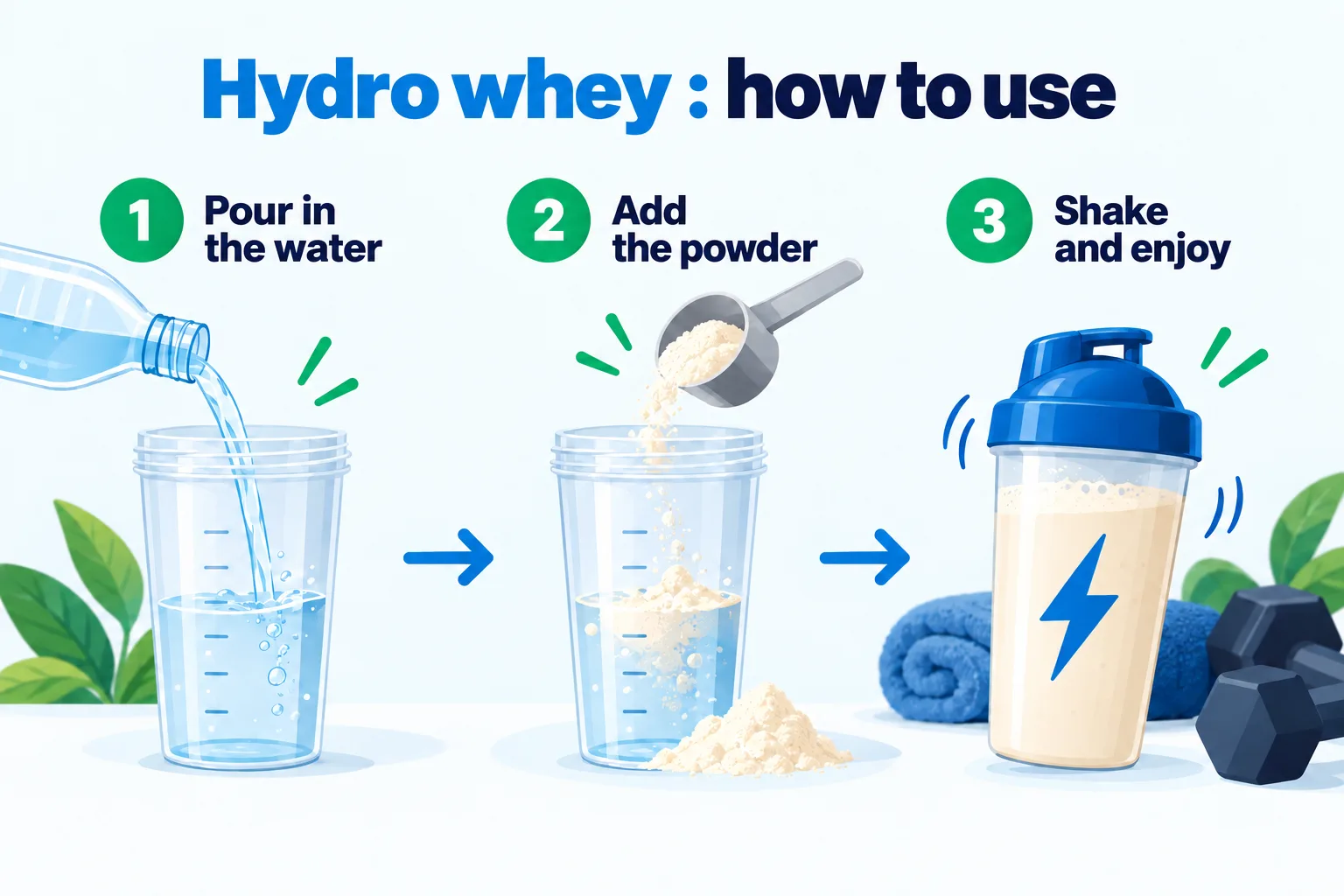
You have just bought a hydrolysed whey and you are wondering how best to drink it? Good news: it is very simple, and there is no special protocol reserved for hydrolysates. Here is the how-to in four steps, built on the numbers in the scientific recommendations rather than on changing-room rules 😇.
If you are still weighing up the purchase, or want to understand exactly what a hydrolysate is, start with our full guide to hydrolysed whey:
 Read nextHydrolysed whey protein: what it is and whether it is worth it
🎯 Which athletes actually need this supplement?
Nobody “needs” a hydrolysed whey specifically: it is simply a convenient way to top up a protein intake. It earns its place above all with:
- Anyone chasing a lean bulk who wants protein without piling on extra calories
- Lifters in a cutting phase, who have to keep protein high on a tight calorie budget
- Athletes training twice a day or back to back, or who struggle to digest other wheys
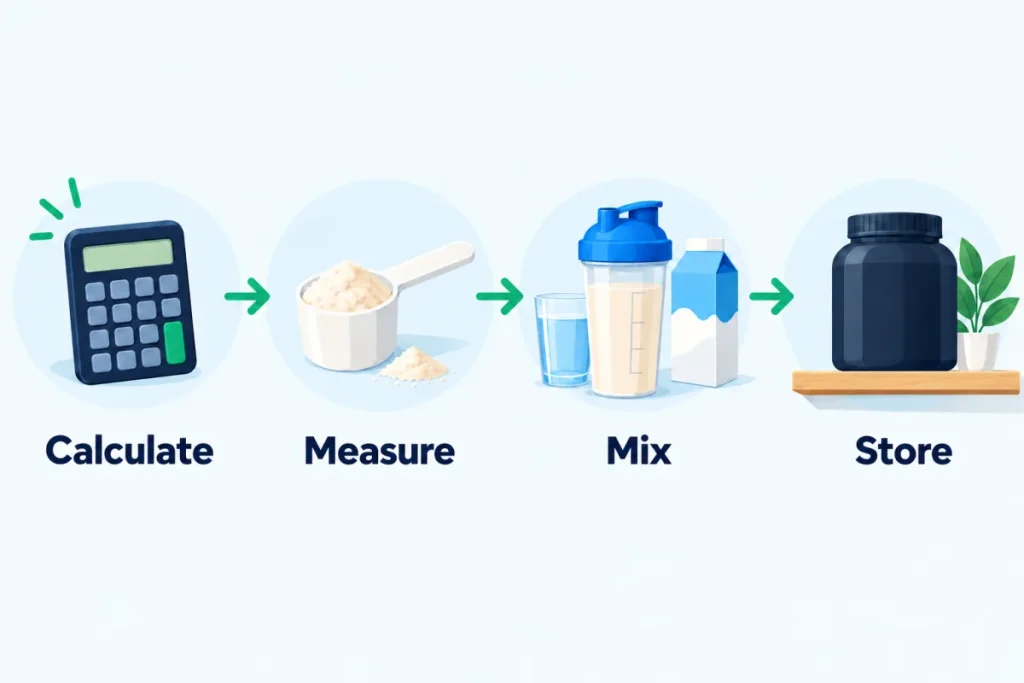
📋 The 4-step guide to using hydro whey
1) Set your dose from your ideal protein intake
Start with your total requirement. The International Society of Sports Nutrition (ISSN) recommends 1.4 to 2 g of protein per kilo per day for athletes who want to build muscle (ISSN position stand). A meta-analysis of 49 studies found that beyond roughly 1.6 g per kilo, lean mass gains stopped rising (Morton et al., 2018): that makes a sound starting point.
Take a worked example: at 75 kg, 75 x 1.6 = 120 g of protein a day. If your meals already bring 90 g, you are 30 g short, which is a single serving of most hydrolysates. If your meals already cover it, the powder is pointless.
On the dose per serving, the ISSN puts the effective amount at around 20 to 40 g of protein, spread every 3 to 4 hours. Read the label on your tub: Optimum Nutrition’s Platinum Hydrowhey, for instance, delivers 30 g of protein in a 40 g scoop of powder. To go further, read how much whey protein per day 💪.
2) Drink it around your training
The most logical moment to down your whey protein shake is still before or after the session. If you cannot take it straight after training, it does not matter: the ISSN puts the useful window inside the 2 hours that follow (ISSN, 2017).
Keep the hierarchy straight: for building muscle, it is your total protein intake across the day that counts first, far more than the hour your shake lands (Schoenfeld et al., 2013). For the detail according to your own schedule, read our article on when to take whey protein.
3) Cutting = with water / bulking = with milk
If you are in a cutting phase, meaning you are trying to drop fat while holding on to your muscle, mix your whey with water: that way you keep the whole point of a low-calorie powder. Our guide to the whey to water ratio gives you the right proportions.
When you are bulking, on the other hand, milk is a useful ally: it adds calories and protein, and makes the shake far creamier 🍼. That is exactly the thinking behind our guide to whey protein for mass gain.
4) Store it somewhere cool and dry
On storage, keep your powder somewhere cool and dry, away from the light, and close the tub properly after every use. Respect the date printed on the packaging: a powder that has taken on moisture turns lumpy and keeps far less well.
🍳 3 ideas to ring the changes with your hydrolysed whey
An unflavoured hydrolysate goes down much better mixed into something else. It slots easily into simple recipes:
- Add it to your favourite smoothie recipe
- Stir it into porridge oats or yoghurt at breakfast
- Use it for whey protein pancakes or whey protein crepes
🔬 Our method
The doses and timings in this guide come from the official ISSN position stands (protein, 2017; nutrient timing, 2017) and from two meta-analyses (Schoenfeld 2013, Morton 2018), not from personal experience. The label examples come from the official product pages, checked in October 2026, and the creatine claim from the 2016 opinion of ANSES, the French food safety agency.
✅ Our verdict: the one mistake to avoid with a hydrolysate
The most common mistake is counting on how fast a hydrolysate is absorbed to make up for protein-poor meals. It will not do that: a hydrolysed whey taken at the perfect moment but on too low a daily total will give you less than a standard whey on a correct total.
In our view, this how-to is not for you if your diet already covers your needs: there is no point adding shakes on principle. And if you are pregnant, under 18, have kidney or liver disease, or are on any medication, ask your doctor before you start, which is what ANSES recommends for every supplement aimed at athletes.
⚡ Bonus: add some creatine to it!
 Read nextWhey Protein and Creatine: How to Combine Them
Whey is a staple, but have you ever tried creatine? It is one of the very few supplements whose effect on performance is recognised by the European authorities, and it can go in the same shaker as your whey.
As ANSES points out, EFSA approved the claim “creatine increases physical performance in successive bursts of short-term, high intensity exercise”, at 3 g of creatine a day in adults. A second claim covers the over-55s who lift weights: creatine can strengthen the effect of training on force production, again at 3 g a day.
So do not hesitate to add 3 g of creatine powder to your hydro whey shake if your sessions involve short, intense efforts. ANSES does, however, advise against creatine and protein supplements for people with kidney disease or diabetes: if you have a kidney problem or are on any medication, ask your doctor first.
❓ Frequently asked questions
When should you take your hydrolysed whey?
The simplest approach is to take it inside the 2 hours that follow training. On rest days, take it at any point in the day to top up your meals. What matters above all is reaching your daily protein total.
How many servings of hydrolysed whey a day?
Usually one, sometimes two: just what your meals are missing to reach around 1.6 g of protein per kilo. Depending on the brand, one serving brings between 18 and 30 g of protein. Past your actual needs, extra servings do not buy you any more muscle.
Can you take hydrolysed whey on rest days?
Yes, if your meals do not cover your protein needs that day. Muscle rebuilding carries on after the session, and your daily requirement does not disappear on a Sunday. Our article on whey protein on rest days goes into the detail.
Should you take it with water or with milk?
With water if you are watching your calories, with milk if you are trying to add some. Water preserves the main appeal of a hydrolysate, its low calorie count. Milk improves the taste and the texture when you are bulking.
📚 Sources
- ISSN position stand on protein and exercise (Jäger et al., 2017)
- ISSN position stand on nutrient timing (Kerksick et al., 2017)
- Schoenfeld et al. (2013), meta-analysis on protein timing
- Morton et al. (2018), meta-analysis on protein supplementation
- ANSES opinion on food supplements for athletes (2016) (in French)