
Contents 8 sections
What is your main goal?
How do you digest dairy?
What matters most to you?
Summarise this article with:
💡 The essentials
- For a healthy person, creatine monohydrate is not dangerous at the doses studied: it is one of the most researched supplements in sport.
- The real side effects are mild: 1 to 2 kg of water stored in the muscle at the start, and stomach upset if you swallow a big dose in one go.
- Kidneys, hair loss, liver, heart, doping: none of these dangers is proven in healthy adults, but kidney, liver or heart disease means asking your doctor first.
“Creatine wrecks your kidneys.” You have surely heard it at the gym. That line comes from a biochemical mix-up, not from a study: creatine turns into creatinine, and creatinine is exactly the marker your doctor reads to judge your kidneys. Rising creatinine is not a damaged kidney. Here is what the studies and health agencies actually say, source by source.
🔬 Our method
This guide relies on official positions (ISSN, EFSA, the French agency Anses, the World Anti-Doping Agency) and on published meta-analyses, read on 24 October 2026. We run no clinical trials and no lab tests: we summarise what the research measured, and we say when proof is missing.
🧪 What is creatine, exactly?
Creatine is a molecule your body already makes and that you eat with meat and fish. It recharges the energy of short, intense efforts: a set of squats, a sprint. Supplementing tops up your muscle stores a little, which helps you handle more training volume.
According to the ISSN position stand (2017), it improves high-intensity exercise capacity and lean mass gains, with no compelling evidence of harm at recommended doses in healthy people. Everything else starts from there.
🏛️ What health agencies say
- ISSN (2017): effective for intense efforts, and no compelling evidence of harm in healthy adults at recommended doses.
- EFSA (2011): the EU approved the claim that creatine improves performance in repeated short, intense efforts, at 3 g a day.
- Anses: in France, a supplement may not recommend more than 3 g of creatine a day, and the agency advises against it with kidney disease or diabetes.
- World Anti-Doping Agency: creatine is not on the prohibited list.
Every one of these sources points the same way: a 3 g a day benchmark, and no danger signal in healthy people. That does not mean zero side effects, which we cover next.
⚖️ The real side effects
Water retention, and the kilos on the scale
Yes, creatine moves the scale, and no, it is not fat. Expect 1 to 2 kg at the start: water the muscle stores along with the creatine. It goes into the muscle, not under the skin, and leaves when you stop.
Stomach upset
This is the best documented side effect, and it is almost always avoidable. Bloating or diarrhoea mostly come from one big dose on an empty stomach. Take 3 to 5 g with a meal and a large glass of water, and split the doses if you load.
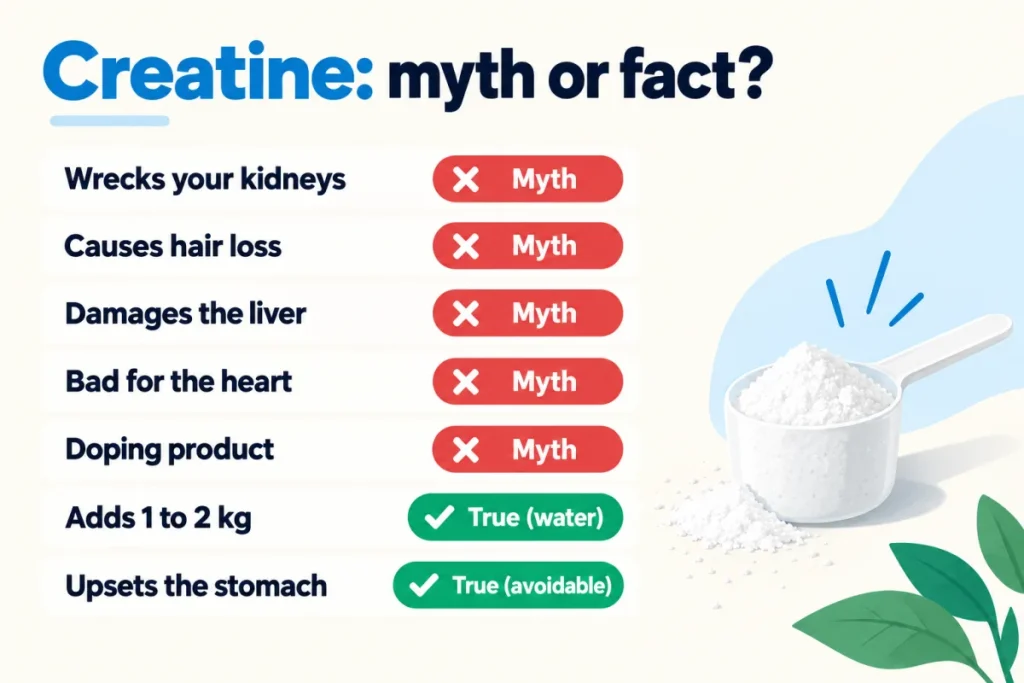
❌ Creatine dangers: the myths that do not hold up
The kidneys
In healthy adults, studies show no kidney damage at the doses tested. The 2019 meta-analysis in the Journal of Renal Nutrition, covering 15 studies, found no evidence of harm. It does confirm that blood creatinine can rise without any kidney damage. Tell your doctor you take creatine before a blood test, or the result may worry them for nothing.
Hair loss
The myth comes from one small 2009 study on 20 rugby players that never measured hair. It saw a rise in DHT, a hormone, and that result was never replicated. The ISSN review of common myths (2021) concludes that nothing shows creatine causes hair loss.
Liver and heart
No serious signal in healthy people at recommended doses. If you already have liver or heart disease, or cardiovascular risk factors, Anses advises against this kind of supplement: your doctor decides.
Doping
Creatine is not a doping product. The only real anti-doping risk is a badly made supplement containing an undeclared banned substance. That is why a tested, single-ingredient creatine matters.
| Myth | What the studies say | Verdict |
|---|---|---|
| “It wrecks your kidneys” | 2019 meta-analysis: no damage in healthy adults, creatinine can rise | Myth, except with kidney disease |
| “It makes your hair fall out” | One 2009 study on a hormone, hair never measured | Myth |
| “It damages the liver” | No signal at recommended doses | Myth, caution with liver disease |
| “It is bad for the heart” | No cardiac effect documented at usual doses | Myth, ask a doctor with heart disease |
| “It is a doping product” | Not on the World Anti-Doping Agency list | Myth |
| “It makes you gain weight” | 1 to 2 kg of water in the muscle at the start | True, but temporary and not fat |
| “It upsets your stomach” | Mostly with one big dose on an empty stomach | True, and avoidable |
💊 What dose is safe?
The studies’ benchmark: 3 to 5 g of creatine monohydrate a day, every day, rest days included. French supplement labels show 3 g a day at most, which is enough for most lifters.
- Without loading: 3 g a day fills your stores in 3 to 4 weeks.
- With loading: about 20 g a day in 4 doses for 5 to 7 days, then 3 to 5 g. Faster, but a higher risk of stomach upset.
Our advice: skip the loading phase and aim for consistency. We compare the forms and prices in our guide on how to choose creatine.
🛒 How to choose a safe creatine
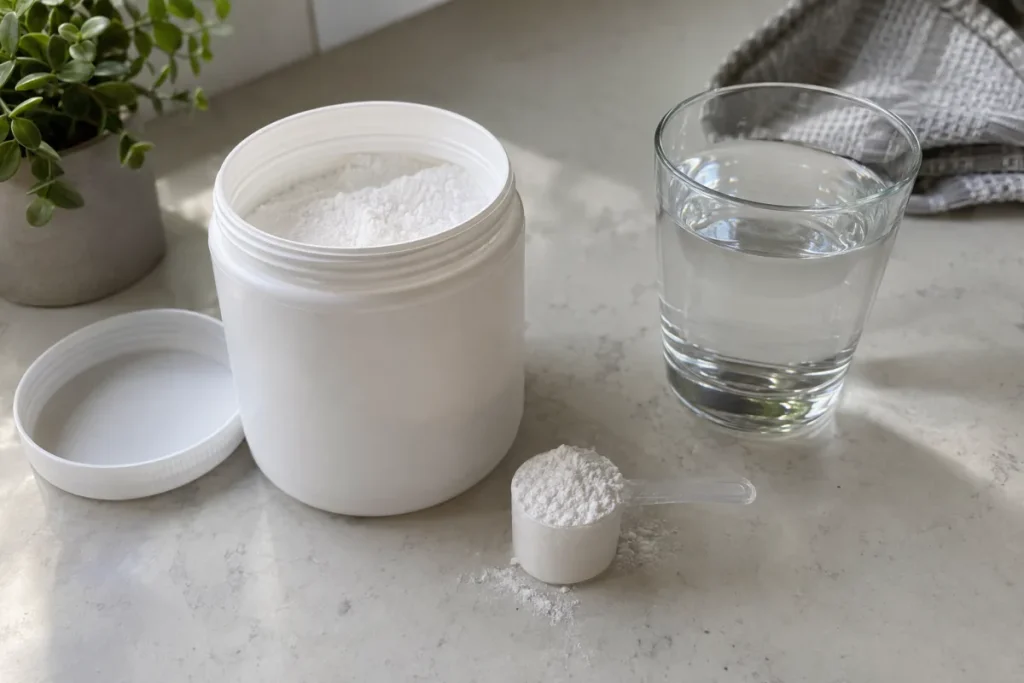
- Creatine monohydrate, nothing else: the most studied form and the cheapest per gram.
- One ingredient on the label: no blend hiding the real dose.
- Tested purity: the Creapure® label or a batch analysis published by the brand.
- The price per gram of creatine, not the price of the tub.
Our pick remains Nutripure Creatine (Creapure®): one ingredient, a purity label, and a French brand. It is not the cheapest per gram in its small size.
You can take it in the same shaker as your whey, no negative interaction is known: we explain it in our guide on whey protein and creatine. And if whey is what worries you, read is whey protein dangerous.
⚠️ Warning
Ask your doctor before taking creatine if you have kidney, liver or heart disease, diabetes or high blood pressure, if you are pregnant or breastfeeding, on medication, or under 18. This article summarises studies, it does not replace a consultation.
🏁 Our verdict
Creatine is not dangerous in itself: what matters is the dose, your health and the quality of the product. For a healthy adult, 3 g of monohydrate a day is one of the safest and most studied choices in supplementation. It is not for you if you have kidney disease or are under 18: see your doctor first.
❓ Frequently asked questions
Is creatine bad for your health?
No, not for a healthy person at usual doses. The ISSN found no compelling evidence of harm, and the documented side effects stay digestive and water related.
Does creatine damage your kidneys?
In healthy people, studies show no kidney damage. Blood creatinine can rise without harm; with kidney disease, Anses advises against creatine.
Does creatine cause hair loss?
No study has shown it. The one study people quote measured a hormone in 20 rugby players, never hair, and was not replicated.
Should you cycle off creatine?
No break is needed according to the available data. Stay on 3 to 5 g a day, continuously, as long as it helps you.
Is creatine a doping product?
No, it is not on the World Anti-Doping Agency list. The risk comes from contaminated products, hence a tested creatine.