Contents 10 sections
- Which creatine to choose by form
- Creapure or regular monohydrate: is it worth paying more
- How much does a good creatine cost
- Our pick: Nutripure Creapure® Creatine
- How much creatine per day
- ⏰ When to take creatine
- Creatine and whey: the duo that works
- Common myths about creatine
- Our verdict
- Frequently asked questions
What is your main goal?
How do you digest dairy?
What matters most to you?
Summarise this article with:
💡 The essentials
- In 9 cases out of 10, the creatine to choose is creatine monohydrate powder: the most studied form, the most concentrated and the cheapest per gram.
- The Creapure® label guarantees purity and traceability, not a stronger effect: it is worth it as long as it does not cost much more.
- The dose that works: 3 to 5 g a day, every day, with or without a loading phase, at whatever time suits you.
Creatine is the best-selling bodybuilding supplement after whey, and also the one surrounded by the most myths. Between forms “absorbed 10 times better” and bargain tubs, it is easy to get lost. Good news: science settled the question long ago, and only one form really deserves your money. Here is how to choose, with prices read on 22 October 2026.
🔬 Our method
This guide relies on official scientific positions (ISSN, Anses) and on the brands’ product pages, with the prices shown on their French websites on 22 October 2026. These shops bill in euros: dollar prices are converted at the European Central Bank rate of 21 October 2026 (1 € = $1.1234). The price per gram is calculated on the creatine actually contained (monohydrate holds about 88% creatine). We do not run lab tests and we do not taste the products: we compare labels and prices.
🧪 Which creatine to choose by form?
Not all creatines are equal, but not for the reasons marketing puts forward. Here is what the forms you will find on the shelf are really worth.
| Form | What it promises | What studies say | Buy it? |
|---|---|---|---|
| Monohydrate | The reference | The most studied, hundreds of trials | Yes, without hesitation |
| Creapure® | Ultra-pure German monohydrate | Same molecule, plus purity and traceability | Yes, if the price gap stays reasonable |
| Creatine HCL | More soluble, no water retention | No solid human data | No |
| Kre-Alkalyn® | No loading phase | No advantage over monohydrate at equal dose | No |
| Ethyl ester | “Improved” absorption | Breaks down into creatinine, so less effective | No |
| Gummies | Fun, no water needed | Low and variable doses, added sugars | No |
| Capsules | Convenient, exact dose | Same molecule as the powder | Yes, if you hate powder |
A 2022 review of alternative forms concludes that monohydrate remains the only option that ticks every box: effectiveness, safety and price. “Micronised” only means a finer powder that dissolves better, with no proven performance gain.
🏷️ Creapure or regular monohydrate: is it worth paying more?
Creapure® is not a different creatine: it is creatine monohydrate made in Germany by Alzchem, with a stated purity of 99.9% and documented contaminant testing. You pay for traceability, not for a boosted effect.
Our rule: if Creapure® costs less than 50% more than a serious generic monohydrate, take it. Beyond that, a monohydrate from a brand that publishes its batch analyses does the job very well.
💵 How much does a good creatine cost?
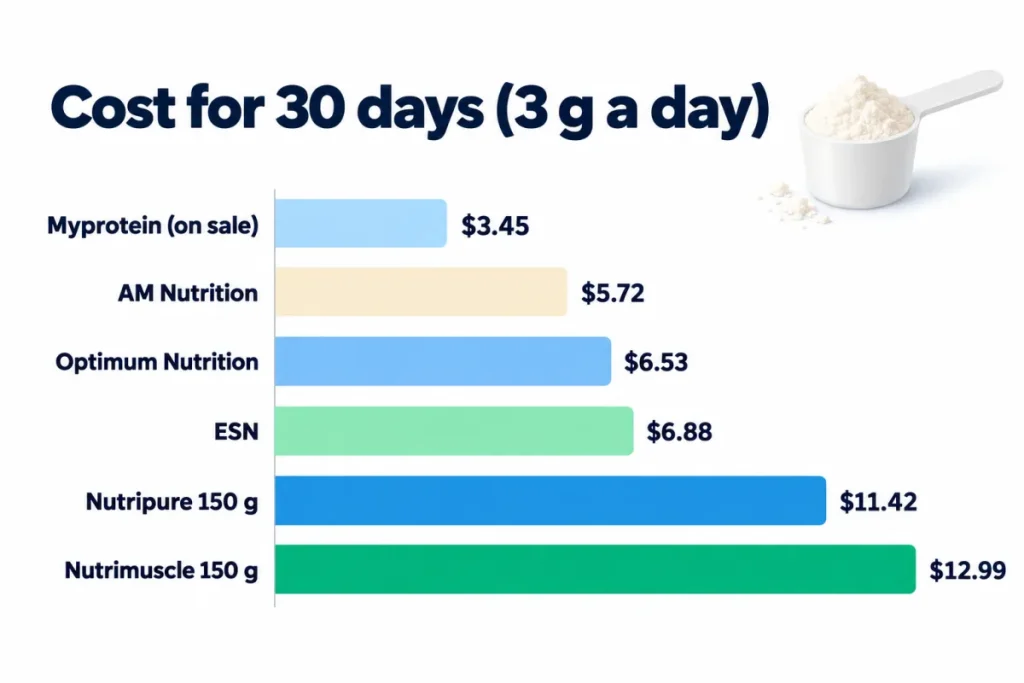
| Creatine | Size | Price | Price per gram of creatine | Cost for 30 days at 3 g/day |
|---|---|---|---|---|
| Nutripure Creatine (Creapure®) | 150 g | $16.74 | $0.127 | $11.42 |
| Nutrimuscle Creatine (Creapure®) | 150 g | $19.04 | $0.144 | $12.99 |
| ESN Ultrapure Creatine | 500 g | $33.59 | $0.076 | $6.88 |
| AM Nutrition PURE Creatine | 500 g | $27.97 | $0.064 | $5.72 |
| Myprotein Creatine Monohydrate | 500 g | $16.84 on sale ($28.07 otherwise) | $0.038 | $3.45 |
| Optimum Nutrition Micronised Creatine | 317 g | $20.21 | $0.072 | $6.53 |
In small sizes, Creapure® creatines are the most expensive per gram: that is the price of the label and of the 150 g pouch. If price is your only criterion, a 500 g monohydrate (AM Nutrition, ESN or Myprotein on sale) costs two to three times less per month. Prices move fast, especially on sale: check the product page before ordering.
🥇 Our pick: Nutripure Creapure® Creatine
Nutripure Creatine (Creapure®): the easiest to recommend
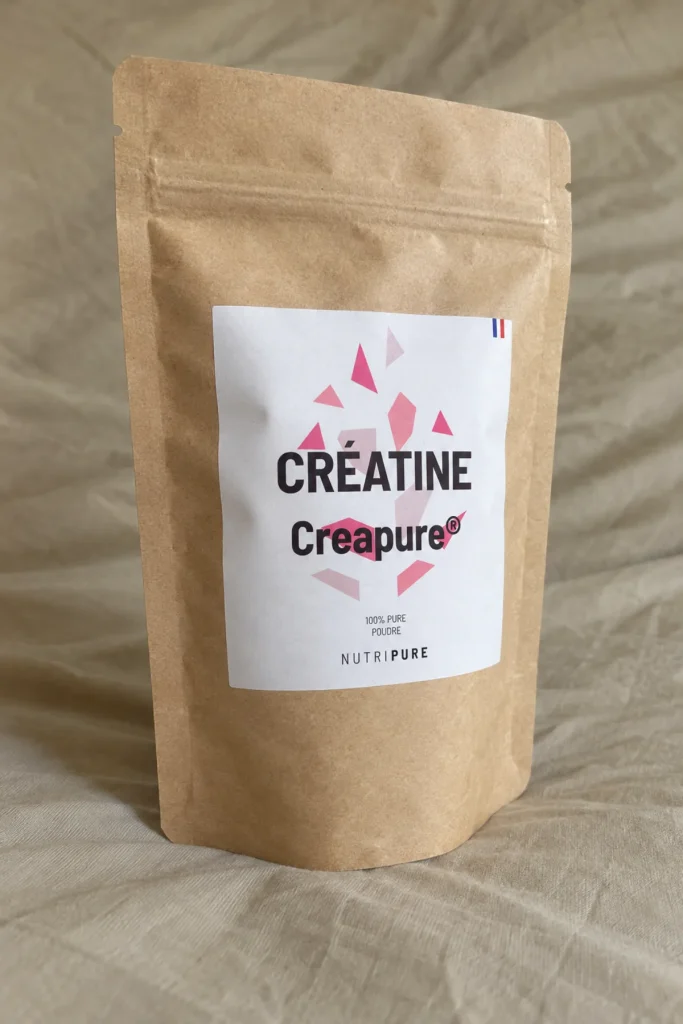
It is a single-ingredient creatine: Creapure® monohydrate, nothing else. No flavouring, no sweetener, no blend. The 150 g pouch is listed at $16.74 and the brand also offers 450 g and 1 kg sizes, plus capsules. Its weak point is the price per gram of the small pouch, higher than a generic monohydrate: take a larger size as soon as it is available.
⚖️ How much creatine per day?
The maintenance dose retained by the ISSN is 3 to 5 g of creatine a day, every day. Above that, your muscles do not store more, and the rest ends up in your urine.
- 3 g a day for most lifters.
- 5 g a day for heavier profiles, above 90 kg.
- Optional loading phase: 20 g a day in 4 doses for 5 to 7 days saturates your stores in one week, against 3 to 4 weeks at 3 g a day, with a higher risk of digestive trouble.
Our advice: skip the loading phase, unless you have a competition within ten days. You gain three weeks, not three months, and your stomach will thank you.
⏰ When to take creatine?
Timing matters little: what matters is taking it every day, rest days included. Creatine works by saturating your muscle stores, not through a peak at training time. After your session in your shaker, or with the next meal, is the easiest to remember. With a meal, it is also better tolerated than on an empty stomach.
🥤 Creatine and whey: the duo that works
You can take creatine and whey together, in the same shaker. No negative interaction is known, and creatine powder has no taste, so it disappears into a flavoured whey. We cover the doses in our guide to whey protein and creatine, and to choose your protein, see our ranking of the best whey protein.
For bulking, the creatine to choose is still monohydrate: there is no special mass-gain creatine. It helps you handle more training volume, and the rest comes from calories and protein, as explained in our guide to whey protein for mass gain.
❌ Common myths about creatine
- “It damages your kidneys”: not in a healthy person. It raises blood creatinine, which can skew a blood test, without kidney damage.
- “It makes you lose hair”: no study has shown it. The myth comes from a small 2009 study that never measured hair, and a 12-week trial found no difference.
- “It makes you bloated”: it holds water in the muscle, not under the skin. Expect 1 to 2 kg on the scale at first, then it stabilises.
- “It is for men only”: false, women respond the same way, at a dose adapted to their body.
🏁 Our verdict
The best creatine is the cheapest serious creatine monohydrate, and Creapure® is worth its small premium for peace of mind. Our preference goes to Nutripure Creatine for its single ingredient and its label. It is not for you if you are after the lowest price per gram: take a 500 g monohydrate instead.
⚠️ Warning
If you have kidney or liver disease, are pregnant or breastfeeding, or for a teenager, ask your doctor before taking creatine. And drink enough water throughout supplementation.
👉 Read also: Best pre-workout: 8 products compared in 2026
👉 Read also: Creatine dangers: what the studies really say
❓ Frequently asked questions
What is the best creatine for beginners?
Creatine monohydrate powder, 3 g a day, without a loading phase. It is the most studied, the cheapest and the simplest form.
Creatine monohydrate or Creapure: what is the difference?
No difference in molecule, only in manufacturing. Creapure® is a monohydrate made in Germany with a stated purity of 99.9% and documented testing; the effect is the same.
Do you need a creatine loading phase?
No, it is optional. It saturates your stores in one week instead of three to four, but raises the risk of digestive trouble.
Is creatine bad for your kidneys?
Not in a healthy person. It raises blood creatinine without causing damage; if you have kidney disease, ask your doctor.
Can you take creatine and whey together?
Yes, in the same shaker. No negative interaction is known, and it is the most cost-effective duo in supplementation.
📚 Sources
- ISSN position stand on creatine (2017)
- Effectiveness, safety and cost of alternative forms of creatine (2022)
- Common questions and misconceptions about creatine, ISSN (2021)
- Nutripure Creatine (Creapure®) product page